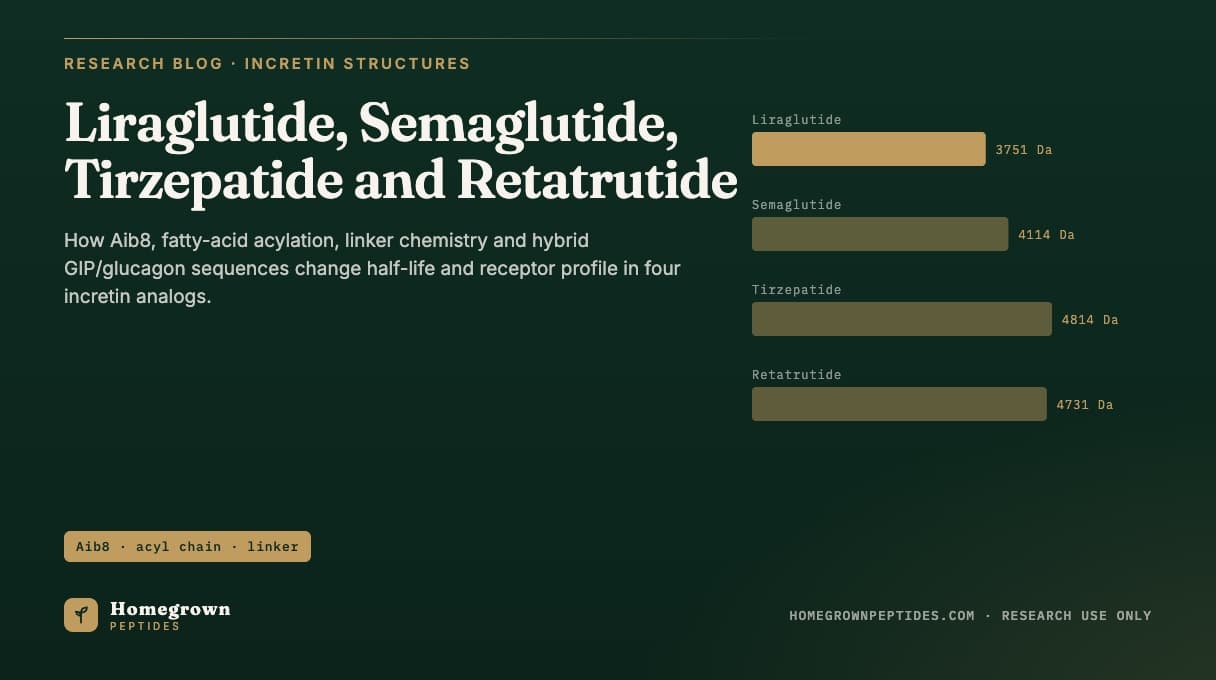
Liraglutide, NN9535, LY3298176 and LY3437943 all trace back to the native 30-residue GLP-1(7-37) sequence or, for the two newer molecules, to a related hybrid built on a GIP backbone. The differences in how long each one persists in circulation and which receptors it engages come down to four engineered changes: whether residue 8 is native alanine or the non-natural amino acid Aib, the length and branching of the fatty acid attached to the backbone, the chemical linker connecting that fatty acid to the peptide, and, in LY3298176 and LY3437943, additional sequence changes that let the same molecule activate the GIP receptor and, for LY3437943, the glucagon receptor as well (Lau et al., 2015; Coskun et al., 2018; Coskun et al., 2022).
| Compound | Receptors engaged | Published half-life | Backbone / acylation |
|---|---|---|---|
| Liraglutide | GLP-1R | ~13 hours | GLP-1(7-37) analog, C16 fatty acid (Knudsen and Lau, 2019) |
| NN9535 | GLP-1R | ~165 hours (about 1 week) | GLP-1(7-37) analog, Aib8, C18 fatty diacid (Lau et al., 2015) |
| LY3298176 | GIPR, GLP-1R | ~5 days | GIP/GLP-1 hybrid sequence, C20 fatty diacid (Coskun et al., 2018; Schneck et al., 2024) |
| LY3437943 | GIPR, GLP-1R, GCGR | ~6 days | GIP/GLP-1/glucagon hybrid sequence, C20 fatty diacid (Coskun et al., 2022) |
What backbone do all four molecules actually share?
Native GLP-1(7-37) is a 30-residue peptide that is degraded within minutes of release because dipeptidyl peptidase-4 (DPP-4) cleaves the His-Ala bond between residues 7 and 8. Liraglutide and NN9535 are direct analogs of this sequence, each carrying an Arg34Lys substitution that frees up Lys26 as the acylation site. LY3298176 and LY3437943 are not simple GLP-1(7-37) analogs; they are engineered 39-residue peptides built on a GIP-receptor-binding backbone that has been modified so the same chain also activates the GLP-1 receptor, and in LY3437943's case the glucagon receptor too (Coskun et al., 2018; Coskun et al., 2022). The shared design logic across all four is the same: start from a native incretin sequence, block the DPP-4 cleavage site, and attach a lipid chain for albumin binding.
What does the Aib8 substitution actually block?
DPP-4 recognizes a free N-terminal His-Ala and cleaves immediately after the alanine. Replacing that alanine with 2-aminoisobutyric acid (Aib), a non-natural amino acid with two methyl groups on its alpha carbon instead of one hydrogen, creates steric bulk the enzyme's active site cannot accommodate. Deacon and colleagues demonstrated this directly by incubating GLP-1(7-37) analogs with purified DPP-4 and measuring intact peptide loss over time: analogs with a modified residue 8 resisted cleavage almost completely, while the native sequence was degraded within minutes (Deacon et al., 1998). NN9535 carries this Aib8 substitution, a major reason its roughly one-week half-life is so much longer than liraglutide's. Liraglutide retains native Ala8 and is only partially DPP-4-resistant; its half-life advantage over native GLP-1 comes mostly from strong albumin binding and a self-association effect that slows absorption from subcutaneous tissue, not from blocking the enzyme outright (Knudsen and Lau, 2019).
How does the fatty-acid side chain change elimination half-life?
All four molecules are acylated: a lipid chain is attached through a linker to a lysine side chain, and that lipid reversibly binds circulating albumin. A peptide bound to albumin is too large to be filtered by the kidney and is shielded from protease attack, so a stronger, longer-lived albumin interaction translates into a longer plasma half-life. Liraglutide uses a single C16 (palmitic acid) chain attached through a gamma-glutamic acid spacer. NN9535 and LY3298176 both move to a fatty diacid instead of a simple fatty acid, meaning the chain has a free carboxylic acid at its far end as well as near the backbone; NN9535's diacid is 18 carbons long and LY3298176's is 20. LY3437943 also carries a C20 fatty diacid. A related study on fatty-diacid acylation of a different gut peptide, PYY(3-36), found that moving from a mono-acid to a diacid chain and extending chain length increased both measured albumin affinity and in vivo half-life in minipigs, the same structure-activity relationship exploited across this drug class (Ostergaard et al., 2021).
What makes the linker matter as much as the fatty acid itself?
The fatty acid is not bolted directly onto the lysine side chain; a short linker sits between them, and its chemistry affects both solubility and how tightly the final construct binds albumin. Liraglutide uses a single gamma-glutamic acid (gamma-Glu) spacer. NN9535 extends this with two units of AEEA (2-(2-aminoethoxy)ethoxy acetic acid, a short polyethylene-glycol-like spacer) between the gamma-Glu and the C18 diacid, which increases water solubility around the hydrophobic chain and positions the diacid for better albumin engagement (Lau et al., 2015). LY3298176 and LY3437943 use their own linker chemistry to carry a C20 diacid on a larger hybrid backbone, a design choice each discovery paper describes as central to reaching a long circulating half-life (Coskun et al., 2018; Coskun et al., 2022).
What sequence changes let LY3298176 and LY3437943 hit more than one receptor?
Engaging the GIP receptor (GIPR) in addition to the GLP-1 receptor (GLP-1R) requires a sequence that both receptor families can recognize, a different engineering problem than simply stabilizing GLP-1 itself. Coskun and colleagues describe LY3298176 as a 39-amino-acid peptide built on a GIP backbone carrying substitutions that confer potent GLP-1R activity alongside native-level GIPR activity, combined with the same acylation logic used in NN9535 (Coskun et al., 2018). Willard and colleagues then characterized LY3298176's receptor pharmacology in cell-based cAMP assays, reporting it as a highly potent GIPR agonist whose GLP-1R activity, while still substantial, is comparatively lower relative to native GLP-1, a pattern they described as imbalanced or biased agonism (Willard et al., 2020). LY3437943 extends this approach with further sequence changes that add measurable activity at the glucagon receptor (GCGR) on top of GIPR and GLP-1R, making it a three-receptor agonist across all three receptor-expressing cell lines (Coskun et al., 2022). For LY3437943's own sequence and half-life data, see LY3437943 structure, sequence and half-life, and for a side-by-side comparison, see LY3437943 vs LY3298176 vs NN9535.
How are these modifications actually measured in a lab?
Three assay types generate most of the data referenced above. DPP-4 stability assays incubate a peptide with purified DPP-4 enzyme in buffer and sample the reaction over time, measuring intact peptide by LC-MS or HPLC to build a degradation curve; this is the method Deacon and colleagues used to show that Aib8 blocks cleavage (Deacon et al., 1998). Albumin-binding assays, commonly equilibrium dialysis or surface plasmon resonance, measure the dissociation constant between a peptide and purified serum albumin, generating the binding-affinity values researchers correlate with in vivo half-life (Ostergaard et al., 2021). Receptor potency is measured with cell-based cAMP accumulation assays: cells expressing a single receptor (GLP-1R, GIPR or GCGR) are treated with a concentration series of the test peptide, intracellular cAMP is read with a luminescent or fluorescent reporter, and the resulting curve yields an EC50 (concentration for half-maximal response) and an Emax (maximum response relative to the native hormone) for that receptor. This is how Willard and colleagues generated LY3298176's GIPR and GLP-1R potency values, and the same format underlies LY3437943's three-receptor data (Willard et al., 2020; Coskun et al., 2022). A dedicated walkthrough of this assay format is at how LY3437943's receptor potency is measured.
What do these structural differences change on a certificate of analysis?
| Property on a COA | What changes and why |
|---|---|
| Molecular weight | Each acylation step adds mass beyond the bare backbone; a fatty diacid plus a multi-unit linker adds more mass than a single C16 chain on a gamma-Glu spacer, so MW climbs from liraglutide through NN9535 to the larger hybrid molecules. |
| HPLC retention time | A longer, more hydrophobic fatty-acid chain retains longer on a reverse-phase C18 column under identical gradient conditions, so retention time tends to increase with acyl chain length and chain type (mono-acid versus diacid). |
| ESI-MS charge state envelope | Larger peptides carry more ionizable sites and are observed across a wider series of charge states ([M+3H]3+ and higher) in electrospray mass spectrometry; the free carboxylic acid on a fatty diacid also shifts how the molecule ionizes in negative mode compared with a mono-acid chain. |
| Identity confirmation | Intact-mass LC-MS is the standard identity check for all four, since the acylated side chain and linker are part of the confirmed mass and cannot be inferred from amino acid composition alone. |
Lot-specific identity and purity data are posted with each certificate of analysis; see the LY3437943 lot page, the LY3298176 lot page and the NN9535 lot page for current specifications. For LY3298176's own structure in more detail, see what is LY3298176.
Frequently asked questions
Is LY3298176 a modified version of GLP-1, like NN9535 is?
No. LY3298176 is engineered from a GIP-receptor-binding backbone, with sequence changes added so the same molecule also activates GLP-1R. NN9535 and liraglutide are both direct analogs of native GLP-1(7-37).
Does LY3437943 use the same Aib8 substitution as NN9535?
LY3437943 and LY3298176 are built on a different backbone than GLP-1(7-37), so the DPP-4-blocking logic is applied within that hybrid sequence rather than at the exact residue-8 position used in NN9535's numbering. The underlying principle, a sterically bulky non-natural residue at the protease cleavage site, is shared across the class (Coskun et al., 2018; Coskun et al., 2022).
Why does a longer fatty acid chain mean a longer half-life?
A longer, more hydrophobic chain binds circulating albumin more tightly, shielding the peptide from kidney filtration and protease degradation. Moving from a mono-acid to a diacid chain adds a second binding interaction and further increases that affinity (Ostergaard et al., 2021).
What is a fatty diacid, and why do three of these four molecules use one?
A fatty diacid has a carboxylic acid at both ends of the chain instead of just one. The second carboxylic acid changes how the chain sits in the albumin binding pocket and has been associated with higher measured albumin affinity than a matched mono-acid chain of similar length (Ostergaard et al., 2021).
How is receptor potency (EC50) actually reported in these papers?
EC50 values come from cell-based cAMP accumulation assays run separately for each receptor of interest, where a dose-response curve across a concentration series of the test peptide is fit to generate the concentration producing half-maximal signal. Emax values from the same curves show how close the peptide's maximum response comes to that of the native hormone at that receptor (Willard et al., 2020).
Can intact-mass LC-MS distinguish these four molecules from each other?
Yes. Because the fatty acid, linker and backbone substitutions are all part of the confirmed molecular mass, intact-mass LC-MS readily distinguishes all four from one another and from their unacylated backbone peptides.
Has LY3437943's three-receptor activity been confirmed in published assays?
Yes. Coskun and colleagues published cAMP-based potency data at GLP-1R, GIPR and GCGR generated with each receptor expressed individually in cell lines, the peer-reviewed basis for describing LY3437943 as a triple-receptor agonist (Coskun et al., 2022).
References
- Lau J, Bloch P, Schaffer L, et al. Discovery of the Once-Weekly Glucagon-Like Peptide-1 (GLP-1) Analogue NN9535. J Med Chem. 2015;58(18):7370-80. PubMed 26308095.
- Knudsen LB, Lau J. The Discovery and Development of Liraglutide and NN9535. Front Endocrinol (Lausanne). 2019;10:155. PubMed 31031702.
- Deacon CF, Knudsen LB, Madsen K, Wiberg FC, Jacobsen O, Holst JJ. Dipeptidyl peptidase IV resistant analogues of glucagon-like peptide-1 which have extended metabolic stability and improved biological activity. Diabetologia. 1998;41(3):271-8. PubMed 9541166.
- Coskun T, Sloop KW, Loghin C, et al. LY3298176, a novel dual GIP and GLP-1 receptor agonist for the treatment of type 2 diabetes mellitus: From discovery to clinical proof of concept. Mol Metab. 2018;18:3-14. PubMed 30473097.
- Willard FS, Douros JD, Gabe MB, et al. LY3298176 is an imbalanced and biased dual GIP and GLP-1 receptor agonist. JCI Insight. 2020;5(17):e140532. PubMed 32730231.
- Coskun T, Urva S, Roell WC, et al. LY3437943, a novel triple glucagon, GIP, and GLP-1 receptor agonist for glycemic control and weight loss: From discovery to clinical proof of concept. Cell Metab. 2022;34(9):1234-1247.e9. PubMed 35985340.
- Urva S, Coskun T, Loh MT, et al. LY3437943, a novel triple GIP, GLP-1, and glucagon receptor agonist in people with type 2 diabetes: a phase 1b, multicentre, double-blind, placebo-controlled, randomised, multiple-ascending dose trial. Lancet. 2022;400(10366):1869-1881. PubMed 36354040.
- Schneck K, Zhang X, Boyd S, et al. Population pharmacokinetics of the GIP/GLP receptor agonist LY3298176. CPT Pharmacometrics Syst Pharmacol. 2024;13(3):389-401. PubMed 38356317.
- Østergaard S, Paulsson JF, Kjaergaard Gerstenberg A, et al. The effect of fatty diacid acylation of human PYY(3-36) on Y(2) receptor potency and half-life in minipigs. Sci Rep. 2021;11(1):21179. PubMed 34707178.
Research use only. Homegrown Peptides products are for laboratory research and are not for human or animal use. Nothing in this article is medical advice.