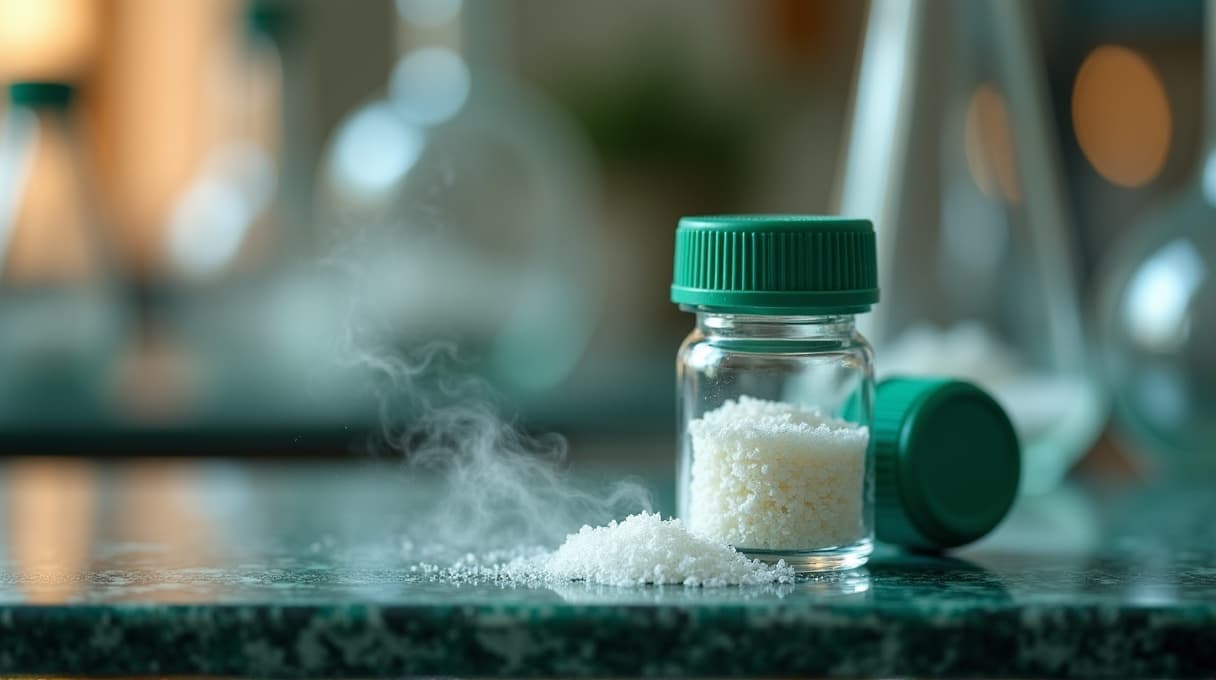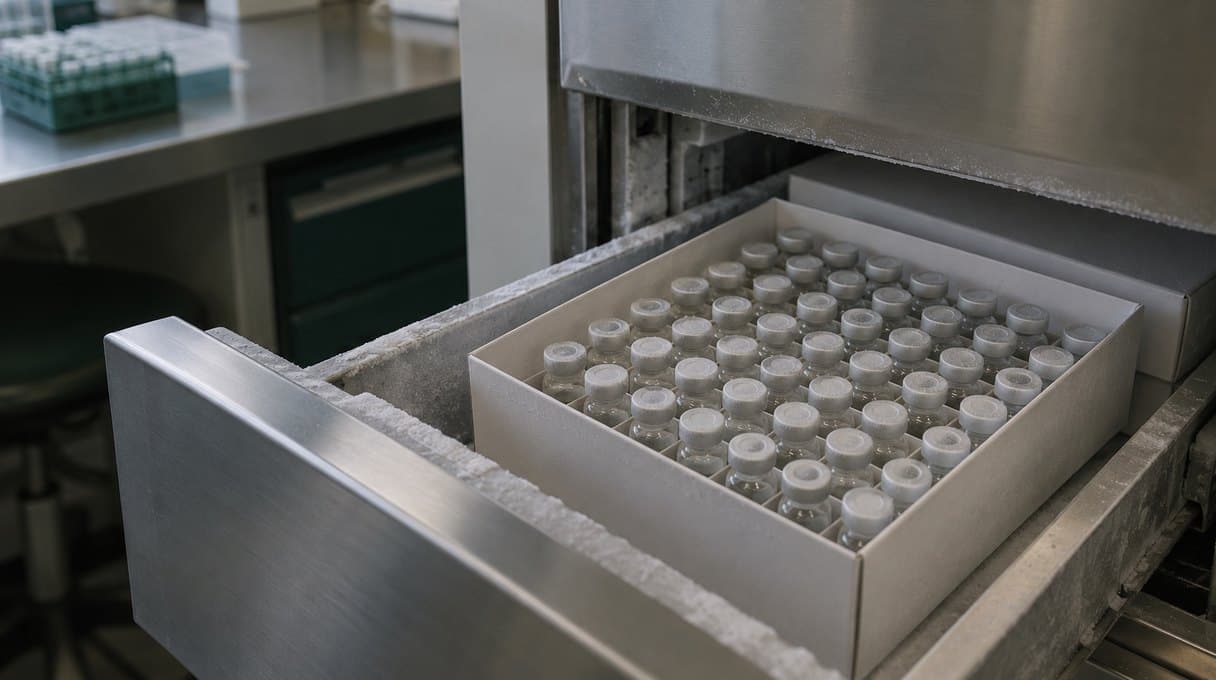
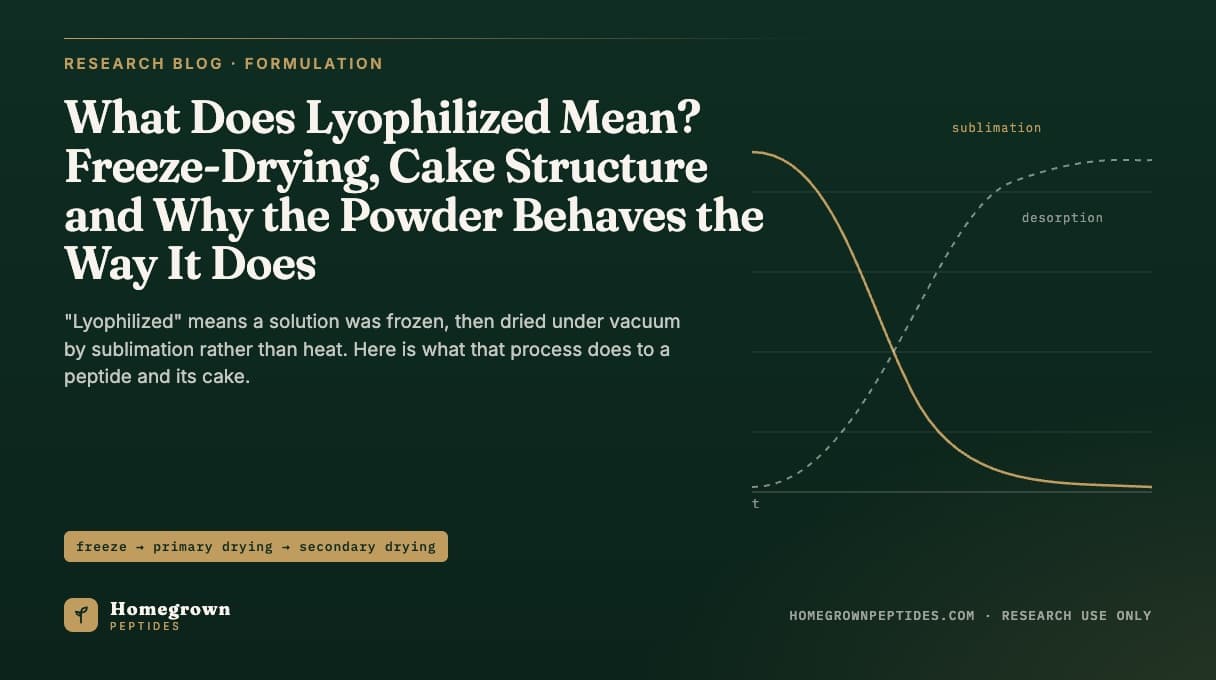
Lyophilized means freeze-dried: a solution was frozen solid, then had its water removed under vacuum by sublimation rather than by evaporative heating. The result is a dry, porous solid, the "cake," that reconstitutes faster and degrades more slowly than the same molecule stored as a liquid.
| Parameter | Typical published range | Source |
|---|---|---|
| Freezing shelf temperature | -40°C to -50°C | Tang & Pikal, 2004 |
| Primary drying chamber pressure | ~50-200 mTorr (0.07-0.27 mbar) | Tang & Pikal, 2004 |
| Product temperature during primary drying | Held several degrees below the collapse temperature | Tang & Pikal, 2004 |
| Collapse temperature (Tc) vs. glass transition (Tg') | Tc is roughly 1-3°C above Tg' | Rambhatla et al., 2005 |
| Tg' of amorphous sugar-based systems | Approximately -30°C to -32°C (sucrose, trehalose) | Franks, 1998 |
| Secondary drying shelf temperature | +20°C to +40°C under continued vacuum | Tang & Pikal, 2004 |
| Target residual moisture (lyophilized protein/peptide cake) | Commonly held below about 1-3% w/w, by Karl Fischer titration | Breen et al., 2001 |
What does "lyophilized" actually mean?
Lyophilization removes water from a frozen solution in two sequential drying steps rather than one. First the fill is frozen solid. Then chamber pressure is dropped far below atmospheric so the ice sublimates directly to vapor without passing through a liquid phase. A second, warmer drying step then pulls out the water that was never frozen as ice in the first place. Because the solid matrix never melts or boils, the dried structure retains the shape of the frozen fill, which is why a well-run lyophilization leaves a porous plug that looks almost like a mold of the original liquid (Franks, 1998).
What happens during the freezing stage?
As the fill cools, water crystallizes into ice while the dissolved peptide, buffer salts and any excipient are excluded from the growing ice lattice and concentrated into shrinking liquid channels between ice crystals. A solute that can crystallize on its own, such as mannitol or sodium chloride, separates out at a defined eutectic temperature. A solute that cannot, which describes most small peptides and amorphous sugars like trehalose, instead forms a rigid amorphous solid on further cooling, a state called a frozen glass. The temperature at which that glass forms, Tg', sets the ceiling for every step that follows (Tang and Pikal, 2004). Formulators sometimes hold the frozen fill at an intermediate temperature for an extended period, called annealing, to let a crystallizable component such as mannitol finish crystallizing before drying begins, which changes the resulting cake's pore structure and mechanical strength (Lu and Pikal, 2004).
What happens during primary drying, and why is it sublimation?
Once the fill is fully frozen, the chamber is evacuated to roughly 50 to 200 mTorr and the shelf is warmed just enough to drive sublimation without raising the product above its safe temperature limit. Ice at the sublimation front converts straight to water vapor, which travels up through pores already opened in the dried layer above it and is captured on a much colder condenser elsewhere in the system. The drying front recedes from the top of the fill downward, and because dried material conducts heat poorly, primary drying commonly accounts for the majority of total process time, sometimes many hours for a single run (Tang and Pikal, 2004). The point of primary drying is to keep the product temperature below its collapse temperature, Tc, at every moment. Tc is typically only one to three degrees above the Tg' measured during freezing, which is why process design for a new peptide formulation starts with measuring Tg' directly (Rambhatla et al., 2005).
What happens during secondary drying, and why is it called desorption?
By the end of primary drying, all the ice is gone, but a meaningful fraction of water remains, adsorbed onto the surfaces of the now-dry solid matrix rather than frozen as ice. Removing that bound water requires breaking an adsorption interaction rather than a phase change, so the shelf temperature is raised substantially, often into the range of 20°C to 40°C, while the chamber stays under vacuum. Because the solid is already dry and rigid, it tolerates a shelf temperature that would have collapsed it during primary drying. Secondary drying brings residual moisture down from a percentage in the high single digits to the low single digits or less, and it is usually a shorter step than primary drying even though it finishes the job of hitting the moisture specification (Tang and Pikal, 2004).
Why does a lyophilized cake look different from one vial to the next?
Three visual outcomes show up repeatedly in freeze-dried peptide vials, each tied to how the run was controlled relative to Tg' and Tc. A solid, uniform "puck" that holds the shape of the vial and resists breaking is what a cake looks like when product temperature stayed below Tc throughout primary drying and solute concentration was high enough to build a mechanically continuous porous network. A cracked or fissured disc, still largely intact but visibly split, usually indicates product temperature brushed against or briefly exceeded Tc, causing localized microcollapse without full structural failure (Rambhatla et al., 2005). A thin film or flaky layer confined to the base of the vial, rather than a cake filling the original liquid volume, is typical of low-solute-content fills: many research peptides are packaged at low milligram quantities with no bulking agent, so there is not enough solid mass to build a tall porous structure, and what dries is a thin, low-volume residue instead (Lu and Pikal, 2004). None of these outcomes by itself proves a stability problem; identity and purity are still confirmed from the lot-specific certificate of analysis, covered in more depth in our companion article on how long lyophilized peptides last.
How much residual moisture is acceptable, and how is it measured?
Residual moisture is measured almost universally by Karl Fischer titration, which reacts the water in a sample stoichiometrically with iodine and detects the endpoint electrically, a result independent of weight-loss-on-drying measurements that can be confounded by other volatiles. Published specifications for lyophilized protein and peptide products commonly target below roughly 1 to 3% residual moisture by weight, though the number that matters is the one validated for a given formulation. Breen and colleagues found that a lyophilized monoclonal antibody held across controlled moisture levels showed its lowest storage aggregation rate at an intermediate moisture level, not the driest condition tested, so "drier is always better" is not a safe blanket rule (Breen et al., 2001).
Why are many research peptides lyophilized without bulking agents?
Large biologics such as monoclonal antibodies are frequently lyophilized with mannitol, trehalose, sucrose or a combination, partly to build cake volume and mechanical strength and partly because an amorphous sugar glass directly stabilizes protein structure through hydrogen bonding that substitutes for the bonds normally supplied by water, called the water-replacement effect (Carpenter and Crowe, 1989). That interaction depends on the excipient staying amorphous rather than crystallizing; Izutsu and Kojima showed a crystalline excipient provides far less protein-structure stabilization than the same excipient kept amorphous, even though crystalline mannitol still gives the cake physical bulk and an elegant appearance (Izutsu and Kojima, 2002). Short synthetic research peptides are a different case: most lack the complex tertiary fold a water-replacement mechanism protects in an antibody, come in small milligram quantities where a bulking agent would dilute the vial and complicate weighing, and are frequently stable as a neat lyophilized solid without added sugar. That is why a research peptide vial often shows the thin-film or flaky pattern described above rather than the tall, uniform puck of a bulked biologic, a formulation choice rather than a defect.
| Attribute | Lyophilized | Solution | Spray-dried |
|---|---|---|---|
| Water removal method | Freeze, then sublimation/desorption under vacuum | None, kept as liquid | Hot-air atomization, seconds of thermal exposure |
| Typical residual moisture | Roughly 1-3% w/w | Not applicable | Often higher than lyophilized, commonly several percent |
| Physical form | Porous cake or powder | Liquid | Fine free-flowing particles |
| Relative shelf stability for a given peptide | Longest under cold, dry storage | Shortest; hydrolysis and deamidation proceed continuously | Intermediate; thermal exposure during drying is a separate stress |
| Needs reconstitution before analytical use | Yes | No | Sometimes |
| Common role in peptide research supply | Standard format for most research peptide vials | Used for ready-to-use diluted reference standards | Uncommon for small research peptides |
Why is a lyophilized peptide more stable than the same peptide in solution?
In solution, a peptide's degradation pathways, hydrolysis of the backbone, deamidation of asparagine and glutamine residues, and oxidation of susceptible side chains, all require water as a reactant or a mobility-enabling medium, and proceed continuously even under refrigeration; our companion article on how peptides degrade covers those pathways in depth. Removing nearly all the water removes the reaction medium for hydrolysis and sharply restricts molecular mobility, so a cake held well below its glass transition temperature behaves, chemically, almost like a solid frozen in time. Carpenter and Crowe's infrared spectroscopic work showed an amorphous glassy matrix does more than remove water: it replaces the hydrogen-bonding environment water would have provided, physically immobilizing the peptide in a rigid lattice (Carpenter and Crowe, 1989).
How does cake structure relate to reconstitution behavior?
Cake porosity and surface area, both legacies of how primary drying was controlled, govern how a lyophilized solid behaves when solvent is added back. An elegant, highly porous cake presents a large internal surface area to the incoming solvent, so wetting and dissolution proceed quickly and evenly. A collapsed region has a denser, lower-porosity structure with fewer open channels, so solvent penetration and solute diffusion are measurably slower, the physical basis for the longer dissolution times reported for collapsed versus elegant cakes (Rambhatla et al., 2005). Visible foaming on reconstitution generally traces to gas trapped in cake pores releasing as the solid wets and breaks apart, tracking with porosity rather than peptide identity. Particulates most often trace to incompletely dissolved collapsed fragments or crystalline excipient not yet solubilized, analytical observations about physical structure rather than chemical identity. For solvent and concentration selection, see our article on peptide solubility and solvent selection, and for the hardware itself see our reconstitution kit lot page. General background on the process is covered in what is lyophilization.
Frequently asked questions
Is "lyophilized" the same as "freeze-dried"?
Yes. Lyophilized is the technical term for freeze-drying: freezing a solution, then removing water under vacuum by sublimation and desorption rather than heating or air drying.
Why does freeze-drying use vacuum instead of heat?
Vacuum lowers pressure enough that frozen water sublimates, converting ice directly to vapor without melting. That preserves the frozen structure's shape and avoids the thermal stress a heat-based drying method would involve.
What is the difference between Tg' and Tc?
Tg' is the glass transition temperature of the maximally concentrated frozen solution, measured during freezing. Tc, the collapse temperature, is the practical ceiling for product temperature during primary drying and sits roughly one to three degrees above Tg' (Rambhatla et al., 2005).
Does a cracked or thin cake mean a peptide vial is degraded?
Not by itself. Cake appearance reflects the physics of how the run was controlled relative to Tc and how much solute mass was present, not chemical identity or purity, which are confirmed from the lot's certificate of analysis.
Why do some formulations use mannitol and others use trehalose?
Mannitol typically crystallizes on freezing and is chosen mainly for cake bulk and physical elegance. Trehalose stays amorphous and forms a glass that directly stabilizes dissolved protein structure through hydrogen bonding, a different, complementary function (Izutsu and Kojima, 2002).
References
- Tang X, Pikal MJ. Design of freeze-drying processes for pharmaceuticals: practical advice. Pharm Res. 2004;21(2):191-200. PMID 15032301.
- Franks F. Freeze-drying of bioproducts: putting principles into practice. Eur J Pharm Biopharm. 1998;45(3):221-9. PMID 9653626.
- Rambhatla S, Obert JP, Luthra S, Bhugra C, Pikal MJ. Cake shrinkage during freeze drying: a combined experimental and theoretical study. Pharm Dev Technol. 2005;10(1):33-40. PMID 15776811.
- Lu X, Pikal MJ. Freeze-drying of mannitol-trehalose-sodium chloride-based formulations: the impact of annealing on dry layer resistance to mass transfer and cake structure. Pharm Dev Technol. 2004;9(1):85-95. PMID 15000469.
- Breen ED, Curley JG, Overcashier DE, Hsu CC, Shire SJ. Effect of moisture on the stability of a lyophilized humanized monoclonal antibody formulation. Pharm Res. 2001;18(9):1345-53. PMID 11683251.
- Carpenter JF, Crowe JH. An infrared spectroscopic study of the interactions of carbohydrates with dried proteins. Biochemistry. 1989;28(9):3916-22. PMID 2526652.
- Izutsu K, Kojima S. Excipient crystallinity and its protein-structure-stabilizing effect during freeze-drying. J Pharm Pharmacol. 2002;54(8):1033-9. PMID 12195816.
Research use only. Homegrown Peptides products are for laboratory research and are not for human or animal use. Nothing in this article is medical advice.