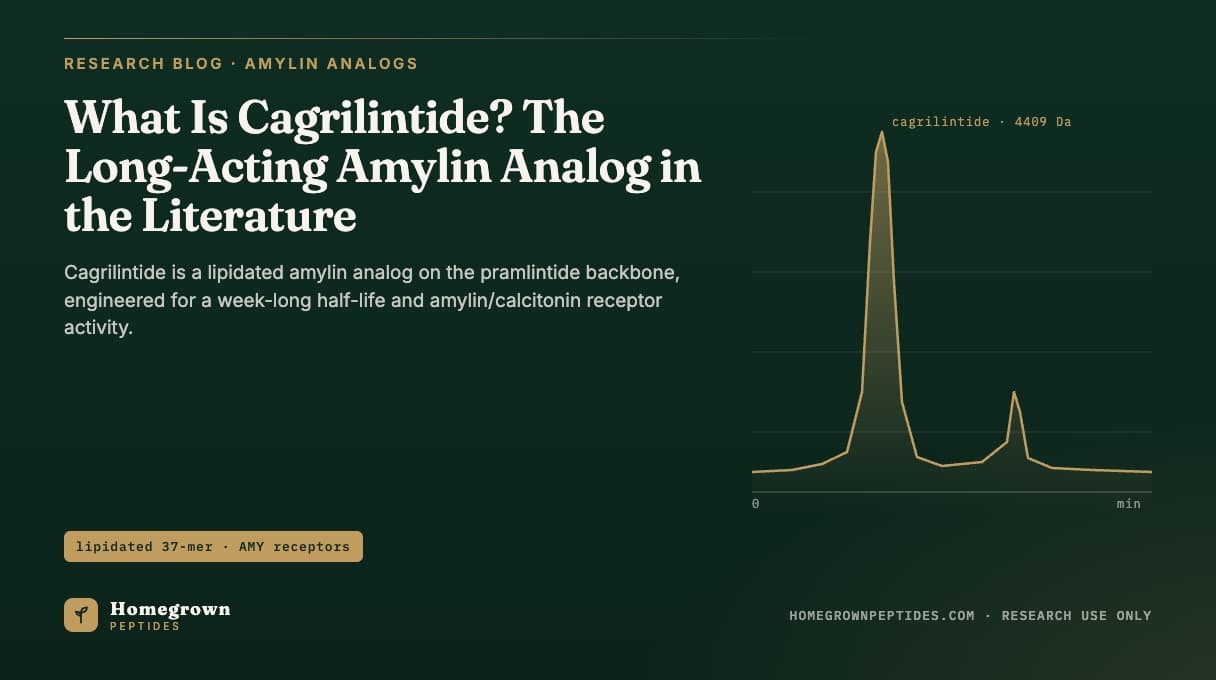
AM833 is a lipidated, 37-amino-acid analog of human amylin engineered for a long circulating half-life and agonist activity at amylin receptors (AMY1R, AMY3R) and the calcitonin receptor (CTR). It carries the same two stabilizing proline substitutions used in the older amylin analog pramlintide to block amyloid fibril formation, plus a C20 fatty diacid attached through a linker for albumin binding, the same design principle used in long-acting GLP-1 analogs (Kruse et al., 2021). Published pharmacokinetic data put its terminal half-life at roughly 159 to 195 hours in humans across a 0.16 to 4.5 mg dose range (Enebo et al., 2021).
| Attribute | Detail | Source |
|---|---|---|
| Class | Lipidated, 37-residue amylin analog; dual amylin/calcitonin receptor agonist | Kruse et al., 2021 |
| Backbone | Pramlintide-type sequence with Pro25, Pro28, Pro29 substitutions against fibrillation, plus additional stabilizing changes | Kruse et al., 2021 |
| Lipidation | C20 diacid moiety attached via a linker to a non-native lysine for albumin binding | Kruse et al., 2021 |
| Receptors engaged | AMY1R and AMY3R (calcitonin receptor + RAMP1 or RAMP3) and CTR itself, determined by cryo-EM structures of active Gs-coupled complexes | Cao et al., 2025 |
| Terminal half-life | Approximately 159-195 hours across 0.16-4.5 mg subcutaneous doses in a phase 1b trial | Enebo et al., 2021 |
| Median tmax | 24-72 hours post-dose in the same trial | Enebo et al., 2021 |
| Renal/hepatic impairment effect on exposure | No consistent change in AUC0-∞ across mild, moderate or severe renal or hepatic impairment groups | Nielsen et al., 2026 |
| Form supplied | Lyophilized powder, research use only | Homegrown Peptides COA |
What is amylin, and why build an analog of it?
Amylin, also called islet amyloid polypeptide, is a 37-residue peptide hormone co-secreted with insulin from pancreatic beta cells. It signals through a receptor system built from the calcitonin receptor (CTR) core paired with one of three receptor activity-modifying proteins, RAMP1, RAMP2 or RAMP3, which reshapes the CTR ectodomain into a distinct binding pocket for amylin. These CTR+RAMP pairings are formally classified as AMY1, AMY2 and AMY3 receptors under the International Union of Pharmacology nomenclature for the calcitonin receptor family, which also includes the structurally related calcitonin gene-related peptide and adrenomedullin receptor systems (Poyner et al., 2002). CTR without a RAMP partner can also respond to amylin and calcitonin directly, though with different affinity than the RAMP-assembled complexes.
Native human amylin has a short circulating half-life and a strong tendency to self-assemble into amyloid fibrils, the same process that deposits amylin aggregates in pancreatic islets in type 2 diabetes (Lutz, 2022). Both properties make unmodified amylin a poor tool for sustained receptor engagement in a research protocol, the rationale published medicinal chemistry programs give for building stabilized, longer-acting analogs (Kruse et al., 2021).
How is AM833's sequence different from amylin and pramlintide?
Pramlintide, the first clinically developed amylin analog, carries three proline substitutions (at positions 25, 28 and 29, using human amylin numbering) that disrupt the beta-sheet packing responsible for fibril formation without eliminating receptor binding. AM833 retains this fibrillation-resistant proline-substituted backbone and adds a lipidation strategy that pramlintide does not have: a C20 fatty diacid is conjugated through a gamma-glutamic acid and other spacer chemistry to a non-native lysine side chain, giving the molecule a non-covalent albumin-binding handle (Kruse et al., 2021). Albumin binding slows renal clearance and proteolytic degradation, which published structure-activity work credits for extending the molecule's half-life from roughly tens of minutes for native amylin to multiple days for AM833 (Kruse et al., 2021; Enebo et al., 2021).
Reviews of this peptide class group pramlintide, davalintide and AM833 together as amylin analogs that depend on engineered proline substitutions specifically to prevent the amyloidogenic aggregation problem inherent to the native hormone, a problem that also affects formulation stability and is tracked analytically as high-molecular-weight product formation (Lima and Icart, 2022).
| Feature | Human amylin | Pramlintide | AM833 |
|---|---|---|---|
| Residue count | 37 | 37 | 37 |
| Fibrillation-blocking substitutions | None (native sequence self-assembles) | Pro25, Pro28, Pro29 | Proline-substituted backbone plus further stabilizing changes |
| Lipidation for albumin binding | None | None | C20 diacid via linker to an engineered lysine |
| Approximate half-life | Minutes in circulation | Roughly 48 minutes, requiring repeated dosing in its labeled use | Approximately 159-195 hours (about 7-8 days) in a phase 1b trial |
| Receptor activity | AMY1R/AMY3R agonist, weaker CTR activity | AMY1R/AMY3R agonist | AMY1R, AMY3R and CTR agonist, amylin-like binding mode at each |
What do structural studies show about how AM833 engages its receptors?
Cryo-EM structures of AM833 bound to active, G protein-coupled AMY1R, AMY2R and AMY3R complexes, and to CTR alone, show that the peptide adopts a binding mode closely resembling that of rat amylin, with its C-terminal segment occupying the same groove in the receptor's extracellular domain used by other calcitonin-family peptides (Cao et al., 2025). The same study reports that AM833's non-lipidated backbone retains essentially the same potency as the lipidated molecule in cAMP reporter-gene assays using cells expressing AMY3R, indicating that the lipid side chain itself contributes little to intrinsic receptor activation and instead serves its pharmacokinetic, albumin-binding role. The authors also found that AM833 induces receptor conformational dynamics at calcitonin-family receptors that differ from those triggered by rat amylin or salmon calcitonin, which they propose as a structural basis for differences in signaling behavior across this receptor class (Cao et al., 2025).
A separate line of work using RAMP1/RAMP3 knockout mice found that loss of both RAMPs blunted AM833's pharmacodynamic effects and reduced activation (measured by cFos induction) in the dorsal vagal complex and lateral parabrachial nucleus, two hindbrain regions downstream of circulating amylin-receptor signals, while the same RAMP knockout improved the response to salmon calcitonin, a non-selective CTR/AMY agonist used for comparison (Carvas et al., 2025). That pattern is consistent with AM833 acting substantially through AMY1R and AMY3R rather than through CTR alone in that model.
What has pharmacokinetic and analytical characterization work reported?
In a randomized, placebo-controlled phase 1b trial, researchers co-administered ascending subcutaneous doses of AM833 (0.16 to 4.5 mg) alongside a fixed-dose NN9535 regimen; AM833 exposure (AUC0-168h) rose from roughly 926 to 24,271 nmol·h/L across that dose range, with a terminal half-life of 159 to 195 hours and a median time to peak concentration of 24 to 72 hours. Co-administration did not alter NN9535's own exposure or elimination (Enebo et al., 2021). Separate single-dose studies in participants with renal or hepatic impairment found no consistent shift in AM833's AUC0-∞ across mild, moderate or severe impairment groups for either organ system, with estimated AUC ratios against normal function all falling within roughly 0.9 to 1.2 (Nielsen et al., 2026).
For preclinical mechanistic work where regulatory restrictions limit AM833 access, one research group characterized a close structural analog, internally designated 0839, sharing 95% sequence identity with AM833 and the identical acylation side chain, as a tool compound for mouse and rat studies; the two molecules produced comparable reductions in food intake and body weight in diet-induced obese rodents and comparable potentiation of NN9535's effects in the same models (Gabery et al., 2025). Formulation-stability reviews of this peptide class flag fibril and amorphous aggregate formation as the primary analytical concern for lyophilized or reconstituted amylin analogs, tracked through assays for high-molecular-weight product alongside standard reversed-phase HPLC purity and mass spectrometry identity confirmation used across peptide-hormone analogs generally (Lima and Icart, 2022).
Why has AM833 been studied in combination with NN9535?
Amylin-receptor signaling and GLP-1 receptor signaling act through distinct, non-overlapping pathways that both converge on hindbrain and hypothalamic circuits involved in feeding behavior. The published rationale for pairing AM833 with NN9535 (a combination referred to in the literature as CagriSema) is that combining two mechanistically distinct agonists allows each to be investigated for additive or complementary pharmacodynamic effects, rather than substituting one pathway for a higher dose of the other (Enebo et al., 2021; Gabery et al., 2025). In the phase 1b trial, co-administration was well tolerated and AM833 pharmacokinetics were proportional to dose without affecting NN9535's own exposure (Enebo et al., 2021). The rodent tool-compound study similarly reported that AM833 and its close analog potentiated NN9535's effects on food intake and body weight in diet-induced obese rats to a comparable degree, framing the amylin/GLP-1 combination as an active area of mechanistic investigation (Gabery et al., 2025). For background on the GLP-1 receptor agonist itself, see what is NN9535, and for how NN9535 compares with other incretin-pathway peptides studied alongside it, see LY3437943 vs LY3298176 vs NN9535.
How does AM833 fit alongside other multi-receptor research peptides?
AM833 is studied as a standalone amylin/calcitonin receptor agonist, but it also appears in the literature as a research pairing partner for triple incretin-receptor agonists; a more detailed look at that specific combination, including what an amylin-pathway agonist adds mechanistically to a GIP/GLP-1/glucagon triple agonist, is covered in LY3437943 and AM833 explained. Background on the triple agonist's own sequence engineering and half-life data is in LY3437943 structure, sequence modifications and half-life. Lot-specific identity and purity data for AM833 supplied in combination with LY3437943 are posted on the LY3437943/AM833 product page.
Frequently asked questions
Is AM833 the same molecule as pramlintide?
No. Both are synthetic amylin analogs that carry proline substitutions to resist fibril formation, but AM833 additionally carries a C20 fatty diacid lipidation for albumin binding that pramlintide does not have, which is the main structural reason for its much longer half-life (Kruse et al., 2021).
What receptors does AM833 activate?
Published structural and functional studies show AM833 acts as an agonist at AMY1R and AMY3R, the amylin receptor complexes formed by the calcitonin receptor paired with RAMP1 or RAMP3, and at the calcitonin receptor (CTR) itself, with an amylin-like binding mode at each (Cao et al., 2025; Carvas et al., 2025).
Is AM833 the same as calcitonin or salmon calcitonin?
No. Salmon calcitonin (sCT) is a separate, non-selective CTR/amylin-receptor agonist used in comparator studies. AM833 is a distinct engineered amylin analog with a different sequence backbone and a lipidation chemistry that sCT does not have (Carvas et al., 2025).
What animal models have been used to study AM833's mechanism?
Published work includes RAMP1/RAMP3 knockout mice for receptor-dependence studies, diet-induced obese mice and rats for pharmacodynamic characterization, and cryo-EM structural studies of the peptide bound to purified, reconstituted receptor complexes (Carvas et al., 2025; Gabery et al., 2025; Cao et al., 2025).
Why do some preclinical studies use a related compound instead of AM833 itself?
Because AM833 is restricted under pharmacovigilance rules tied to its clinical development program, at least one research group has used a close structural analog (95% sequence identity, identical acylation side chain) as a surrogate tool compound for routine mouse and rat mechanistic work (Gabery et al., 2025).
What analytical methods confirm AM833 identity and purity?
As with other peptide-hormone analogs, identity is confirmed by mass spectrometry and purity by reversed-phase HPLC; because amylin analogs are prone to amyloid and amorphous aggregation, stability assessments for this class also track high-molecular-weight product formation over time and storage condition (Lima and Icart, 2022).
Has AM833's pharmacokinetics been studied in organ impairment?
Yes. Single-dose studies in participants with renal or hepatic impairment found no consistent change in AM833's overall plasma exposure across mild, moderate or severe impairment of either organ system compared with normal function (Nielsen et al., 2026).
References
- Kruse T, Hansen JL, Dahl K, et al. Development of AM833, a Long-Acting Amylin Analogue. J Med Chem. 2021;64(15):11183-11194. PubMed 34288673.
- Cao J, Belousoff MJ, Johnson RM, et al. Structural and dynamic features of AM833 binding to calcitonin and amylin receptors. Nat Commun. 2025;16(1):3389. PubMed 40204768.
- Carvas AO, Leuthardt A, Kulka P, et al. AM833 lowers bodyweight through brain amylin receptors 1 and 3. EBioMedicine. 2025;118:105836. PubMed 40609154.
- Enebo LB, Berthelsen KK, Kankam M, et al. Safety, tolerability, pharmacokinetics, and pharmacodynamics of concomitant administration of multiple doses of AM833 with NN9535 2.4 mg for weight management: a randomised, controlled, phase 1b trial. Lancet. 2021;397(10286):1736-1748. PubMed 33894838.
- Poyner DR, Sexton PM, Marshall I, et al. International Union of Pharmacology. XXXII. The mammalian calcitonin gene-related peptides, adrenomedullin, amylin, and calcitonin receptors. Pharmacol Rev. 2002;54(2):233-246. PubMed 12037140.
- Lima LMTR, Icart LP. Amyloidogenicity of peptides targeting diabetes and obesity. Colloids Surf B Biointerfaces. 2022;209(Pt 1):112157. PubMed 34715595.
- Lutz TA. Creating the amylin story. Appetite. 2022;172:105965. PubMed 35183619.
- Nielsen MJF, Becker NP, Duus HHH, et al. Renal or Hepatic Impairment Does Not Affect Pharmacokinetics, Safety, or Tolerability of Subcutaneous AM833. Clin Pharmacokinet. 2026;65(7):1087-1099. PubMed 42228334.
- Gabery S, Glendorf T, Ballarin-Gonzalez B, et al. Characterization of 0839 - A tool compound for pre-clinical mode-of-action studies of amylin analogues such as AM833. Life Sci. 2025;378:123845. PubMed 40628316.
Research use only. Homegrown Peptides products are for laboratory research and are not for human or animal use. Nothing in this article is medical advice.