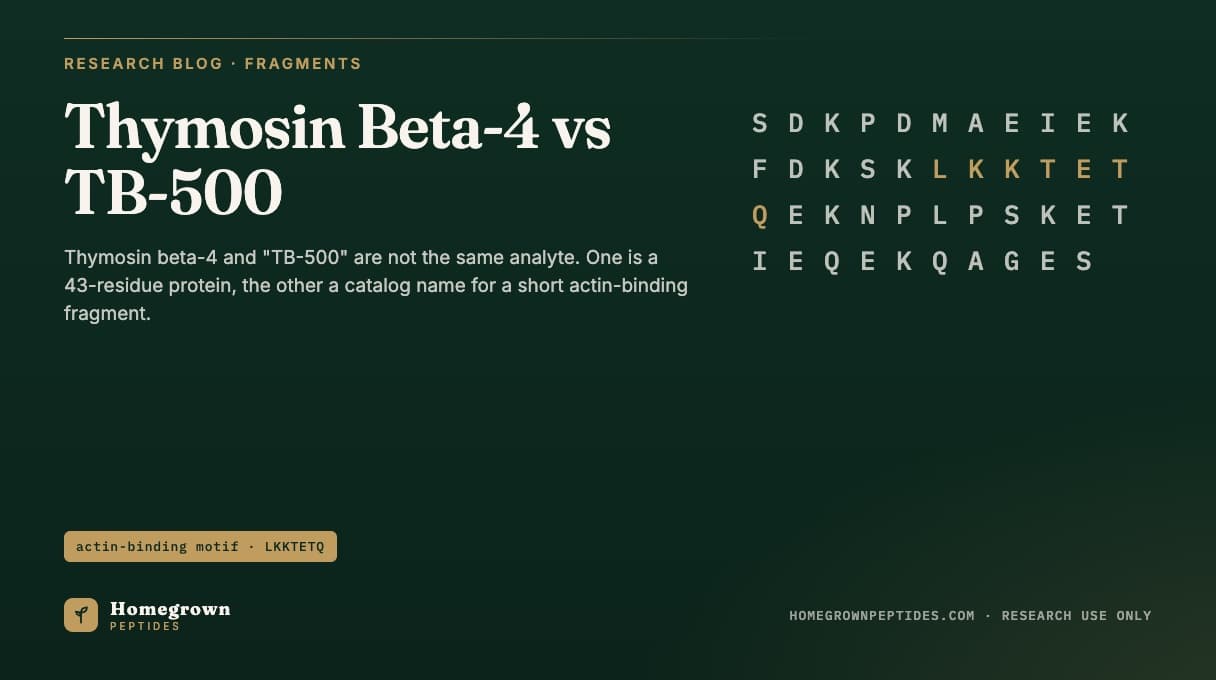
Thymosin beta-4 is the full-length, 43-residue, 4,963 Da protein first sequenced from bovine thymus (Low et al., 1981). "TB-500" is a catalog name, not a formal peptide designation, used for a much shorter synthetic fragment covering the actin-binding region of that sequence, residues 17-23, Leu-Lys-Lys-Thr-Glu-Thr-Gln (LKKTETQ). The two are not interchangeable on a certificate of analysis: they differ in molecular weight by roughly sixfold, in HPLC retention time, and in what a mass spectrometer reports for identity. A vial labeled one or the other should be verified against its own data, not the name on the label.
| Attribute | Thymosin beta-4 (full protein) | "TB-500" (catalog fragment) | Source |
|---|---|---|---|
| Sequence length | 43 residues, N-terminal acetylated | Short fragment spanning residues 17-23 (LKKTETQ) of the parent sequence | Low et al., 1981 |
| Molecular weight | 4,963 Da | Roughly 850 Da for the bare heptapeptide, calculated from residue masses | Low et al., 1981 |
| N-terminus | Acetyl-serine (Ac-Ser1) | Varies by manufacturer; often unmodified unless stated on the certificate | Low et al., 1981 |
| Natural occurrence | Endogenous intracellular G-actin-sequestering protein in platelets and other cell types | Not reported as a free circulating fragment; a synthetic research reagent | Safer et al., 1990 |
| Known cleavage product | Yields the Ac-SDKP tetrapeptide (residues 1-4) via prolyl oligopeptidase | Lacks residues 1-4, so it cannot generate Ac-SDKP | Cavasin et al., 2004 |
| What published studies tested | Nearly all cited cell-migration, wound-repair and fibrosis literature used the full acetylated protein | A synthetic actin-binding-domain peptide was tested alongside the full protein in one murine wound-repair study | Philp et al., 2003 |
What is the complete sequence of thymosin beta-4?
The bovine sequence reported by Low and colleagues, matching the human sequence encoded by TMSB4X, is Ac-Ser-Asp-Lys-Pro-Asp-Met-Gly-Glu-Ile-Ala-Ser-Phe-Asp-Lys-Ala-Lys-Leu-Lys-Lys-Thr-Glu-Thr-Gln-Glu-Lys-Asn-Pro-Leu-Pro-Ser-Lys-Glu-Thr-Ile-Glu-Gln-Glu-Lys-Gln-Ala-Gly-Glu-Ser, 43 residues with an acetylated N-terminal serine (Low et al., 1981). That full sequence gives the intact protein its actin-sequestering function; the isolated 7-residue segment at 17-23 is only a fragment of the contact surface involved. The calculated average molecular weight for the acetylated 43-mer is 4,963 Da, the figure belonging on a certificate for this protein, not a shorter derivative sold under an informal name.
Why is the N-terminus acetylated, and what does that mean for a COA?
N-terminal acetylation is a defining feature of the beta-thymosin family and blocks the aminopeptidase-mediated degradation that would otherwise strip residues from an unmodified N-terminus. On a mass spectrum this appears as a shift relative to the unacetylated sequence, roughly 42 Da higher, small but detectable, and is one check confirming a vial holds the acetylated form rather than a byproduct missing that modification. Short fragments marketed under informal names do not automatically carry this modification unless the manufacturer verifies it, which is why acetylation state belongs on the certificate, not assumed from the name.
What is Ac-SDKP and how is it produced from thymosin beta-4?
Ac-SDKP, also called seraspenide, is the N-terminal tetrapeptide Ac-Ser-Asp-Lys-Pro, residues 1-4 of thymosin beta-4. Prolyl oligopeptidase, which cleaves on the C-terminal side of proline, cuts between positions 4 and 5 and liberates the acetylated tetrapeptide (Cavasin et al., 2004). Ac-SDKP has its own literature, largely unrelated to actin binding: reduced circulating Ac-SDKP has been associated with increased organ fibrosis in rodent models, with cardiac and renal studies examining its role once ACE, which normally degrades it, is inhibited (Cavasin et al., 2007). A vial of thymosin beta-4 and a vial of Ac-SDKP are two different molecules sharing four residues; neither should be confused with a product labeled "TB-500."
What does "TB-500" refer to, and where does the name come from?
"TB-500" is not a systematic peptide name, a CAS-indexed designation, or a term used consistently in the primary literature. It functions in the commercial market as shorthand for material intended to represent the actin-binding region of thymosin beta-4, usually built around the LKKTETQ segment at residues 17-23. The scientific basis for treating this short region as meaningful on its own comes from work mapping which short sequences retain measurable activity, and from a study testing a synthetic actin-binding-domain peptide directly against the full protein in the same wound-repair model (Sosne et al., 2010; Philp et al., 2003). Because the name was never pinned to one reference sequence, length or purity standard, two vials sold under it from different sources are not guaranteed to match. For background, see what is TB-500; this article covers the analytical distinction that overview does not.
How is actin binding actually measured?
G-actin sequestration is measured with assays built on the fact that monomeric (G) actin and filamentous (F) actin behave differently under specific probes. A common approach uses pyrene-labeled actin, where fluorescence intensity shifts depending on whether actin is polymerized or held as free monomer; a sequestering peptide suppresses polymerization, and the suppression versus concentration yields a binding affinity. Viscometric and sedimentation assays give an orthogonal readout, since filaments raise viscosity and pellet under centrifugation while sequestered monomer does not. Thymosin beta-4 was first identified as the platelet actin-sequestering factor by this kind of functional work, after earlier purification of an "actin-sequestering peptide" shown to be indistinguishable from it by sequence and activity (Safer et al., 1990). Later work examined its interaction with muscle and platelet actin isoforms to refine the binding model (Weber et al., 1992). A COA does not typically report actin-binding affinity; that comes from published functional studies, which is reason to treat market claims about a fragment's binding potency skeptically absent a cited source.
What have cell-migration and scratch-assay studies examined?
Thymosin beta-4 has been examined in human umbilical vein endothelial cell cultures for its effect on directional migration, with the full-length protein reported to stimulate migration in a modified Boyden-chamber assay (Malinda et al., 1997). Separately, topical application was examined in rodent skin-wound models, with studies reporting accelerated closure of excisional wounds and changes in granulation-tissue markers (Malinda et al., 1999). The study most relevant to the fragment-versus-full-protein question compared thymosin beta-4 against a synthetic actin-binding-domain peptide in diabetic (db/db) and aged mice, reporting that both were associated with improved dermal wound closure in these impaired-healing models (Philp et al., 2003). That is the clearest precedent for treating a short fragment as a distinct research tool rather than a stand-in for the intact protein.
Fragment and peptide map of thymosin beta-4
| Residue positions | Sequence | What it represents | Appears in |
|---|---|---|---|
| 1 (N-terminus) | Ac-Ser | Acetylation site; blocks N-terminal aminopeptidase degradation | Intact protein only |
| 1-4 | Ac-Ser-Asp-Lys-Pro (Ac-SDKP) | Tetrapeptide cleavage product, studied independently as an antifibrotic peptide | Released from the full protein by prolyl oligopeptidase; sold separately as its own research peptide |
| 17-23 | Leu-Lys-Lys-Thr-Glu-Thr-Gln (LKKTETQ) | Central actin-binding segment; the region the catalog name "TB-500" is generally intended to denote | Synthetic actin-binding-domain peptides tested in published wound-repair work |
| 1-43 | Full sequence | Complete, acetylated G-actin-sequestering protein | Nearly all cited cell-migration, wound-healing and fibrosis literature |
How does a certificate of analysis tell the fragment and the full protein apart?
Three lines on a credible certificate settle the question without relying on the product name. First, molecular weight by mass spectrometry: the intact protein reads at 4,963 Da, while a fragment built around residues 17-23 reads close to its own calculated mass, roughly 850 Da for the bare heptapeptide, shifting with any flanking residues or terminal modification added. A certificate reporting one mass while the label implies the other is a mismatch worth questioning. Second, HPLC retention time: a 43-residue protein and a 7- to 20-residue fragment elute at different points under the same gradient, since retention tracks hydrophobicity and chain length. Third, the stated sequence or at least residue count; a credible COA names one, the fastest way to confirm which molecule is in the vial. Background on reading these lines is in how to read a peptide certificate of analysis, and the arithmetic for calculating expected molecular weight from a sequence is in how to calculate a peptide's molecular weight from its sequence.
Why are market labels for this compound so inconsistent?
Because "TB-500" was never a formally registered sequence, length, or purity standard, vendors apply it to material ranging from short synthetic fragments of varying length to, occasionally, full-length thymosin beta-4 sold under the shorter, more commonly searched name. This is a labeling problem, not a chemistry problem: each underlying molecule is well-defined and independently characterizable, but the name on a listing does not reliably indicate which one is inside. Treat the product name as a shopping label, and the certificate, specifically its stated sequence, molecular weight, and HPLC retention time, as the only reliable identity check for a given lot. The same inconsistency shows up in blends pairing this material with other tissue-repair peptides; see the GLOW blend research overview.
Handling and verification notes
Both are supplied as lyophilized powder for research use. Confirm sequence, molecular weight, and HPLC method against the lot certificate, not the catalog name. Specifications are posted on our TB-500 lot page, and a paired-peptide option combining this material with BPC-157 for comparative tissue-repair research is listed on our BPC-157 / TB-500 combination page.
Frequently asked questions
Is TB-500 just a shorter name for thymosin beta-4?
No. Thymosin beta-4 is the specific 43-residue, 4,963 Da protein. "TB-500" is an informal catalog name for a much shorter synthetic fragment built around the actin-binding region of that protein, residues 17-23. Verify both as separate analytes on any certificate of analysis.
Does the short fragment sequester G-actin the same way the full protein does?
Pyrene-actin fluorescence and sedimentation assays have characterized the full-length protein directly. The actin-binding-domain region has been studied as an active segment in its own right in one comparative wound-repair model, but it is not assumed to reproduce every property of the intact protein's actin interaction (Philp et al., 2003; Sosne et al., 2010).
What is Ac-SDKP, and is it the same thing as thymosin beta-4?
Ac-SDKP is the N-terminal four-residue cleavage product of thymosin beta-4, released by prolyl oligopeptidase. It is a distinct, smaller molecule with its own fibrosis literature, not the same material as the full protein or the fragment.
How can a mass spectrometry result distinguish the two materials?
Thymosin beta-4 should read at approximately 4,963 Da. A short actin-binding fragment reads at roughly one-sixth that mass, close to 850 Da for the bare heptapeptide, shifting with any flanking residues or terminal modifications. A certificate should state both the observed and expected mass for the stated sequence.
Why does the N-terminal acetylation matter analytically?
Acetylation blocks aminopeptidase-mediated degradation and produces a small, detectable mass shift relative to the unacetylated sequence. Confirming its presence distinguishes the biologically relevant acetylated form from an unmodified synthesis product.
Has this compound been studied in humans?
The literature cited here is cell-culture and rodent work. This article summarizes research models and analytical characterization, not clinical evidence.
What should appear on a certificate of analysis for either material?
Stated sequence or residue count, observed and theoretical molecular weight by mass spectrometry, HPLC purity with retention time, lot number, and test date, read together to identify the molecule in the vial.
References
- Low TL, Hu SK, Goldstein AL. Complete amino acid sequence of bovine thymosin beta 4: a thymic hormone that induces terminal deoxynucleotidyl transferase activity in thymocyte populations. Proc Natl Acad Sci U S A. 1981;78(2):1162-6. PubMed 6940133.
- Safer D, Golla R, Nachmias VT. Isolation of a 5-kilodalton actin-sequestering peptide from human blood platelets. Proc Natl Acad Sci U S A. 1990;87(7):2536-40. PubMed 2320573.
- Weber A, Nachmias VT, Pennise CR, et al. Interaction of thymosin beta 4 with muscle and platelet actin: implications for actin sequestration in resting platelets. Biochemistry. 1992;31(27):6179-85. PubMed 1627561.
- Cavasin MA, Rhaleb NE, Yang XP, Carretero OA. Prolyl oligopeptidase is involved in release of the antifibrotic peptide Ac-SDKP. Hypertension. 2004;43(5):1140-5. PubMed 15037553.
- Cavasin MA, Liao TD, Yang XP, Yang JJ, Carretero OA. Decreased endogenous levels of Ac-SDKP promote organ fibrosis. Hypertension. 2007;50(1):130-6. PubMed 17470726.
- Malinda KM, Goldstein AL, Kleinman HK. Thymosin beta 4 stimulates directional migration of human umbilical vein endothelial cells. FASEB J. 1997;11(6):474-81. PubMed 9194528.
- Malinda KM, Sidhu GS, Mani H, et al. Thymosin beta4 accelerates wound healing. J Invest Dermatol. 1999;113(3):364-8. PubMed 10469335.
- Philp D, Badamchian M, Scheremeta B, et al. Thymosin beta 4 and a synthetic peptide containing its actin-binding domain promote dermal wound repair in db/db diabetic mice and in aged mice. Wound Repair Regen. 2003;11(1):19-24. PubMed 12581423.
- Sosne G, Qiu P, Goldstein AL, Wheater M. Biological activities of thymosin beta4 defined by active sites in short peptide sequences. FASEB J. 2010;24(7):2144-51. PubMed 20179146.
Research use only. Homegrown Peptides products are for laboratory research and are not for human or animal use. Nothing in this article is medical advice.