Sermorelin, ipamorelin and the research combination marketed as CJC-1295 plus ipamorelin belong to two different pharmacological classes and have been studied with three distinct designs. Sermorelin is a 29-residue fragment of growth hormone-releasing hormone (GHRH) acting on the pituitary GHRH receptor; CJC-1295 is a modified GHRH(1-29) analog from the same receptor family; ipamorelin is an unrelated five-residue molecule that activates the ghrelin receptor (GHS-R1a). No published trial has co-administered CJC-1295 (No DAC) and ipamorelin together and reported combined pharmacokinetic data. What exists is a monotherapy literature for each mechanism, run in different species, at different amounts, against different endpoints.
| Compound | Class / receptor | What the published record shows | Source |
|---|---|---|---|
| Sermorelin-class GHRH(1-29) analog | GHRH receptor agonist | Twice-daily injection for one year in age-advanced men and women raised 24-hour GH output and IGF-1 relative to placebo | Khorram et al., 1997, PubMed 9141536 |
| Ipamorelin | Selective ghrelin receptor (GHS-R1a) agonist | Released GH from isolated rat pituitary cells and in rats and pigs with minimal change in cortisol, ACTH, prolactin or aldosterone | Raun et al., 1998, PubMed 9849822 |
| Ipamorelin | Ghrelin receptor agonist | Daily injection increased tibial growth plate width and longitudinal bone growth rate in young rats | Johansen et al., 1999, PubMed 10373343 |
| CJC-1295 (with DAC) | GHRH receptor agonist, covalently linked to circulating albumin | A single injection in healthy adults raised GH and kept IGF-1 above baseline for multiple days afterward | Teichman et al., 2006, PubMed 16352683 |
| CJC-1295 (No DAC) | GHRH receptor agonist, no albumin-binding modification | Not the molecule studied in the Teichman trial; the unmodified backbone is the short-acting class, pharmacologically closer to sermorelin than to CJC-1295 with DAC | Contrast drawn from Teichman et al., 2006 |
How do sermorelin and CJC-1295 differ in structure?
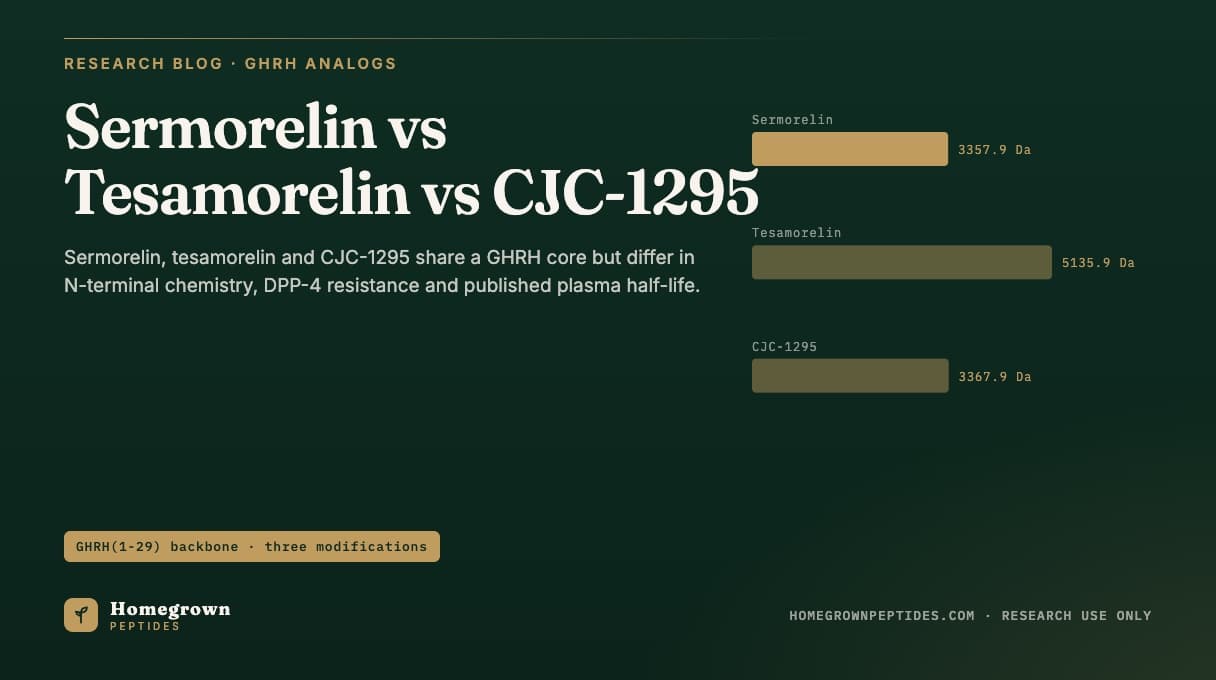
Sermorelin corresponds to the first 29 amino acids of native human GHRH, the minimum fragment that retains full activity at the GHRH receptor. CJC-1295 starts from the same backbone with substitutions reported to resist enzymatic breakdown, and in its "with DAC" form carries a linker that forms a covalent bond with circulating albumin. Jette and colleagues first described this chemistry in rats: the albumin-bound conjugate activated the pituitary GHRH receptor and persisted in circulation far longer than the unconjugated peptide. Teichman and colleagues translated that mechanism to humans, where it extends the window over which GH and IGF-1 stay elevated after one injection to days rather than minutes. The No DAC version, sold alongside ipamorelin in research blends, omits that albumin-binding chemistry; despite sharing the "CJC-1295" name commercially, it has not been shown in a published pharmacokinetic study to share the multi-day elevation reported for the DAC form.
What does the ipamorelin selectivity data show?
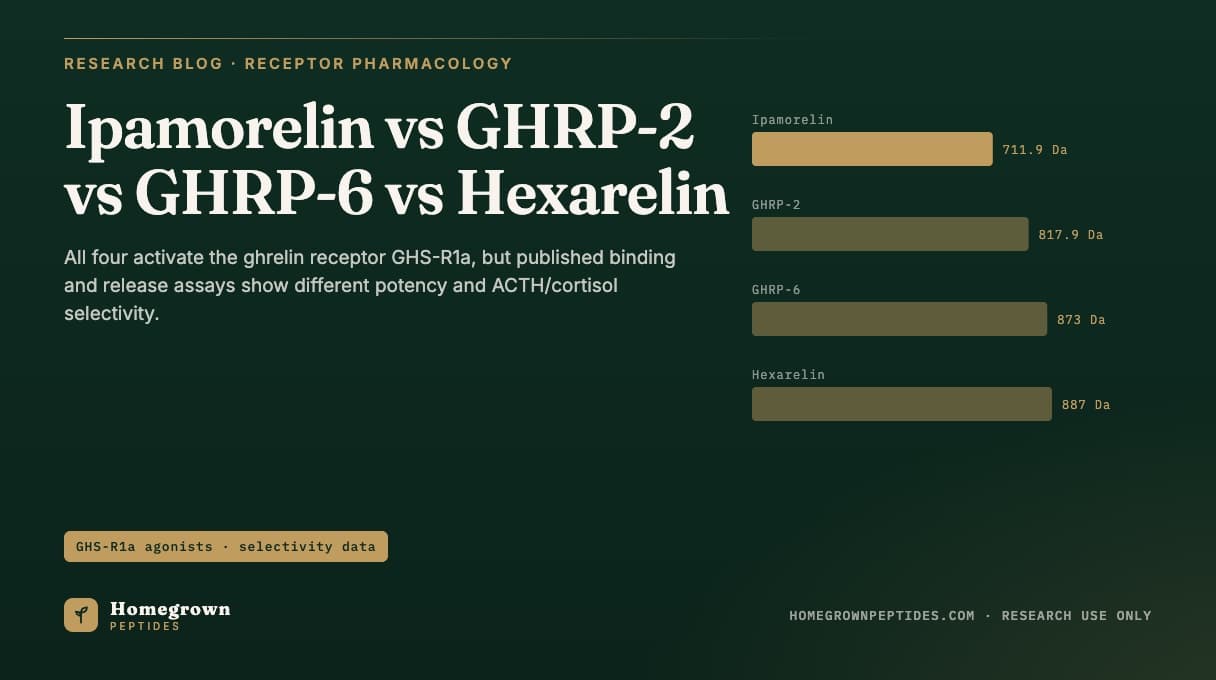
Raun and colleagues characterized ipamorelin against the same panel of hormones that older growth hormone-releasing peptides (GHRPs) are known to move. In isolated rat pituitary cells, ipamorelin produced dose-dependent GH release with potency in the same range as GHRP-6 in the same assay system. In conscious rats and pigs, amounts of ipamorelin that produced a maximal GH response did not produce a comparable rise in cortisol, adrenocorticotropic hormone, prolactin or aldosterone, a selectivity profile the authors described as distinguishing ipamorelin from several earlier ghrelin-receptor agonists tested under the same conditions. Johansen and colleagues extended the in vivo picture in young rats, reporting that repeated ipamorelin administration increased the width of the tibial growth plate and the rate of longitudinal bone growth, an endpoint used in that era of GH-secretagogue pharmacology as a functional readout of sustained GH/IGF-1 exposure rather than a single hormone measurement.
Is CJC-1295 plus ipamorelin studied as a combination in a published trial?
Not directly. The rationale for pairing a GHRH-receptor agonist with a ghrelin-receptor agonist rests on the two receptors acting through separate intracellular pathways on the same somatotroph cell, a mechanism discussed further at cjc-1295-and-ipamorelin-in-combination-research. That rationale is built from two separate bodies of monotherapy work, not from a single published study that dosed both molecules together and reported a combined GH or IGF-1 curve. Vendor-stated ratios are a commercial convention rather than a cited trial result; the amounts each molecule has been studied at on its own are summarized in the study table below.
What study designs were used for each compound?
The three literatures differ in subject, scale and endpoint. The GHRH(1-29)-class sermorelin data reviewed here come from a randomized, placebo-controlled human trial in older men and women receiving twice-daily subcutaneous injections for a full year, with 24-hour hormone sampling and body-composition measurement at intervals. Most of the ipamorelin data come from preclinical pharmacology: isolated pituitary cell cultures, then conscious rats and pigs, then a separate young-rat bone-growth study. A separate human pharmacokinetic-pharmacodynamic study by Gobburu and colleagues modeled ipamorelin's plasma concentration and GH response in human volunteers, which is the closest the ipamorelin literature comes to the kind of human dosing data available for CJC-1295. The CJC-1295 with DAC data come from a randomized, double-blind, placebo-controlled Phase 1 study in healthy adult volunteers, run first as single ascending amounts and then as a repeated-dosing arm over roughly a month, with GH and IGF-1 as the primary endpoints and tolerability recorded throughout. A side-by-side structural and half-life comparison of the GHRH analogs themselves is at sermorelin-vs-th9507-vs-cjc-1295, and the DAC chemistry specifically is covered at cjc-1295-dac-vs-no-dac.
What endpoints did each trial or assay measure?
GH and IGF-1 recur across all three literatures but are read differently. In the sermorelin-class trial, IGF-1 served as an integrated marker of sustained GH exposure over a year, alongside fat mass and fat-free mass by body-composition scanning. In the ipamorelin pharmacology papers, GH release was the primary readout, with cortisol, ACTH, prolactin and aldosterone measured to test receptor selectivity rather than efficacy, and bone growth rate serving as a longer-term functional endpoint. In the CJC-1295 trial, IGF-1's persistence after a single injection, rather than its peak, was the headline finding. In aging-population studies like Khorram's, IGF binding proteins also matter to interpretation: Benbassat and colleagues reported that IGF binding protein-1 and -3 shift with age and insulin status in men, part of why a raw IGF-1 number from an older cohort is read alongside binding-protein context.
How is this handled in a research setting?
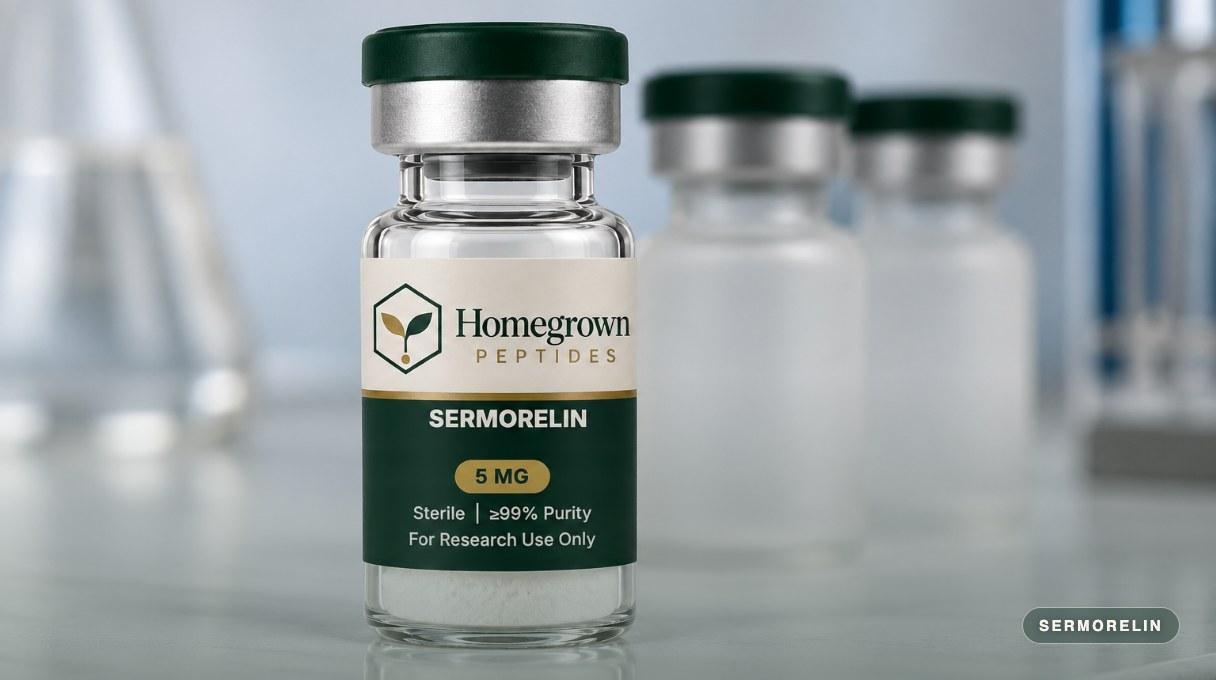
All three peptides ship as lyophilized powder and require correct reconstitution before any bench use; the concentration math is explained at reconstituting-lyophilized-peptides. A certificate of analysis confirming identity and purity should accompany any vial used to replicate work like Raun's or Teichman's; what to check is covered at how-to-read-a-peptide-coa. Lot-matched certificates are available for sermorelin, ipamorelin and CJC-1295 (No DAC) plus ipamorelin research vials.
Does CJC-1295 abolish the normal pulsatile pattern of GH secretion?
No. Ionescu and Frohman followed subjects from the CJC-1295 program with frequent blood sampling and reported that GH continued to be secreted in discrete pulses even while CJC-1295 produced its sustained, multi-day elevation of IGF-1. This matters for comparing the three literatures: ipamorelin's acute experiments were designed around a single pulse, and the finding that CJC-1295 preserves pulsatility rather than flattening it into a constant plateau means the two mechanisms are acting on the same underlying secretory pattern rather than replacing it with a different one.
Study data: amounts, routes and endpoints as reported
| Study | Model and n | Amount and route as reported | Endpoint | Finding |
|---|---|---|---|---|
| Khorram et al., 1997, PubMed 9141536 | Age-advanced men and women, human trial, placebo-controlled | Twice-daily subcutaneous injection of a GHRH(1-29) analog for a one-year study period | 24-hour GH secretory profile, IGF-1, body composition | GH and IGF-1 increased versus placebo; fat mass decreased and fat-free mass increased over the year |
| Raun et al., 1998, PubMed 9849822 | Isolated rat anterior pituitary cells (in vitro) | Ipamorelin added directly to the culture medium across a wide concentration range | GH released into the medium (immunoassay) | Dose-dependent GH release with potency comparable to GHRP-6 in the same assay |
| Raun et al., 1998 | Conscious rats (in vivo) | Injection across a series of amounts reported in the paper | GH, cortisol, ACTH, prolactin, aldosterone in blood | GH rose with amount; the other four hormones were not meaningfully changed at GH-maximal amounts |
| Raun et al., 1998 | Pigs (in vivo) | Injection across a series of amounts reported in the paper | GH and the same hormone panel as the rat arm | Selectivity pattern for GH over cortisol, ACTH, prolactin and aldosterone held across species |
| Johansen et al., 1999, PubMed 10373343 | Young male rats | Daily subcutaneous injection for a period of several weeks | Tibial growth plate width, longitudinal bone growth rate | Bone growth rate increased with amount, up to the highest amount tested |
| Teichman et al., 2006, PubMed 16352683 | Healthy adult volunteers, single-amount cohorts, placebo-controlled | Single subcutaneous injection of CJC-1295, amount escalated across separate cohorts | Plasma GH and IGF-1 over several days | GH rose within hours; IGF-1 remained above baseline for multiple days, longer at higher amounts |
| Teichman et al., 2006 | Healthy adult volunteers, repeated-injection cohorts | Subcutaneous injections repeated on a once- or twice-weekly interval for about a month | Plasma GH, IGF-1, tolerability over the study period | IGF-1 stayed above baseline throughout dosing and for days after the final injection; reported as well tolerated |
| Jette et al., 2005 | Rats (in vivo), albumin-conjugate pharmacology | Injection of the albumin-bound GRF(1-29) conjugate across amounts reported in the paper | Receptor activation at the pituitary, plasma persistence of the conjugate | The conjugate activated the GHRH receptor and remained in circulation markedly longer than unconjugated GRF(1-29), the basis for the CJC-1295 with DAC chemistry |
| Ionescu and Frohman, 2006 | Healthy adult volunteers from the CJC-1295 program | Frequent blood sampling during continuous CJC-1295 stimulation, amount as used in the parent trial | Pulsatile pattern of GH secretion | GH pulsatility persisted during CJC-1295 stimulation rather than being replaced by a flat, continuous elevation |
| Gobburu et al., 1999 | Human volunteers | Ipamorelin administered to volunteers at amounts reported in the paper; plasma sampled for pharmacokinetic modeling | Plasma ipamorelin concentration and GH response, modeled together | A pharmacokinetic-pharmacodynamic model linked ipamorelin plasma levels to the GH response, the main human dosing data point in the ipamorelin literature |
Frequently asked questions
Does ipamorelin act on the same receptor as sermorelin?
No. Sermorelin and CJC-1295 both act on the GHRH receptor on pituitary somatotrophs. Ipamorelin acts on a separate receptor, the ghrelin receptor (GHS-R1a), which is why the two mechanisms are described in the literature as complementary rather than redundant.
Is CJC-1295 No DAC the same molecule studied by Teichman and colleagues?
No. The Teichman 2006 trial studied CJC-1295 with DAC, the albumin-binding form. The No DAC backbone lacks that linker chemistry and has not been shown in a published pharmacokinetic study to produce the same multi-day GH/IGF-1 elevation.
Why do research designs pair a GHRH analog with a ghrelin-receptor agonist?
The two receptors signal through different pathways on the somatotroph, and preclinical work combining GHRH analogs with GHRPs has reported additive GH release versus either mechanism alone, though not specifically for the CJC-1295 No DAC and ipamorelin pairing as marketed.
What species make up most of the ipamorelin data?
Most of the ipamorelin pharmacology cited here comes from isolated rat pituitary cells, conscious rats and pigs, and a separate young-rat bone-growth study. The exception is a human pharmacokinetic-pharmacodynamic study by Gobburu and colleagues that modeled ipamorelin's plasma levels against its GH response in volunteers. The sermorelin-class and CJC-1295 data cited here come from human trials.
How long does one CJC-1295 with DAC injection keep GH markers elevated, according to the published trial?
Teichman and colleagues reported that a single injection produced a GH rise followed by IGF-1 levels that stayed above baseline for several days, which the authors attributed to the albumin-binding chemistry slowing clearance.
Are sermorelin and CJC-1295 interchangeable in study design terms?
No. They share a receptor target but differ in reported duration of action, and the published trials used different dosing intervals and sampling windows as a direct consequence of that difference. A structural comparison across GHRH analogs is at sermorelin-vs-th9507-vs-cjc-1295.
Where can the ipamorelin receptor-selectivity data be compared against other ghrelin-receptor agonists?
A head-to-head of ipamorelin against GHRP-2, GHRP-6 and hexarelin on receptor-binding and GH-release data is at ipamorelin-vs-ghrp-2-vs-ghrp-6-vs-hexarelin.
References
- Teichman SL, Neale A, Lawrence B, Gagnon C, Castaigne JP, Frohman LA. Prolonged stimulation of growth hormone (GH) and insulin-like growth factor I secretion by CJC-1295, a long-acting analog of GH-releasing hormone, in healthy adults. J Clin Endocrinol Metab. 2006;91(3):799-805. PubMed PMID 16352683.
- Raun K, Hansen BS, Johansen NL, Thøgersen H, Madsen K, Ankersen M, Andersen PH. Ipamorelin, the first selective growth hormone secretagogue. Eur J Endocrinol. 1998;139(5):552-561. PubMed PMID 9849822.
- Johansen PB, Nowak J, Skjaerbaek C, Flyvbjerg A, Andreassen TT, Wilken M, Orskov H. Ipamorelin, a new growth-hormone-releasing peptide, induces longitudinal bone growth in rats. Growth Horm IGF Res. 1999;9(2):106-113. PubMed PMID 10373343.
- Khorram O, Laughlin GA, Yen SSC. Endocrine and metabolic effects of long-term administration of [Nle27]growth hormone-releasing hormone-(1-29)-NH2 in age-advanced men and women. J Clin Endocrinol Metab. 1997;82(5):1472-1479. PubMed PMID 9141536.
- Benbassat CA, Maki KC, Unterman TG. Circulating levels of insulin-like growth factor (IGF) binding protein-1 and -3 in aging men: relationships to insulin, glucose, IGF, and dehydroepiandrosterone sulfate levels and anthropometric measures. J Clin Endocrinol Metab. 1997;82(5):1484-1491. PubMed PMID 9141538.
- Jette L, Léger R, Thibaudeau K, Benquet C, Robitaille M, Pellerin I, Paradis V, Bridon DP. Human growth hormone-releasing factor (hGRF)1-29-albumin bioconjugates activate the GRF receptor on the anterior pituitary in rats: identification of CJC-1295 as a long-lasting GRF analog. Endocrinology. 2005;146(7):3052-3058. PubMed PMID.
- Ionescu M, Frohman LA. Pulsatile secretion of growth hormone (GH) persists during continuous stimulation by CJC-1295, a long-acting GH-releasing hormone (GHRH) analog. J Clin Endocrinol Metab. 2006;91(12):4792-4797. PubMed PMID.
- Gobburu JVS, Agersø H, Jusko WJ, Ynddal L. Pharmacokinetic-pharmacodynamic modeling of ipamorelin, a growth hormone releasing peptide, in human volunteers. Pharm Res. 1999;16(9):1412-1416. PubMed PMID.
Research use only. Homegrown Peptides products are for laboratory research and are not for human or animal use. Nothing in this article is medical advice.