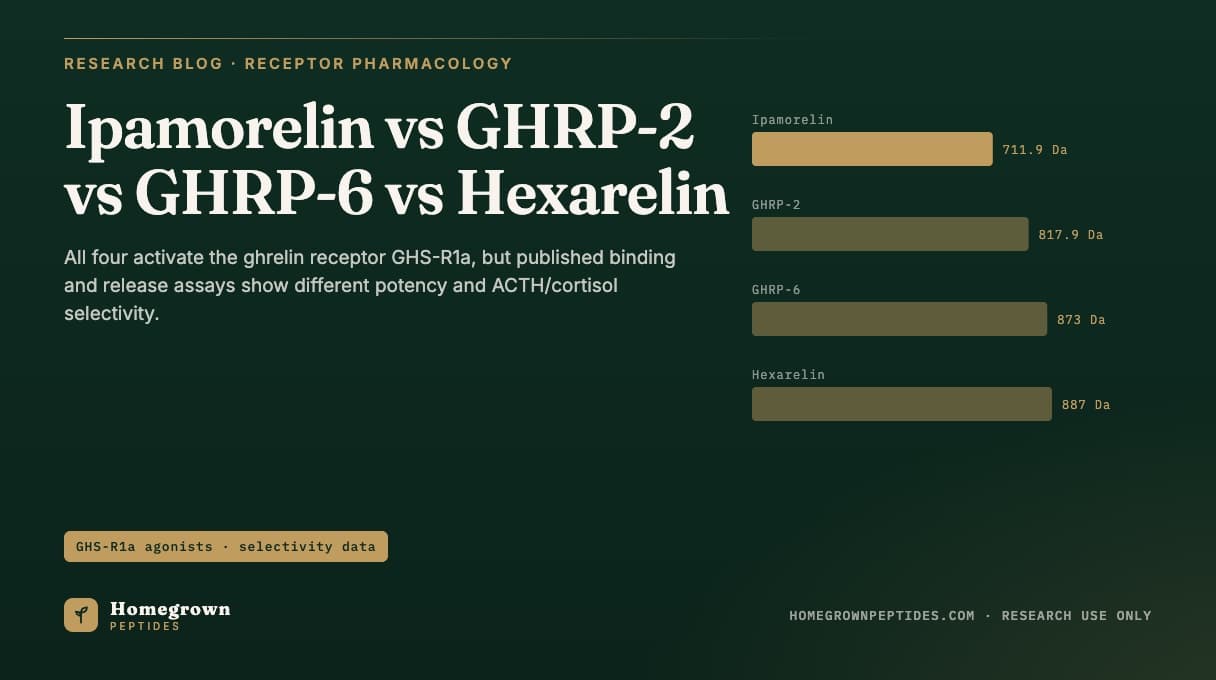
Ipamorelin, GHRP-2, GHRP-6 and Hexarelin are all agonists of the same receptor, the growth hormone secretagogue receptor GHS-R1a: all bind this seven-transmembrane G-protein-coupled receptor on pituitary somatotrophs and trigger calcium-dependent growth hormone (GH) release. What separates them in the published cell and animal data is potency (EC50/ED50), efficacy (Emax), and, most notably, selectivity: ipamorelin releases GH without raising ACTH or cortisol in the cited pig model, while GHRP-6 and GHRP-2 raise both (Raun et al., 1998). Hexarelin, closest in structure to GHRP-6, has been studied mainly for comparable GH-releasing potency rather than this same selectivity endpoint.
| Attribute | Detail |
|---|---|
| Shared target | Ghrelin receptor GHS-R1a, a Gq/11-coupled GPCR on pituitary somatotrophs and hypothalamic neurons |
| Shared readout in cited studies | GH release from primary pituitary cells in vitro, or plasma GH after systemic dosing in rats or pigs |
| Where the four diverge | EC50/ED50 potency, Emax efficacy, and off-target release of ACTH, cortisol and prolactin |
| Most selective for GH alone | Ipamorelin, a pentapeptide that did not raise ACTH or cortisol at doses more than 200-fold its ED50 for GH release in pigs (Raun et al., 1998) |
| Least selective by the same dataset | GHRP-6 and GHRP-2, both of which raised plasma ACTH and cortisol in that pig model (Raun et al., 1998) |
| Structural class | Hexapeptide amides for GHRP-6, GHRP-2 and hexarelin; a pentapeptide amide for ipamorelin |
What is GHS-R1a, and how do these four peptides engage it?
The growth hormone secretagogue receptor (GHS-R1a) was cloned from pig and human pituitary and hypothalamus as the common target of structurally diverse GH secretagogues, including peptides and small nonpeptide molecules (Howard et al., 1996). It is a seven-transmembrane, G-protein-coupled receptor that signals mainly through Gq/11 and phospholipase C, raising intracellular calcium in somatotrophs and driving GH exocytosis. A rat ortholog cloned the following year showed over 90% sequence identity to the human and pig receptors and bound the nonpeptide secretagogue [35S]MK-0677 with a dissociation constant of 0.7 nM (McKee et al., 1997). None of the four peptides engages the GH-releasing hormone (GHRH) receptor; receptor-blockade experiments with GHRP- and GHRH-selective antagonists confirmed that ipamorelin, like GHRP-6, signals through the GHRP-type receptor rather than the GHRH pathway (Raun et al., 1998).
How selective is ipamorelin compared with GHRP-6 and GHRP-2 for GH release alone?
The defining selectivity study pitted ipamorelin directly against GHRP-6 and GHRP-2 in the same laboratory, species and assays (Raun et al., 1998). In primary rat pituitary cells and in anesthetized rats and conscious pigs dosed systemically, ipamorelin's potency (EC50/ED50) and efficacy (Emax) for GH release tracked closely with GHRP-6's across all three systems; GHRP-2 was more potent than either in the pig model but reached a lower maximum GH level (exact values in the table below).
The selectivity finding, not the potency finding, is what made this paper notable. None of the three secretagogues altered plasma FSH, LH, PRL or TSH in the pig study. But GHRP-6 and GHRP-2 both produced measurable increases in plasma ACTH and cortisol, while ipamorelin did not, even at doses exceeding 200 times its own ED50 for GH release (Raun et al., 1998). That gap, GH release with no detectable activation of the adrenal axis, is the specific property the authors mean by calling ipamorelin "the first selective growth hormone secretagogue."
What do the structure, molecular weight and receptor-binding data show side by side?
| Compound | Sequence | MW / formula | Receptor | Reported potency (cited studies) | ACTH/cortisol effect | Prolactin effect |
|---|---|---|---|---|---|---|
| Ipamorelin | Aib-His-D-2-Nal-D-Phe-Lys-NH2 (pentapeptide amide) | ~711.9 g/mol, C38H49N9O5 | GHS-R1a | EC50 1.3 nmol/L (rat cells); ED50 80 nmol/kg (rat), 2.3 nmol/kg (pig) (Raun 1998) | Not increased at >200x GH ED50 (pig) (Raun 1998) | No change (pig) (Raun 1998) |
| GHRP-6 | His-D-Trp-Ala-Trp-D-Phe-Lys-NH2 (hexapeptide amide) | ~873.0 g/mol, C46H56N12O6 | GHS-R1a | EC50 2.2 nmol/L (rat cells); ED50 115 nmol/kg (rat), 3.9 nmol/kg (pig) (Raun 1998); active 1-10 ng/mL in pituitary incubate across species (Bowers 1984) | Increased (pig) (Raun 1998) | No change (Bowers 1984; Raun 1998) |
| GHRP-2 | D-Ala-D-2-Me-Trp-Ala-Trp-D-Phe-Lys-NH2 (hexapeptide amide) | ~818.0 g/mol, C45H55N9O6 | GHS-R1a | ED50 0.6 nmol/kg, Emax 56 ng GH/mL (pig) (Raun 1998) | Increased (pig) (Raun 1998) | No change (pig) (Raun 1998) |
| Hexarelin | His-D-2-Me-Trp-Ala-Trp-D-Phe-Lys-NH2 (hexapeptide amide) | ~887.1 g/mol, C47H58N12O6 | GHS-R1a | GH magnitude/onset comparable to GHRP-6 IV in adult rats; SC slightly more effective in infant rats (Deghenghi 1994) | Not isolated as an endpoint in this study | Not isolated as an endpoint in this study |
Hexarelin and GHRP-6 differ by one modification: hexarelin substitutes 2-methyl-D-tryptophan for D-tryptophan at position 2, made for stability rather than to shift selectivity (Deghenghi et al., 1994). GHRP-2 carries the same 2-methyl-tryptophan at a different backbone position, consistent with the receptor's tolerance for substitutions around one shared anchor point used by all peptide and nonpeptide agonists (Feighner et al., 1998). Molecular weights above are calculated from each published sequence.
How are GHS-R1a binding and activation measured in these studies?
Four assay types recur across this literature.
| Assay | What it measures | Used in |
|---|---|---|
| Radioligand binding displacement | Competition of a test peptide against a radiolabeled secretagogue (e.g., [35S]MK-0677) for the receptor in membrane preparations, yielding binding affinity | Pong et al., 1996; McKee et al., 1997 |
| Calcium flux / mobilization | Receptor-coupled rise in intracellular Ca2+ in cells expressing cloned GHS-R1a, used to derive functional EC50 values | Howard et al., 1996; Feighner et al., 1998 |
| Site-directed mutagenesis mapping | Identifies which transmembrane residues are required for a given ligand class to activate the receptor, revealing shared versus class-specific contact points | Feighner et al., 1998 |
| Pituitary cell / whole-animal GH release | Static incubation of dispersed pituitary cells, or plasma GH measured after systemic dosing, used to derive EC50/ED50 and Emax for GH output | Bowers et al., 1984; Deghenghi et al., 1994; Raun et al., 1998 |
Binding displacement work in porcine and rat pituitary membranes found that binding affinity for this group of secretagogues, including GHRP-6 and hexarelin, correlates tightly with GH-secretory potency; binding was magnesium-dependent, blocked by GTP-gamma-S, and not displaced by GHRH or somatostatin (Pong et al., 1996). Mutagenesis of the cloned human receptor later localized a shared binding domain in transmembrane helix 3 that all peptide and nonpeptide secretagogues depend on, while other transmembrane and extracellular-loop residues accounted for differences between chemical classes (Feighner et al., 1998).
What do pituitary cell and whole-animal release assays show about potency?
The original GHRP-6 work used a static pituitary incubation assay and found the hexapeptide active across rat, monkey, lamb and calf tissue, with active concentrations of 1-10 ng/mL and no concurrent release of LH, FSH, TSH or prolactin (Bowers et al., 1984). After an intravenous dose in rats, plasma GH rose within 2 minutes, peaked at 10-20 minutes, and returned toward baseline by about 2 hours. Hexarelin, built on the same scaffold, was tested against GHRP-6 in infant and adult rats: intravenous dosing gave comparable magnitude and timing, while subcutaneous hexarelin gave a longer-lasting response somewhat greater than GHRP-6 (Deghenghi et al., 1994). None of these release assays report a classic elimination half-life; what is reported is the GH-response time course, a pharmacodynamic readout rather than a measure of peptide clearance.
Why do GHRP-6, GHRP-2 and hexarelin raise ACTH and cortisol when ipamorelin does not?
The receptor-level studies do not pin down a single structural switch that explains this split; the literature shows a consistent functional pattern instead. GHS-R1a agonists beyond these four have been reported to stimulate the hypothalamic-pituitary-adrenal axis and affect hypothalamic peptide release more broadly, including vasopressin release from rat hypothalamic explants exposed to GHRP-6 or hexarelin (Korbonits et al., 1999). Ipamorelin's shorter pentapeptide scaffold, rather than the longer hexapeptide backbone shared by GHRP-6, GHRP-2 and hexarelin, is the structural feature most often pointed to as distinguishing it, though the available binding data do not isolate which exact residue contact is responsible (Raun et al., 1998; Feighner et al., 1998). The whole peptide and nonpeptide secretagogue class is understood as mimicking an endogenous GHS-R1a ligand not yet characterized when these compounds were developed (Bowers, 1998).
Why does this comparison matter for how a study is designed?
Because all four converge on one receptor but diverge in off-target activity, a study using GH release alone will not distinguish ipamorelin's selectivity from GHRP-6's broader profile unless ACTH and cortisol are measured in parallel, as the pig study did (Raun et al., 1998). This is also why GHRP-6 and ipamorelin are frequently paired with a GHRH analog rather than studied alone; see why studies pair a GHRH analog with a ghrelin mimetic and what is GHRP-6. A broader introduction to ipamorelin is in what is ipamorelin. Lot-specific identity and purity data are posted on the ipamorelin product page and the CJC-1295 (No DAC) and GHRP-6 blend page.
Frequently asked questions
Are ipamorelin, GHRP-2, GHRP-6 and hexarelin interchangeable in a receptor assay?
They share one target, GHS-R1a, so all four register activity in a calcium flux or GH-release assay built around that receptor. They are not interchangeable in potency, efficacy or off-target output, which is exactly what the comparative studies cited here were designed to resolve (Raun et al., 1998).
Which of the four has the smallest molecular weight?
Ipamorelin, a pentapeptide amide at roughly 711.9 g/mol, is smaller than the three hexapeptide amides (GHRP-2 at roughly 818.0 g/mol, GHRP-6 at roughly 873.0 g/mol, and hexarelin at roughly 887.1 g/mol), which each carry one additional amino acid residue.
Does GHRP-2's higher potency in the cited pig study make it the "best" compound?
Potency (ED50) and efficacy (Emax) are separate properties, and selectivity is a third. GHRP-2 had the lowest ED50 but also the lowest Emax of the three tested, and it shared GHRP-6's ACTH/cortisol activity that ipamorelin lacked (Raun et al., 1998). Which property matters most depends on what a study measures.
What makes hexarelin different from GHRP-6 at the sequence level?
Hexarelin replaces the D-tryptophan at position 2 of GHRP-6 with 2-methyl-D-tryptophan, introduced for chemical stability. The cited rat dosing study found this did not meaningfully change GH-release potency or timing by the intravenous route (Deghenghi et al., 1994).
Do any of these four affect prolactin release?
In the cited pig study, none of ipamorelin, GHRP-6 or GHRP-2 changed plasma prolactin, FSH, LH or TSH; only ACTH and cortisol rose, and only for GHRP-6 and GHRP-2 (Raun et al., 1998). The original GHRP-6 pituitary incubation and acute in vivo work likewise reported no concurrent prolactin release (Bowers et al., 1984). Other GHS-R1a agonists have been reported to affect prolactin in other animal and human studies, which is why selectivity findings are tied to the specific assay and species used (Korbonits et al., 1999).
Is there a published half-life for these four peptides from animal studies?
The cited studies report the time course of the GH response, not a measured plasma elimination half-life. The closest data point is the original GHRP-6 work: GH levels rose within 2 minutes of an intravenous dose in rats, peaked at 10-20 minutes, and returned toward baseline by about 2 hours (Bowers et al., 1984). See peptide half-life explained for that distinction between a GH-response curve and a peptide's own half-life.
References
- Raun K, Hansen BS, Johansen NL, et al. Ipamorelin, the first selective growth hormone secretagogue. Eur J Endocrinol. 1998;139(5):552-61. PubMed 9849822.
- Bowers CY, Momany FA, Reynolds GA, Hong A. On the in vitro and in vivo activity of a new synthetic hexapeptide that acts on the pituitary to specifically release growth hormone. Endocrinology. 1984;114(5):1537-45. PubMed 6714155.
- Deghenghi R, Cananzi MM, Torsello A, Battisti C, Muller EE, Locatelli V. GH-releasing activity of Hexarelin, a new growth hormone releasing peptide, in infant and adult rats. Life Sci. 1994;54(18):1321-8. PubMed 7910650.
- Howard AD, Feighner SD, Cully DF, et al. A receptor in pituitary and hypothalamus that functions in growth hormone release. Science. 1996;273(5277):974-7. PubMed 8688086.
- Pong SS, Chaung LY, Dean DC, Nargund RP, Patchett AA, Smith RG. Identification of a new G-protein-linked receptor for growth hormone secretagogues. Mol Endocrinol. 1996;10(1):57-61. PubMed 8838145.
- McKee KK, Palyha OC, Feighner SD, et al. Molecular analysis of rat pituitary and hypothalamic growth hormone secretagogue receptors. Mol Endocrinol. 1997;11(4):415-23. PubMed 9092793.
- Feighner SD, Howard AD, Prendergast K, et al. Structural requirements for the activation of the human growth hormone secretagogue receptor by peptide and nonpeptide secretagogues. Mol Endocrinol. 1998;12(1):137-45. PubMed 9440817.
- Bowers CY. Growth hormone-releasing peptide (GHRP). Cell Mol Life Sci. 1998;54(12):1316-29. PubMed 9893708.
- Korbonits M, Little JA, Forsling ML, et al. The effect of growth hormone secretagogues and neuropeptide Y on hypothalamic hormone release from acute rat hypothalamic explants. J Neuroendocrinol. 1999;11(7):521-8. PubMed 10444309.
Research use only. Homegrown Peptides products are for laboratory research and are not for human or animal use. Nothing in this article is medical advice.