CJC-1295 and ipamorelin are two of the most frequently paired compounds in growth hormone secretagogue research, and the reason comes down to receptor biology rather than convenience. Growth hormone secretagogues in research covers the broader category these two belong to; this article looks specifically at why the two are studied together, which receptor pathway each one engages, what the pulsatility literature says about combining a GHRH-pathway compound with a ghrelin-pathway compound, and what published studies have actually measured when the two mechanisms are examined side by side.
| Attribute | Detail |
|---|---|
| CJC-1295 | A long-acting analog of growth hormone-releasing hormone (GHRH), studied for extended stimulation of the GHRH receptor |
| Ipamorelin | A selective agonist at the ghrelin receptor (GHS-R), studied as a growth hormone secretagogue with minimal effect on other pituitary hormones |
| Receptor pathway 1 | GHRH receptor on pituitary somatotrophs, engaged by CJC-1295 |
| Receptor pathway 2 | Ghrelin receptor (GHS-R1a), engaged by ipamorelin |
| What combination research examines | Whether stimulating both receptor pathways together produces a larger or more sustained growth hormone pulse than either pathway alone |
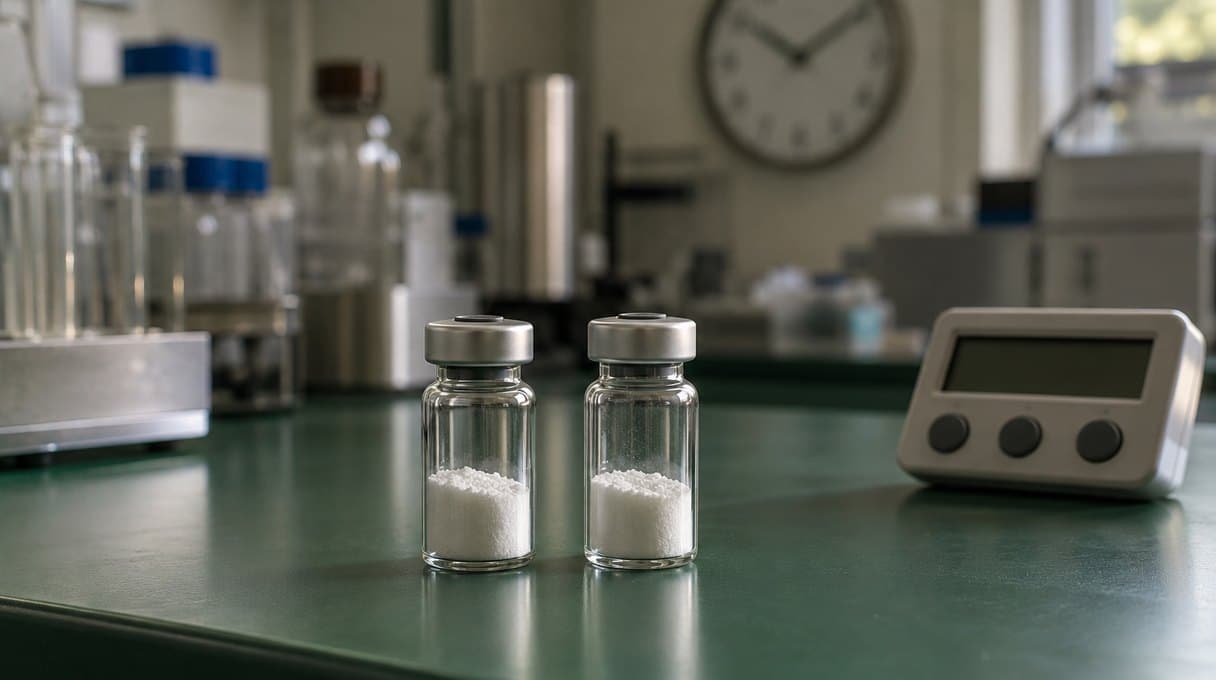
| Form supplied | Lyophilized powder, research use only |
What is the GHRH receptor pathway, and what does CJC-1295 do there?
Growth hormone-releasing hormone is a hypothalamic peptide that signals pituitary somatotroph cells directly through the GHRH receptor to release growth hormone. Early characterization work identified and sequenced this releasing factor from human tissue, establishing the receptor pathway that GHRH analogs are designed to engage (Rivier et al., 1982; Spiess et al., 1983). CJC-1295 is a modified GHRH(1-29) analog studied for a longer duration of receptor engagement than native GHRH, which has a very short circulating half-life. In a human study, CJC-1295 administration produced a sustained increase in growth hormone and IGF-I levels over a multi-day observation window compared with baseline, a duration of effect the authors attributed to the analog's extended pharmacokinetic profile relative to unmodified GHRH (Teichman et al., 2006).
What is the ghrelin receptor pathway, and what does ipamorelin do there?
The ghrelin receptor, also called the growth hormone secretagogue receptor (GHS-R), was identified as a distinct pituitary and hypothalamic signaling target separate from the GHRH receptor, opening a second route to growth hormone release that does not depend on GHRH signaling at all (Howard et al., 1996). Ipamorelin was developed and characterized as a selective agonist at this receptor, and in early pharmacological characterization work it was reported to stimulate growth hormone release in rodent and pig models with comparatively little effect on cortisol, prolactin, or other pituitary hormones that some earlier ghrelin-receptor agonists also affected (Raun et al., 1998). This receptor selectivity is the main reason ipamorelin appears so often in secretagogue research as the ghrelin-pathway half of a two-compound comparison.
What does the pulsatility literature say about combining the two pathways?
Growth hormone is released from the pituitary in discrete pulses rather than as a steady stream, and both the GHRH and ghrelin receptor pathways feed into that pulsatile pattern from different angles. Early human physiology work using a GHRH-pathway peptide isolated from a pancreatic tumor demonstrated that GHRH-receptor stimulation alone could reliably trigger a growth hormone pulse in healthy subjects, establishing the releasing-hormone side of the pulse-generating system as pharmacologically tractable on its own (Thorner et al., 1983). Because the ghrelin-receptor pathway acts through a separate intracellular signaling route, researchers have proposed that engaging both receptors at once could in principle produce an additive or synergistic pulse rather than two pulses that simply compete for the same limited pituitary output. This is a mechanistic rationale drawn from the separate receptor pharmacology rather than a single unified finding, and it is the reason the two compounds are typically discussed together even when the underlying human studies tested them independently.
What have combination studies actually measured?
Most of the controlled human pharmacology in this literature has tested a GHRH-pathway analog or a ghrelin-pathway agonist in isolation, measuring growth hormone and IGF-I response curves over time after a single agent is administered, as in the CJC-1295 and ipamorelin characterization studies cited above. Direct head-to-head or combined-administration trials specifically pairing CJC-1295 with ipamorelin are limited in the peer-reviewed literature relative to the volume of research on each compound separately, which means the rationale for combining them rests mainly on the two receptors' distinct, non-overlapping signaling routes rather than on a large combined-dosing dataset. Researchers designing cell or animal studies around this pairing generally treat it as a two-pathway comparison model: one arm engaging the GHRH receptor, one arm engaging the ghrelin receptor, and readouts such as growth hormone pulse amplitude, IGF-I level, and pulse timing compared across conditions.
How does this pairing compare to other secretagogue combinations?
CJC-1295 and ipamorelin are one of several GHRH-analog-plus-ghrelin-mimetic pairings studied in this category, alongside combinations involving TH9507 on the GHRH side; see what is ipamorelin for background specific to that compound. Researchers preparing multi-peptide research solutions from separate lyophilized vials need to work out combined concentrations carefully; the math for that is covered in calculating peptide blend concentrations rather than repeated here. Across these pairings, the choice of which GHRH-pathway analog to use, whether CJC-1295 or TH9507, generally comes down to which compound's own pharmacokinetic and trial literature is more relevant to the research question at hand, since the ghrelin-pathway half of the pairing is frequently the same selective agonist in either case.
What experimental readouts do researchers use to compare the two pathways?
Because the GHRH receptor and the ghrelin receptor activate different intracellular signaling cascades inside the pituitary somatotroph, researchers studying this pairing in cell or animal models typically track more than a single growth hormone value. Common readouts include the amplitude of the growth hormone pulse following administration, the area under the curve for growth hormone or IGF-I over a defined post-administration window, and the timing of the pulse relative to baseline secretion. Some cell-based work has also looked at cyclic AMP signaling downstream of the GHRH receptor separately from the intracellular calcium and phospholipase signaling more closely associated with ghrelin-receptor activation, treating these as distinct biochemical fingerprints that a combined-pathway study can, in principle, disentangle even when the whole-animal growth hormone output looks similar between conditions.
Handling notes
CJC-1295 and ipamorelin are each supplied as lyophilized powder for laboratory research. Store per the certificate of analysis and confirm identity and purity from the lot-specific documentation before use in an assay. Lot-specific specs for this combination are posted on our CJC-1295 and ipamorelin lot page.
Frequently asked questions
Do CJC-1295 and ipamorelin work through the same receptor?
No. CJC-1295 is a GHRH-receptor pathway analog, while ipamorelin is a selective agonist at the ghrelin receptor (GHS-R). They are studied as two distinct, complementary signaling routes to growth hormone release.
Has the combination itself been studied directly?
Controlled trials specifically combining the two compounds are limited compared with the literature on each compound studied alone. The rationale for pairing them is built primarily from the separate receptor pharmacology rather than a large combined dataset.
Why does ipamorelin get described as "selective"?
Early pharmacological characterization reported that ipamorelin stimulated growth hormone release with comparatively little effect on cortisol and prolactin relative to some earlier ghrelin-receptor agonists tested in the same animal models.
What does CJC-1295 add that native GHRH does not provide in research settings?
CJC-1295 was studied for a longer duration of GHRH-receptor engagement than unmodified GHRH, which is rapidly cleared from circulation. This extended engagement window is the main experimental advantage researchers cite for using the analog instead of native GHRH.
Is any of this research done in humans?
The CJC-1295 and ipamorelin characterization studies cited here included human and animal pharmacology work, respectively. This article summarizes published research findings and is not guidance for use in any subject.
References
- Rivier J, Spiess J, Thorner M, Vale W. Characterization of a growth hormone-releasing factor from a human pancreatic islet tumour. Nature. 1982;300(5889):276-8. PubMed 6292724.
- Spiess J, Rivier J, Rivier C, Vale W. Characterization of rat hypothalamic growth hormone-releasing factor. Nature. 1983;303(5917):532-5. PubMed 6406907.
- Thorner MO, Rivier J, Spiess J, et al. Human pancreatic growth-hormone-releasing factor selectively stimulates growth-hormone secretion in man. Lancet. 1983;1(8314-15):24-8. PubMed 6129370.
- Howard AD, Feighner SD, Cully DF, et al. A receptor in pituitary and hypothalamus that functions in growth hormone release. Science. 1996;273(5277):974-7. PubMed 8688086.
- Raun K, Hansen BS, Johansen NL, et al. Ipamorelin, the first selective growth hormone secretagogue. Eur J Endocrinol. 1998;139(5):552-61. PubMed 9849822.
- Teichman SL, Neale A, Lawrence B, Gagnon C, Castaigne JP, Frohman LA. Prolonged stimulation of growth hormone (GH) and insulin-like growth factor I secretion by CJC-1295, a long-acting analog of GH-releasing hormone, in healthy adults. J Clin Endocrinol Metab. 2006;91(3):799-805. PubMed 16352683.
Research use only. Homegrown Peptides products are for laboratory research and are not for human or animal use. Nothing in this article is medical advice.