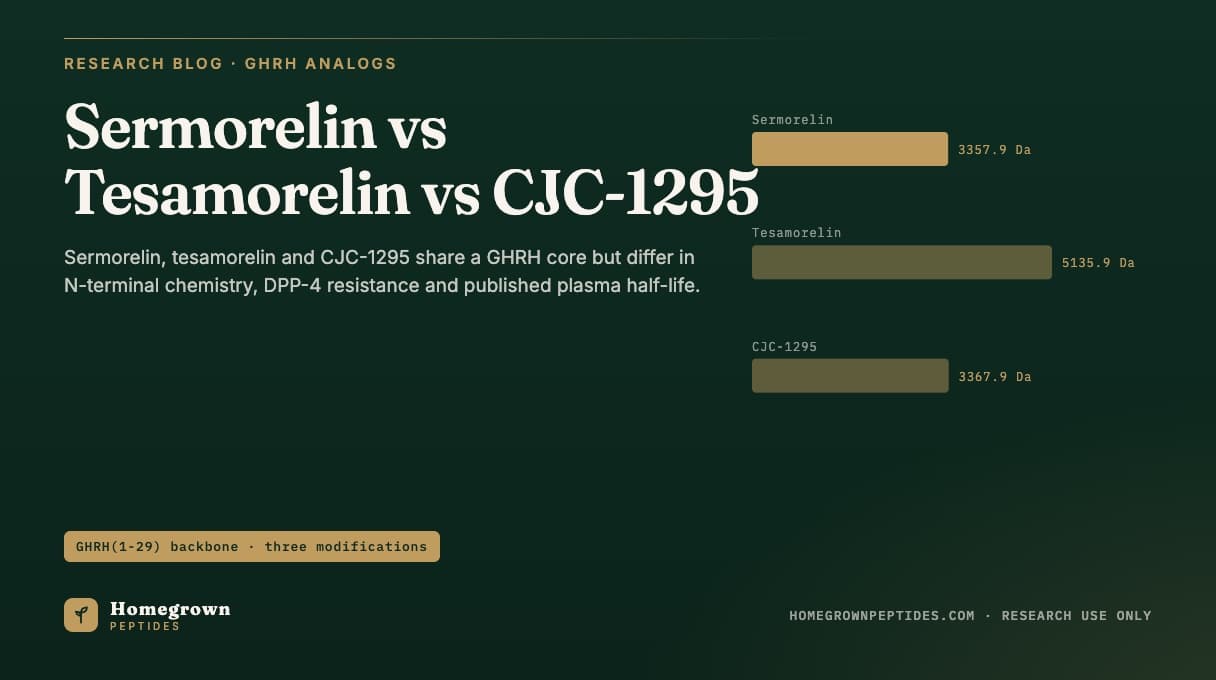
Sermorelin, TH9507 and CJC-1295 are all built from the human growth-hormone-releasing hormone sequence, GHRH, but each addresses the same stability problem with different chemistry. Sermorelin is GHRH(1-29)NH2 with no modification at all, the unmodified 29-residue fragment of the hormone first isolated from a human pancreatic islet tumor. TH9507 keeps the native backbone out to residue 44 and caps the N-terminal tyrosine with a trans-3-hexenoyl acyl group. CJC-1295 returns to the 29-residue frame but carries four amino-acid substitutions, and is supplied with or without a C-terminal maleimidopropionyl group, the drug affinity complex (DAC), that lets it bind circulating albumin. All three are studied against the same plasma enzyme, dipeptidyl peptidase-4 (DPP-4), which inactivates unmodified GHRH within minutes.
| Analog | Backbone | Key modification | Reported stability finding |
|---|---|---|---|
| Sermorelin | GHRH(1-29)NH2, native sequence | None | Cleaved at the same 2-3 bond as full-length GHRH; no added DPP-4 resistance (Frohman et al., 1989) |
| TH9507 | GHRH(1-44)NH2 backbone | Trans-3-hexenoyl cap on the Tyr1 alpha-amine | Population one-compartment model, plasma clearance ~1,060 L/h, volume of distribution ~200 L (González-Sales et al., 2015) |
| CJC-1295 (no DAC) | GHRH(1-29), tetrasubstituted | Four substitutions, commonly reported as D-Ala2, Gln8, Ala15, Leu27 | Tetrasubstitution confirmed as enhancing in vitro DPP-4 resistance versus native GHRH(1-29) (Jetté et al., 2005) |
| CJC-1295 (with DAC) | Tetrasubstituted GHRH(1-29) + Lys-maleimidopropionamide | Covalent conjugation to serum albumin Cys34 | Detected in rat plasma beyond 72 hours; human terminal half-life 5.8-8.1 days (Teichman et al., 2006) |
What is GHRH(1-29), and why do three different analogs exist?
Growth-hormone-releasing hormone was first characterized as a 44-residue peptide isolated from a human pancreatic islet tumor that had been causing acromegaly through ectopic hormone secretion (Rivier et al., 1982). The first 29 residues, GHRH(1-29), carry essentially the full receptor-binding and GH-releasing activity of the 44-residue hormone, which is why sermorelin and CJC-1295 are both built on that shorter frame. The practical problem is that native GHRH, in either length, is degraded by plasma enzymes within minutes of reaching circulation (Frohman et al., 1986). Sermorelin, TH9507 and CJC-1295 are three separate attempts to keep a GHRH-receptor agonist intact in plasma long enough to produce a useful signal; background on why peptide half-life varies this much is in peptide half-life explained.
What is sermorelin, structurally?
Sermorelin is simply GHRH(1-29)NH2, the native N-terminal fragment with no added substitution, acylation or conjugation. When Frohman and colleagues tested GHRH(1-29)NH2 directly alongside the full-length hormone, they found it cleaved at the identical 2-3 peptide bond and at a comparable rate, confirming that shortening the hormone to 29 residues does nothing on its own to change its susceptibility to degradation (Frohman et al., 1989). That is the structural baseline both TH9507 and CJC-1295 were engineered against. A dedicated overview of this compound is in what is sermorelin; lot-specific specs are posted on the sermorelin product page.
What does TH9507's trans-3-hexenoyl group change?
TH9507 keeps the GHRH backbone intact out to residue 44 rather than truncating it, and solves the stability problem at a single point: the free alpha-amino group on the N-terminal tyrosine is acylated with a trans-3-hexenoyl group. Because DPP-4 requires a free N-terminal amine to engage its substrate, capping that amine removes the enzyme's recognition site rather than altering the residues it would otherwise act on. Published population pharmacokinetic modeling in HIV-infected patients and healthy subjects used an open one-compartment model with first- and zero-order absorption, estimating plasma clearance at roughly 1,060 L/h and a volume of distribution near 200 L, with no significant effect of age, body size, race or health status on the parameters; a linked analysis used that same model as the input function for growth hormone and IGF-1 time courses (González-Sales et al., 2015). Further background on this molecule is in what is TH9507; lot data for research use are on the TH9507 product page.
What four substitutions define CJC-1295, with or without DAC?
CJC-1295 was characterized by Jetté and colleagues as a tetrasubstituted form of hGRF(1-29), commonly reported in the secondary literature as D-Ala2, Gln8, Ala15 and Leu27 in place of native Ala2, Asn8, Gly15 and Met27. Each substitution targets a distinct degradation route: the D-amino acid at position 2 blocks DPP-4 recognition at the N-terminus, Gln8 removes a deamidation-prone asparagine, Ala15 removes an isomerization-prone glycine, and Leu27 removes an oxidation-prone methionine. The molecule ships as that tetrasubstituted peptide alone (CJC-1295 without DAC) or with an added C-terminal lysine bearing a maleimidopropionamide group, the drug affinity complex, which reacts with the free thiol on Cys34 of serum albumin once in circulation. The DAC-conjugated form was detected by Western blot on the albumin band of rat plasma from 15 minutes out past 24 hours, with intact peptide still measurable beyond 72 hours versus rapid clearance for native hGRF(1-29) (Jetté et al., 2005). In a subsequent human pharmacokinetic study, CJC-1295 produced sustained increases in plasma GH for six days or more and in IGF-1 for nine to eleven days after a single administration, with an estimated terminal half-life of 5.8 to 8.1 days (Teichman et al., 2006). The two forms are compared in more depth in CJC-1295 with DAC vs without DAC. Research-grade CJC-1295 (no DAC) is listed paired with ipamorelin on the CJC-1295 (no DAC) and ipamorelin product page.
Why is the Tyr1-Ala2 region the DPP-4 cleavage site?
DPP-4 is an exopeptidase that removes a dipeptide from the free N-terminus of a substrate whenever the second residue is proline or alanine. Native GHRH's N-terminal sequence, Tyr1-Ala2-Asp3, fits that requirement exactly: the enzyme recognizes the Tyr1-Ala2 dipeptide and hydrolyzes the bond between Ala2 and Asp3, releasing the intact Tyr-Ala dipeptide and leaving GHRH(3-44) or GHRH(3-29) behind, a fragment with less than one-thousandth of the parent hormone's biological activity (Frohman et al., 1986). Frohman and colleagues confirmed the mechanism directly: cleavage was blocked by diprotin A, a competitive DPP-4 inhibitor, and also by substituting a D-amino acid at either position 1 or 2, both hallmark signatures of DPP-4 specificity rather than some other plasma protease (Frohman et al., 1989). TH9507 and CJC-1295 both exploit that finding through different chemistry: TH9507's N-terminal acyl cap removes the free amine the enzyme needs to bind, while CJC-1295's D-Ala2 substitution keeps a free amine in place but changes its stereochemistry so DPP-4 can no longer process it.
How do researchers measure GHRH analog stability in plasma?
The foundational plasma-stability work on this peptide family combined reverse-phase HPLC, radioimmunoassay (RIA) and a superfused rat pituitary cell bioassay. Peptide was incubated with human or rat plasma at physiological temperature, and timed aliquots were run on HPLC to separate intact peptide from degradation products by retention time. Because RIA immunoreactivity can persist after a cleavage event that destroys biological activity, disappearance curves were cross-checked against the pituitary cell bioassay, and the degradation product's identity was confirmed by sequence analysis and co-elution with a synthetic standard (Frohman et al., 1986; Frohman et al., 1989). That three-way check, HPLC time course, immunoreactivity and bioactivity, remains the basic template for GHRH-pathway stability work. Current work typically substitutes LC-MS for RIA, since mass spectrometry identifies a cleavage product by exact mass rather than antibody cross-reactivity, which matters more as engineered analog panels expand.
How do published half-life and potency values compare?
| Analog | Reported half-life or clearance | What the study measured | Citation |
|---|---|---|---|
| Native GHRH(1-44)NH2 | t1/2 17 min in vitro (HPLC); t1/2 6.8 min after IV injection in healthy men | Plasma incubation and in vivo HPLC/RIA time course | Frohman et al., 1986 |
| GHRH(1-29)NH2 (sermorelin structure) | Cleaved at the 2-3 bond at a rate comparable to the 44-residue hormone | Plasma degradation kinetics, DPP-4 inhibitor blockade | Frohman et al., 1989 |
| TH9507 | Plasma clearance ~1,060 L/h, volume of distribution ~200 L (one-compartment model) | Population pharmacokinetics in HIV-infected patients and healthy subjects | González-Sales et al., 2015 |
| CJC-1295 with DAC | Terminal half-life 5.8-8.1 days | Single and repeated subcutaneous administration, human PK/PD | Teichman et al., 2006 |
Potency comparisons across this family are reported in GH-release terms rather than a single binding constant. CJC-1295 produced a four-fold increase in plasma GH area-under-curve over native hGRF(1-29) in rats, reflecting receptor engagement and plasma persistence together, not binding affinity alone (Jetté et al., 2005). A separate, non-CJC-1295 line of work shows the same substitution logic applied elsewhere: Izdebski and colleagues built "superactive" hGH-RH(1-29) analogs using N-terminal, position-8, -15 and -27 substitutions, reporting GHRH-receptor binding well above native hGH-RH(1-29)NH2 and in-vivo potency 3- to 8-fold higher intravenously (Izdebski et al., 1995). The programs differ, but both show the same degradation pathways can be engineered around more than one way.
Frequently asked questions
Is CJC-1295 with DAC the same peptide as CJC-1295 without DAC?
No. Both share the same tetrasubstituted GHRH(1-29) backbone, but the DAC form carries an additional C-terminal lysine-maleimidopropionamide group that reacts with serum albumin. That conjugation is what extends the reported plasma half-life from the range seen with the DPP-4-resistant substitutions alone out to multiple days (Jetté et al., 2005; Teichman et al., 2006).
Does TH9507 use the same 29-residue backbone as sermorelin?
No. TH9507 retains the full 44-residue GHRH backbone with an N-terminal acyl modification, while sermorelin and CJC-1295 are both built on the shorter 29-residue fragment. The three analogs share a receptor target, not an identical sequence length.
Why does sermorelin degrade as quickly as native GHRH?
Sermorelin is unmodified GHRH(1-29)NH2. Published plasma-stability work found this fragment is cleaved at the same Ala2-Asp3 bond, by the same DPP-4-driven mechanism, at a rate comparable to the full-length 44-residue hormone (Frohman et al., 1989). Shortening the sequence does not by itself change susceptibility to that enzyme.
What is diprotin A, and why does it matter for these studies?
Diprotin A is a competitive inhibitor of DPP-4 used as a research tool to confirm that an observed cleavage is specifically DPP-4-driven. Frohman and colleagues used it to show that GHRH inactivation in plasma was blocked when DPP-4 activity was inhibited, distinguishing it from the separate trypsin-like cleavage also present in plasma (Frohman et al., 1989).
Can an N-terminal modification fully block DPP-4 recognition, and has CJC-1295 without DAC been studied in human trials?
Published mechanistic work shows both an acyl cap on the N-terminal amine and a D-amino acid substitution at position 1 or 2 prevent DPP-4 from processing the peptide, consistent with the enzyme's requirement for a free, correctly configured N-terminal amine (Frohman et al., 1989). The published human pharmacokinetic data on CJC-1295 describe the DAC-conjugated form (Teichman et al., 2006); the tetrasubstituted, non-DAC peptide's in vitro DPP-4 resistance was characterized separately, alongside the DAC form's development (Jetté et al., 2005).
How is identity confirmed on a certificate of analysis?
Mass spectrometry and HPLC retention time are the standard identity checks for any of these GHRH-pathway peptides, the same techniques used in the plasma-stability literature to distinguish intact peptide from its degradation products.
References
- Rivier J, Spiess J, Thorner M, Vale W. Characterization of a growth hormone-releasing factor from a human pancreatic islet tumour. Nature. 1982;300(5889):276-8. PubMed 6292724.
- Frohman LA, Downs TR, Williams TC, Heimer EP, Pan YC, Felix AM. Rapid enzymatic degradation of growth hormone-releasing hormone by plasma in vitro and in vivo to a biologically inactive product cleaved at the NH2 terminus. J Clin Invest. 1986;78(4):906-13. PubMed 3093533.
- Frohman LA, Downs TR, Heimer EP, Felix AM. Dipeptidylpeptidase IV and trypsin-like enzymatic degradation of human growth hormone-releasing hormone in plasma. J Clin Invest. 1989;83(5):1533-40. PubMed 2565342.
- Jetté L, Leger R, Thibaudeau K, et al. Human growth hormone-releasing factor (hGRF)1-29-albumin bioconjugates activate the GRF receptor on the anterior pituitary in rats: identification of CJC-1295 as a long-lasting GRF analog. Endocrinology. 2005;146(7):3052-8. PubMed 15817669.
- Teichman SL, Neale A, Lawrence B, Gagnon C, Castaigne JP, Frohman LA. Prolonged stimulation of growth hormone (GH) and insulin-like growth factor I secretion by CJC-1295, a long-acting analog of GH-releasing hormone, in healthy adults. J Clin Endocrinol Metab. 2006;91(3):799-805. PubMed 16352683.
- González-Sales M, Barriere O, Tremblay PO, Nekka F, Mamputu JC, Boudreault S, Tanguay M. Population pharmacokinetic analysis of TH9507 in HIV-infected patients and healthy subjects. Clin Pharmacokinet. 2015;54(3):285-94. PubMed 25358450.
- González-Sales M, Barriere O, Tremblay PO, Nekka F, Mamputu JC, Boudreault S, Tanguay M. Population pharmacokinetic and pharmacodynamic analysis of TH9507 in HIV-infected patients and healthy subjects. J Pharmacokinet Pharmacodyn. 2015;42(3):287-99. PubMed 25895899.
- Izdebski J, Pinski J, Horvath JE, Halmos G, Groot K, Schally AV. Synthesis and biological evaluation of superactive agonists of growth hormone-releasing hormone. Proc Natl Acad Sci U S A. 1995;92(11):4872-6. PubMed 7761415.
Research use only. Homegrown Peptides products are for laboratory research and are not for human or animal use. Nothing in this article is medical advice.