IGF-1 LR3
Third-Party Tested · Certificate on File- Lot-matched certificate of analysis, identity and purity by HPLC and mass spec
- Ships within 1 business day from the U.S., tracked, in protective packaging
- Research use only. Not for human or animal use
- Ships within 1 business day, tracked, protective packaging
- 2-Day $12.99, free at $1,000 and over
- Overnight $250
- Certificate of analysis available on request
- ≥99% purity specification, HPLC & mass-spec verified at source
- Ships from a U.S. facility within 1 business day
- Secure card checkout on our payment partner's page, 20% already in the total
Complete your setup
Lyophilized peptides need bacteriostatic water and sterile lab supplies to reconstitute. Add the essentials in one click.
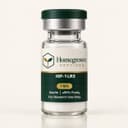 IGF-1 LR3In your order
IGF-1 LR3 is an 83-residue recombinant analog of insulin-like growth factor 1, carrying an arginine substitution at position 3 and a 13-residue N-terminal extension that reduces binding to IGF-binding proteins. Published pharmacology research in large-animal models examines how these modifications change the molecule's circulating behavior and glucose-lowering potency relative to native IGF-1.
IGF-1 LR3 is a modified insulin-like growth factor 1 with a 13-amino-acid extension and an arginine substitution at position 3. The modifications reduce binding to IGF-binding proteins, which extends its active half-life in research models.
Common research applications include:
- Cell proliferation and growth-factor research
- Muscle-cell culture studies
- IGF signaling pathway research
Specifications
- Class: Long-arginine-3 IGF-1 analog
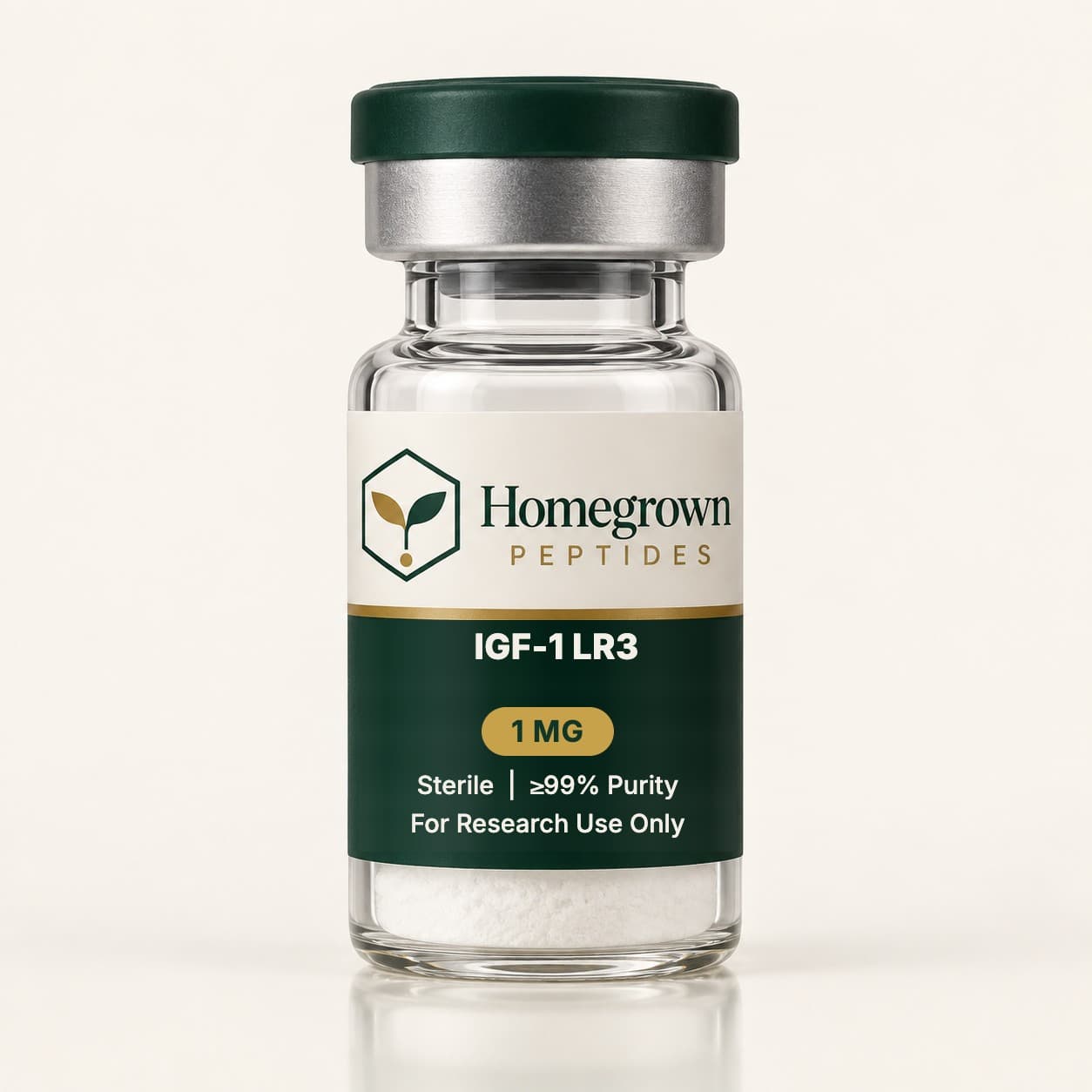
- Form: lyophilized powder in a sealed glass vial
- Available sizes: 1 mg
- Purity: verified at 99% or higher by HPLC, identity confirmed by mass spectrometry
- Testing: every lot is third-party tested, with a lot-matched Certificate of Analysis available on request
- supplied by a U.S. lab
- Storage: keep sealed, cool, dry and away from light; refrigerate after reconstitution
For laboratory research use only. This product is not for human or veterinary use, is not a drug, food or cosmetic, and is not intended to diagnose, treat, cure or prevent any disease.
What the Literature Studies
Tomas and colleagues compared IGF-1 and several low-IGFBP-affinity variants, including long-R3-IGF-I, in pigs and marmoset monkeys in a 1997 paper in the Journal of Endocrinology. Plasma glucose fell in a graded manner after administration in both species, with the pig model more sensitive than the marmoset. Across both models, the IGFBP-resistant variants were consistently two- to three-fold more potent than native IGF-1 at lowering plasma glucose, and the effect lasted four- to eight-fold longer, which the authors attribute to reduced sequestration by IGF-binding proteins leaving more free peptide able to engage the IGF-1 receptor. The paper notes this differential potency could not be explained by changes in circulating insulin or IGF-1 binding protein levels alone, pointing to a direct receptor-level mechanism.
Specification and Handling
This lot is an 83-residue recombinant analog with Arg substituted for Glu at position 3 and a 13-residue N-terminal extension, reducing IGF-binding protein affinity relative to native IGF-1; the full sequence is listed on the COA. Molecular formula is C400H625N111O115S9 with a molecular weight of 9117.60. CAS number is 946870-92-4. Supplied as a lyophilized powder, purity verified at 99% or greater by HPLC with the certificate of analysis for the lot available on request. The powder is soluble in bacteriostatic water. Sealed vials are stored at -20°C protected from light and moisture; reconstituted material is kept refrigerated and handled per standard laboratory procedure for this protein class.
Buying Notes
IGF-1 LR3 is supplied in a single 1 mg lyophilized vial, reflecting the higher cost of producing this larger 83-residue recombinant protein compared to shorter synthetic peptides elsewhere in this catalog. The certificate of analysis verifies both purity and the 9117.60 theoretical mass by mass spectrometry, distinguishing this long-R3 variant from related des(1-3) or standard IGF-1 analogs also discussed in the literature. See /learn/igf-1-lr3 for handling detail specific to this protein and this particular lot, and /blog/igf-1-lr3-vs-igf-1-vs-des-1-3-igf-1 for how the binding-protein affinity differences across these analogs are characterized in published research.
Certificate of Analysis & Safety Data
Frequently Asked Questions
What does the LR3 modification change compared to native IGF-1?
LR3 adds an arginine at position 3 and a 13-residue extension at the N-terminus, which together lower the molecule's affinity for IGF-binding proteins. The 1997 Tomas paper reports this leaves more free peptide available in circulation in the pig and marmoset models tested.
Why is IGF-1 LR3 studied in pig and marmoset models?
Both species were used in the 1997 Journal of Endocrinology paper to compare the potency and duration of glucose-lowering activity between IGF-1 and its low-IGFBP-affinity variants. The pig model showed greater sensitivity than the marmoset in that study.
How does IGF-1 LR3 differ from des(1-3) IGF-1, another analog referenced in the literature on this site?
Both are IGFBP-affinity-reduced variants, but they carry different structural modifications; the comparison guide on this site details how each performed in the same pig and marmoset experiments. The COA sequence data for this lot confirm which variant is in the vial.
What does the certificate of analysis verify for this 83-residue protein?
The COA reports HPLC purity at 99% or greater and a mass spectrometry match to the theoretical mass of 9117.60. For a protein this size, mass spectrometry confirmation is a more sensitive identity check than for short peptides.
Why does this product only come in a 1 mg size?
Recombinant 83-residue proteins are substantially more complex and costly to produce at verified purity than short synthetic peptides. That is reflected in the single available fill size for this catalog listing.
Is IGF-1 LR3 third-party tested?
Yes. Every lot is tested for identity and purity at the source lab by HPLC and mass spectrometry against a ≥99% purity specification. A certificate of analysis for your lot is available on request.
Can I see the Certificate of Analysis before buying?
Yes. Ask us before you order and we will send the certificate of analysis for the current lot, documenting identity, purity, and analytical results.
What does 'Research Use Only' mean?
This product is supplied strictly for laboratory and research use only (RUO). It is not a drug, food, supplement, or cosmetic, is not approved by the FDA, and is not intended to diagnose, treat, cure, or prevent any disease, or for human or veterinary consumption.
How is it shipped and stored?
Orders ship within 1 business day from our U.S. facility with tracking. Store the lyophilized material at −20°C, protected from light and moisture.
Learn more about IGF-1 LR3
From the research blog
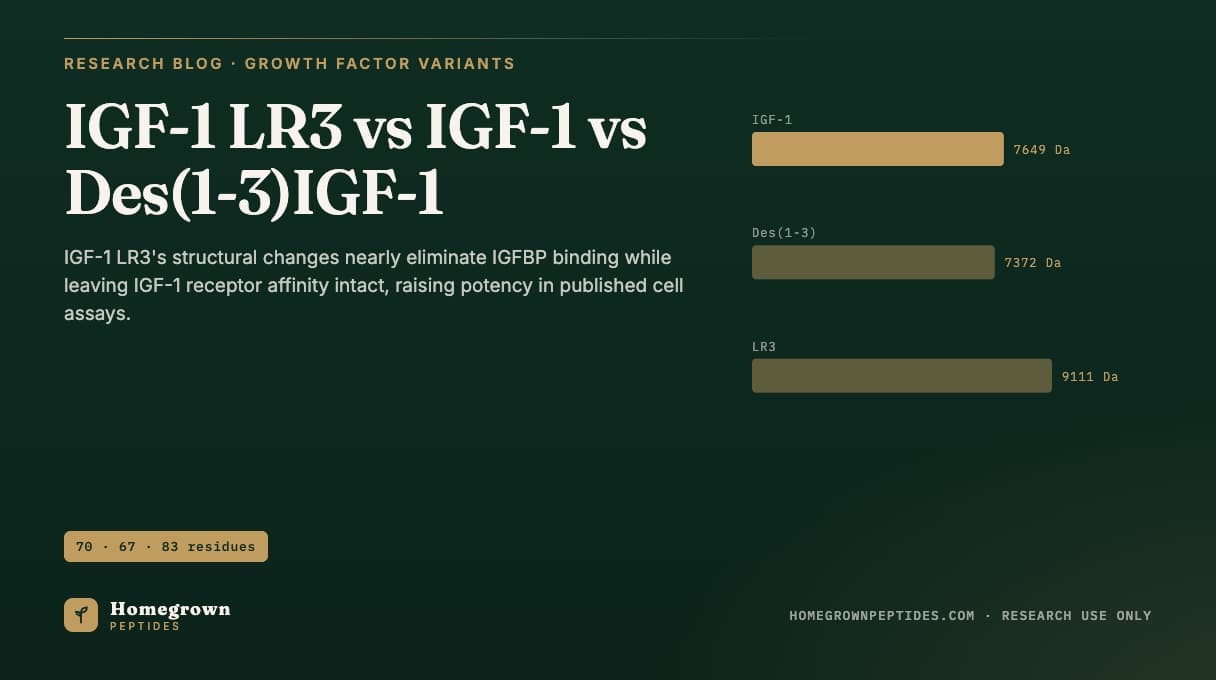
IGF-1 LR3 vs IGF-1 vs Des(1-3)IGF-1: Binding-Protein Affinity and Potency in the Cell Assays
IGF-1 LR3's structural changes nearly eliminate IGFBP binding while leaving IGF-1 receptor affinity intact, raising potency in published cell assays.
Read the article →
What Is IGF-1 LR3? The Long-R3 Analog and Binding-Protein Affinity
IGF-1 LR3 is a recombinant IGF-1 analog with an Arg3 substitution and an N-terminal extension that reduces its affinity for IGF-binding proteins.
Read the article →