BPC-157
Third-Party Tested · Certificate on File- Lot-matched certificate of analysis, identity and purity by HPLC and mass spec
- Ships within 1 business day from the U.S., tracked, in protective packaging
- Research use only. Not for human or animal use
- Ships within 1 business day, tracked, protective packaging
- 2-Day $12.99, free at $1,000 and over
- Overnight $250
- Certificate of analysis available on request
- ≥99% purity specification, HPLC & mass-spec verified at source
- Ships from a U.S. facility within 1 business day
- Secure card checkout on our payment partner's page, 20% already in the total
Complete your setup
Lyophilized peptides need bacteriostatic water and sterile lab supplies to reconstitute. Add the essentials in one click.
 BPC-157In your order
BPC-157 is a synthetic 15-residue pentadecapeptide derived from a partial sequence of human gastric juice protein, supplied as a lyophilized powder. A 2021 review in Frontiers in Pharmacology examines published rat-model research on how this stable peptide affects tissue repair processes across skin, gastrointestinal, and vascular wound models studied by the same research group.
BPC-157 is a 15-amino-acid peptide sequence originally identified in gastric juice. It is one of the most widely studied research peptides in tissue-repair models, with work spanning tendon, ligament, muscle and gut tissue.
Common research applications include:
- Tendon and ligament repair models
- Gastrointestinal protection research
- Angiogenesis and growth-factor signaling
Specifications
- Class: Gastric pentadecapeptide
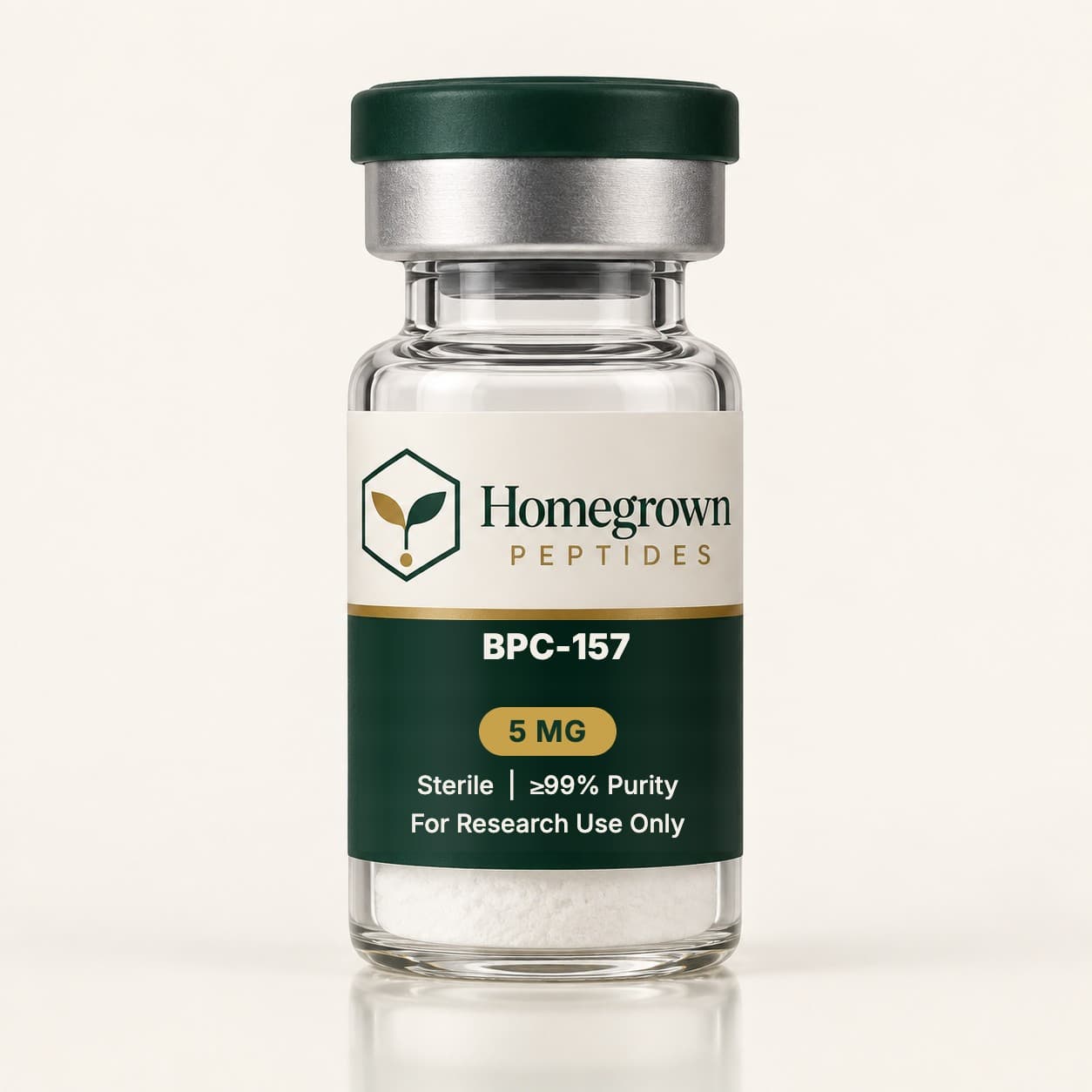
- Form: lyophilized powder in a sealed glass vial
- Available sizes: 5 MG, 10 MG
- Purity: verified at 99% or higher by HPLC, identity confirmed by mass spectrometry
- Testing: every lot is third-party tested, with a lot-matched Certificate of Analysis available on request
- supplied by a U.S. lab
- Storage: keep sealed, cool, dry and away from light; refrigerate after reconstitution
For laboratory research use only. This product is not for human or veterinary use, is not a drug, food or cosmetic, and is not intended to diagnose, treat, cure or prevent any disease.
What the Literature Studies
Seiwerth and colleagues reviewed BPC-157 research in a 2021 paper in Frontiers in Pharmacology, focused on rat models of cutaneous, gastrocutaneous, esophagocutaneous, and related wound models. The review reports that BPC-157 was studied across incisional, excisional, deep burn, and alkali burn wound models in rats using consistent administration routes and comparable outcomes regardless of which tissue was tested. Proposed mechanisms described in the review include resolution of vessel constriction, stabilization of the primary platelet plug and fibrin mesh, and resolution of the clot, processes the authors tie to the peptide's reported activity counteracting bleeding disorders from amputation or anticoagulant use in the same rat models. The review also notes BPC-157 rapidly changed gene expression in rat excisional skin wounds, which the authors propose extends to tendon, ligament, muscle, bone, nerve, and corneal repair models studied elsewhere in the broader literature.
Specification and Handling
This lot is a 15-residue peptide with the sequence Gly-Glu-Pro-Pro-Pro-Gly-Lys-Pro-Ala-Asp-Asp-Ala-Gly-Leu-Val, molecular formula C62H98N16O22, and molecular weight 1419.55. CAS number is 137525-51-0. Supplied as a lyophilized powder, purity verified at 99% or greater by HPLC, identity confirmed by mass spectrometry, with the certificate of analysis for the lot available on request. The peptide is soluble in bacteriostatic water; consult the COA for solvent specifics for this lot. Sealed vials are stored at -20°C, protected from light and moisture, and reconstituted solution is refrigerated at 2-8°C, split into single-use aliquots where practical to limit repeated freeze-thaw cycles.
Buying Notes
BPC-157 is available in 5 mg, 10 mg, and 15 mg lyophilized vials, giving researchers a choice of total peptide quantity per vial for different experiment scales and lab budgets. The certificate of analysis for each lot reports HPLC purity and a mass spectrometry match to the 1419.55 theoretical mass, confirming the pentadecapeptide sequence for that specific lot and batch. Researchers studying tissue-repair peptide combinations should see /learn/bpc-157 for handling detail on this specific lot, and /blog/why-labs-pair-bpc-157-and-tb-500 for how this peptide is discussed alongside TB-500 in the published research literature.
Certificate of Analysis & Safety Data
Frequently Asked Questions
What is the origin of the BPC-157 sequence?
BPC-157 is a synthetic pentadecapeptide based on a partial sequence derived from human gastric juice protein. The catalog spec lists the full 15-residue sequence and its CAS number, 137525-51-0.
What rat wound models does the 2021 review cover?
Seiwerth and colleagues reviewed incisional, excisional, deep burn, and alkali burn skin wound models in rats, along with gastrocutaneous and esophagocutaneous models. The paper appeared in Frontiers in Pharmacology in 2021.
What mechanisms does the review propose for BPC-157's effects in these models?
The review describes resolution of vessel constriction, stabilization of the platelet plug and fibrin mesh, and clot resolution as proposed mechanisms in the rat models studied. It also reports rapid gene expression changes in excisional skin wounds.
Why is BPC-157 often discussed alongside TB-500 in the literature?
Both peptides are studied in overlapping tissue-repair research areas, which is why they appear together in several published comparisons and in this catalog's combination products. The linked guide covers how the two are differentiated in that literature.
What does the certificate of analysis confirm for a BPC-157 lot?
It reports HPLC purity at 99% or greater and a mass spectrometry match to the 1419.55 theoretical mass for the C62H98N16O22 formula. This confirms peptide identity and purity for the specific lot.
Is BPC-157 third-party tested?
Yes. Every lot is tested for identity and purity at the source lab by HPLC and mass spectrometry against a ≥99% purity specification. A certificate of analysis for your lot is available on request.
Can I see the Certificate of Analysis before buying?
Yes. Ask us before you order and we will send the certificate of analysis for the current lot, documenting identity, purity, and analytical results.
What does 'Research Use Only' mean?
This product is supplied strictly for laboratory and research use only (RUO). It is not a drug, food, supplement, or cosmetic, is not approved by the FDA, and is not intended to diagnose, treat, cure, or prevent any disease, or for human or veterinary consumption.
How is it shipped and stored?
Orders ship within 1 business day from our U.S. facility with tracking. Store the lyophilized material at −20°C, protected from light and moisture.
Learn more about BPC-157
From the research blog
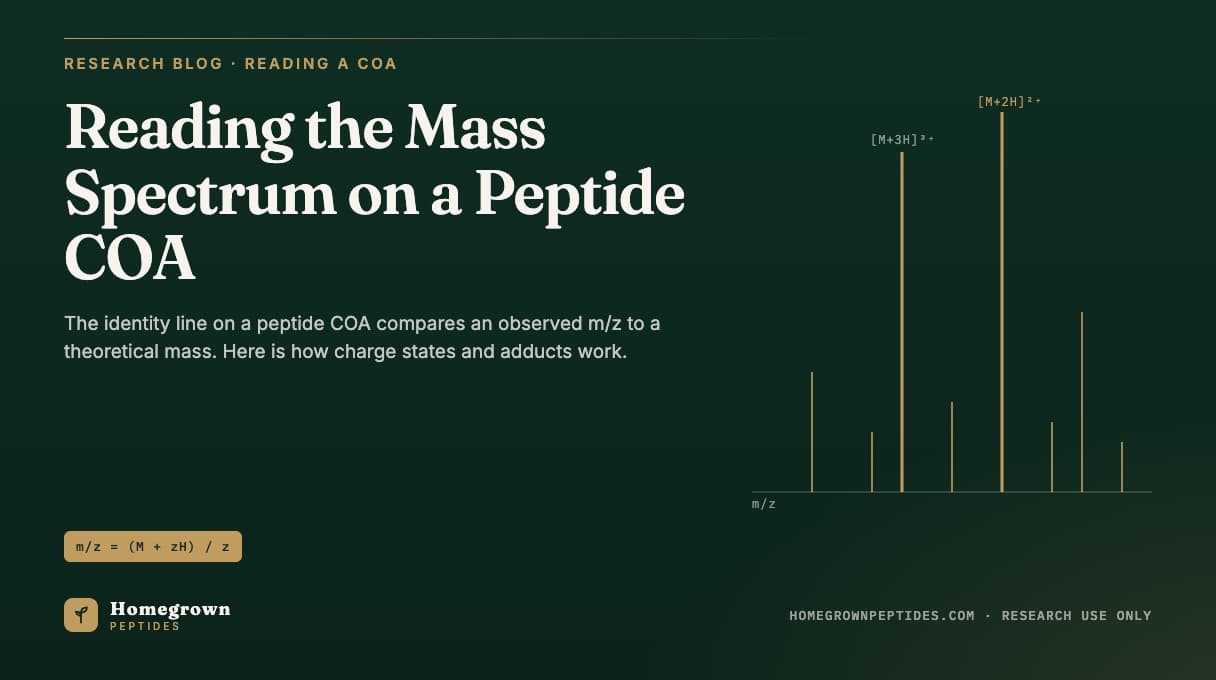
Reading the Mass Spectrum on a Peptide COA: Observed vs Theoretical Mass, Charge States, Adducts and Tolerances
The identity line on a peptide COA compares an observed m/z to a theoretical mass. Here is how charge states and adducts work.
Read the article →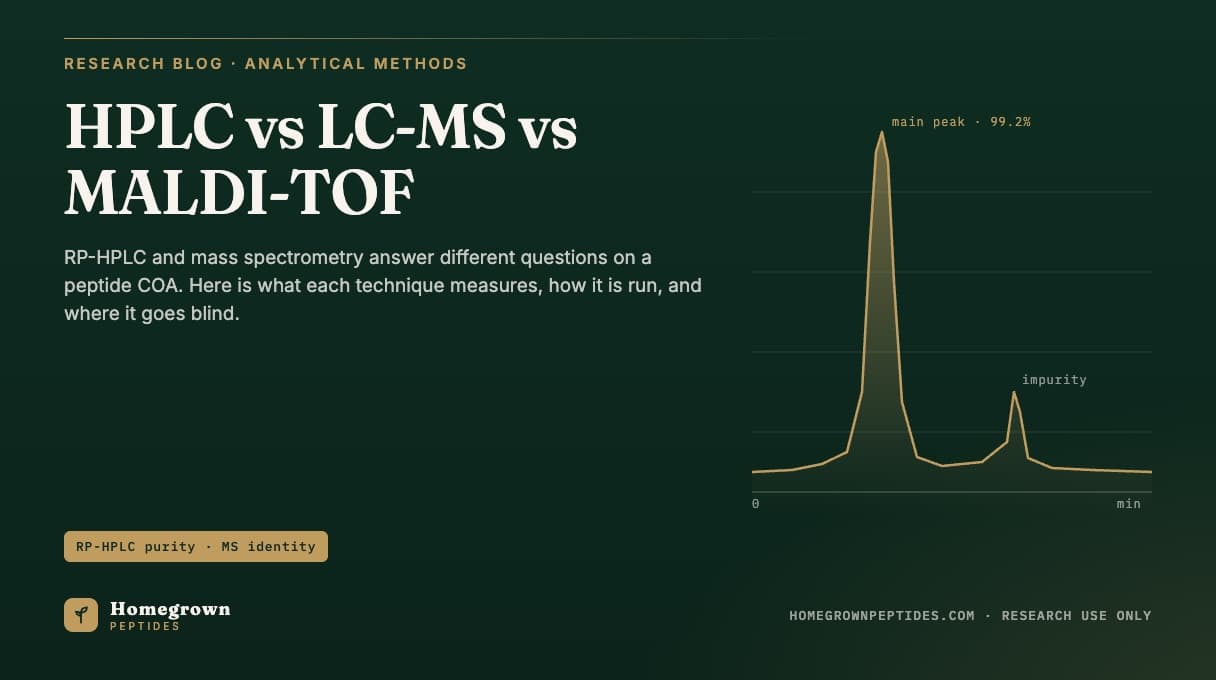
HPLC vs LC-MS vs MALDI-TOF: How Peptide Purity and Identity Are Verified on a Certificate of Analysis
RP-HPLC and mass spectrometry answer different questions on a peptide COA. Here is what each technique measures, how it is run, and where it goes blind.
Read the article →
TFA vs Acetate Salt Forms of Research Peptides: Why Counterions Matter
Peptides elute from HPLC as trifluoroacetate salts by default. This covers counterion chemistry, net peptide content, cell culture findings, and salt exchange.
Read the article →