Published research on this pathway almost never tests the vial contents sold as TB-500 directly. The actual data set comes from thymosin beta-4 (Tβ4), the 43-residue protein TB-500 is a synthetic fragment of: mouse models of cardiac and dermal repair, a cell-based corneal wound model, and a small number of human ophthalmic trials. Amounts, routes and the adverse events recorded in those human programs are reported below exactly as the source papers state them.
| Fact | Reported value | Source |
|---|---|---|
| Parent protein studied in the literature | Thymosin beta-4, a 43-amino-acid actin-sequestering protein | Bock-Marquette et al., 2004 (PubMed 15565145) |
| What a TB-500 research vial contains | A synthetic actin-binding fragment of thymosin beta-4, not the full 43-residue protein used in the trials below | See thymosin-beta-4-vs-tb-500 |
| Earliest cardiac repair model reporting a dose | Mouse myocardial infarction model, intraperitoneal administration | Bock-Marquette et al., 2004 (PubMed 15565145) |
| Epicardial progenitor mobilization model | Adult mouse, pre-treatment before coronary ligation | Smart et al., 2007 (PubMed 17108969) |
| Dermal wound closure model | db/db diabetic mouse, topical and local administration | Malinda et al., 1999 (PubMed 10469335) |
| Human program with published adverse-event language | Ophthalmic dry-eye study population | Sosne, 2016 (PubMed 27450739) |
Is TB-500 the same molecule tested in the thymosin beta-4 literature?
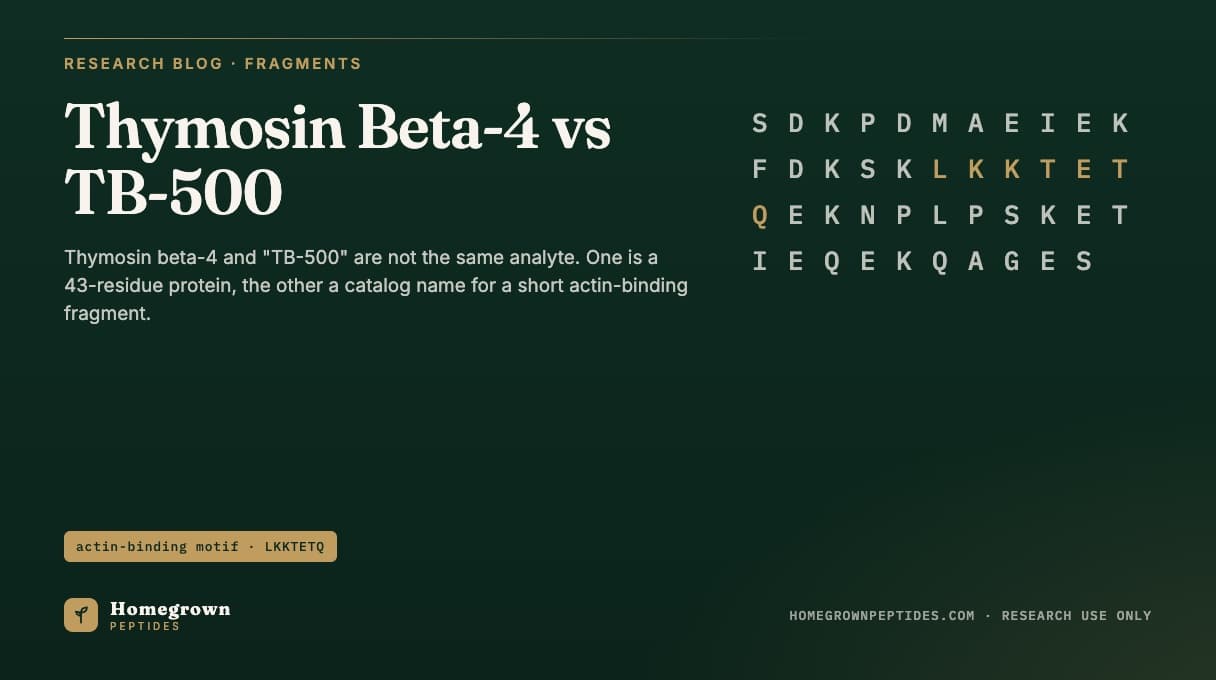
No. TB-500 is a shorthand name used in the research-chemical market for a short synthetic peptide built around the actin-binding region of thymosin beta-4, commonly described as residues 17 through 23 of the parent protein. The papers cited throughout this article, including the foundational cardiac and dermal work, used the native 43-residue thymosin beta-4 protein itself, produced recombinantly or synthesized in full. A separate article, Thymosin Beta-4 vs TB-500, breaks down the sequence difference in full. The distinction matters for reading any amount or outcome below: a reported finding for the 43-residue protein is not automatically a finding for the fragment, and no published trial has tested the fragment itself in humans under that name.
What amounts and routes have been reported in the thymosin beta-4 animal literature?
Rodent studies on thymosin beta-4 span cardiac, dermal and ocular repair models, each with its own administration route and study design. The table below reports the amount and route exactly as each source describes it, alongside the model, the endpoint measured and the finding.
| Study | Model and n | Amount and route (as reported) | Endpoint | Finding |
|---|---|---|---|---|
| Bock-Marquette et al., 2004 (PubMed 15565145) | Adult mouse, coronary artery ligation model, multiple treated and control cohorts | Recombinant thymosin beta-4, systemic (intraperitoneal) administration starting at the time of coronary ligation and continuing across the early post-infarction window | Integrin-linked kinase activation, cardiomyocyte survival markers, echocardiographic function | Treated hearts showed increased cardiomyocyte survival signaling and improved measures of cardiac function compared with vehicle-treated controls |
| Smart et al., 2007 (PubMed 17108969) | Adult mouse, epicardial progenitor cell model, pre-treatment design before coronary ligation | Thymosin beta-4, systemic administration given in advance of the ischemic injury rather than after it | Epicardial progenitor cell mobilization, new vessel formation (neovascularization) in the infarct region | Pre-treatment mobilized epicardial-derived progenitor cells and increased new vessel density in the injured region, an effect not seen when the same agent was given only after injury |
| Malinda et al., 1999 (PubMed 10469335) | db/db diabetic mouse, full-thickness dermal wound model | Thymosin beta-4 solution, applied locally to the wound bed across the observation window | Wound closure rate, keratinocyte and fibroblast migration into the wound | Treated wounds closed faster than vehicle-treated wounds, with increased cell migration into the wound bed |
| Sosne et al., 2002 (PubMed 11950239) | Mouse, alkali-injury corneal wound model | Thymosin beta-4, applied topically to the ocular surface after the chemical injury | Corneal epithelial wound closure, inflammatory cell infiltration into the cornea | Treated corneas closed epithelial defects faster and showed reduced inflammatory cell infiltration compared with untreated controls |
| Sosne, 2016, narrative review (PubMed 27450739) | Human, dry-eye and ocular-surface disease population, narrative review of a controlled ophthalmic study program | Ophthalmic thymosin beta-4 solution, topical instillation to the eye across the review's study window | Dry-eye sign and symptom scores, corneal fluorescein staining, tolerability | The review describes improvement in dry-eye signs and symptoms against the comparator arm, with the adverse-event pattern summarized in the section below |
| Pipes, 2016, narrative review (PubMed 27450736) | Narrative review synthesizing mouse and large-animal cardiac repair models | Not a single-dose primary data set; the chapter synthesizes the systemic administration regimens used in the preclinical studies it reviews | Infarct size, cardiac progenitor activity, vascular density across the reviewed models | Across the reviewed preclinical work, systemic administration around the time of ischemic injury was associated with smaller infarcts and greater progenitor cell activity than vehicle treatment |
Two patterns are consistent across this table. First, every amount is reported against body weight or as a topical concentration, never as a fixed human quantity. Second, timing relative to injury (before versus after) changed the outcome in the epicardial progenitor model, which is a study-design detail that gets lost whenever the finding is summarized as a single headline claim.
What adverse events were reported in the thymosin beta-4 human trials?
Completed human work on thymosin beta-4 is narrower than the preclinical base, concentrated in ophthalmic programs studying topical application for dry eye and related ocular-surface conditions, with earlier-phase cardiac safety work described in review form rather than as a large completed outcomes trial. The adverse-event language below is reported in neutral clinical terms as the source summaries present it.
- Ocular program (dry eye and ocular-surface disease). The published review of this program describes a tolerability profile consistent with a topical ophthalmic solution: instillation-site discomfort and transient visual blurring were the events most frequently recorded, occurring at rates the review characterizes as comparable between the active and comparator arms. No treatment-related serious adverse event is described in the review summary.
- Cardiac program. The cardiac-repair literature on thymosin beta-4 is overwhelmingly preclinical (mouse and large-animal infarction models). Where review chapters describe early human safety assessment in a cardiac-injury population, the adverse events recorded track the expected clinical course of acute cardiac injury itself rather than a distinct pattern attributable to the study agent; the reviews do not report a therapeutic cardiac outcome in humans, only safety observations layered onto the preclinical mechanism. Readers should treat the cardiac program as substantially earlier-stage than the ocular program and confirm any specific adverse-event rate against the primary trial record before citing a number.
- Dermal and corneal animal models. The rodent studies in the table above report local tissue response (wound bed appearance, inflammatory cell counts) rather than a formal adverse-event list, because animal efficacy studies are not structured to capture tolerability the way a human trial is.
How is thymosin beta-4 research material handled in a lab setting?
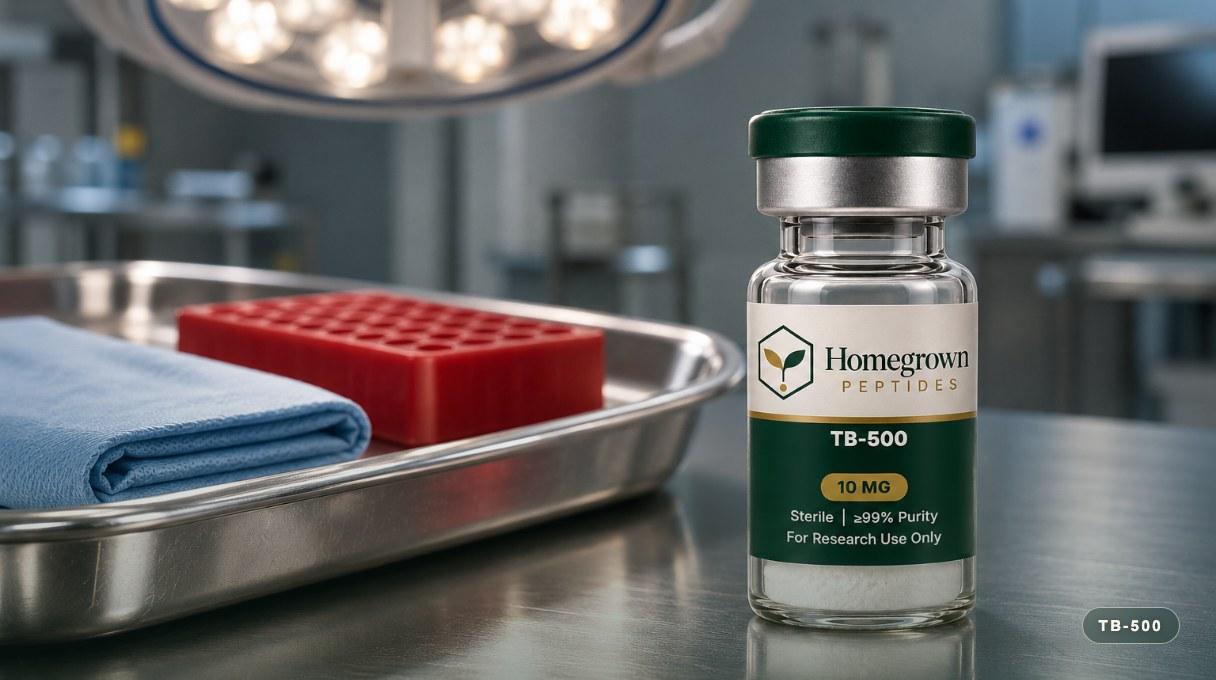
Thymosin beta-4 and the TB-500 fragment both ship as lyophilized powder and are reconstituted with a diluent before use on the bench, the same handling framework used across the peptide catalog. The math for getting a usable concentration from a lyophilized vial is covered step by step in Reconstituting Lyophilized Peptides, and the certificate that should accompany a research-grade vial, including the identity and purity data a buyer should check before using any lot, is covered in How to Read a Peptide Certificate of Analysis. A research-grade TB-500 fragment is available at /products/tb-500 for laboratory use.
What does the actin-binding mechanism tell researchers about where TB-500 and thymosin beta-4 diverge?
The appeal of citing thymosin beta-4 data for a TB-500 vial rests on the fragment carrying the same actin-binding sequence the full protein uses to sequester monomeric actin and influence cell migration. That shared sequence is a reasonable basis for a mechanistic hypothesis. It is not evidence that the fragment reproduces the in vivo findings above, because the full protein also carries additional domains, is subject to different stability and clearance kinetics, and has only ever been the test article in the studies cited here. Any claim that attributes a specific trial finding directly to TB-500 rather than to thymosin beta-4 is going beyond what the cited literature actually measured.
Frequently asked questions
Does any published human trial use the name TB-500?
No. Every human study referenced in the thymosin beta-4 literature, including the ophthalmic dry-eye program, studied the 43-residue protein, not the shorthand fragment sold under the TB-500 name.
What is the actin-binding sequence TB-500 is built around?
TB-500 is typically described as a synthetic peptide spanning the actin-binding domain near the center of the thymosin beta-4 sequence, the same region implicated in the cell-migration findings in the animal studies above. The full comparison is in Thymosin Beta-4 vs TB-500.
Which species have been used in the published cardiac repair work?
The cardiac mechanism papers cited here, Bock-Marquette and colleagues and Smart and colleagues, both used adult mouse coronary-ligation models. Review chapters describing the field also reference large-animal preclinical work, but mouse remains the primary species in the original mechanism papers.
Were the ophthalmic trial adverse events considered serious?
The published review summary of the program describes instillation-site discomfort and transient blurred vision as the most frequently recorded events, with no treatment-related serious adverse event described. Readers should treat this as a summary-level description rather than a line-by-line trial report.
Why does timing of administration matter in the epicardial progenitor study?
Smart and colleagues found that giving thymosin beta-4 before the ischemic injury mobilized epicardial progenitor cells and increased new vessel formation, an effect that was not reproduced when the same material was given only after the injury. That timing dependency is a specific finding of that model and should not be generalized to every administration route or compound.
Do the dermal wound studies report a fixed amount that applies to every wound model?
No. Malinda and colleagues used a diabetic mouse wound model with local, topical application across the observation window, and the reported amount is tied to that specific model and species. Other wound models in the broader literature use different concentrations and schedules, which is why amounts are reported per study rather than as a single figure.
Is there a blended research product that pairs TB-500 with another peptide?
Yes. Labs studying tissue-repair pathways alongside gastric pentadecapeptide research sometimes pair the two fragments in one vial; the rationale and the published pathways each compound is studied in are covered in Why Labs Pair BPC-157 and TB-500.
References
- Bock-Marquette I, Saxena A, White MD, DiMaio JM, Srivastava D. Thymosin beta4 activates integrin-linked kinase and promotes cardiac cell migration, survival and cardiac repair. Nature. 2004;432(7016):466-472. PubMed 15565145.
- Smart N, Risebro CA, Melville AA, et al. Thymosin beta-4 induces adult epicardial progenitor mobilization and neovascularization. Nature. 2007;445(7124):177-182. PubMed 17108969.
- Malinda KM, Sidhu GS, Mani H, et al. Thymosin beta4 accelerates wound healing. J Invest Dermatol. 1999;113(3):364-368. PubMed 10469335.
- Sosne G, Szliter EA, Barrett R, Kernacki KA, Kleinman H, Hazlett LD. Thymosin beta 4 promotes corneal wound healing and decreases inflammation in vivo following alkali injury. Exp Eye Res. 2002;74(2):293-299. PubMed 11950239.
- Sosne G. Thymosin beta 4: a potential novel therapy for neurotrophic keratopathy, dry eye, and ocular surface diseases. Vitam Horm. 2016;102:277-306. PubMed 27450739.
- Pipes GT, Yang J. Cardioprotection by thymosin beta 4. Vitam Horm. 2016;102:209-226. PubMed 27450736.
- Marks ED, Lin ZY, Zhang Z, Kim CW. Thymosin beta 4: roles in development, repair, and engineering of the cardiovascular system. Vitam Horm. 2016;102:227-252. PubMed 27450737.
- Kleinman HK, Sosne G. Thymosin beta 4 promotes dermal healing. Vitam Horm. 2016;102:251-275. PubMed 27450738.
Research use only. Homegrown Peptides products are for laboratory research and are not for human or animal use. Nothing in this article is medical advice.