
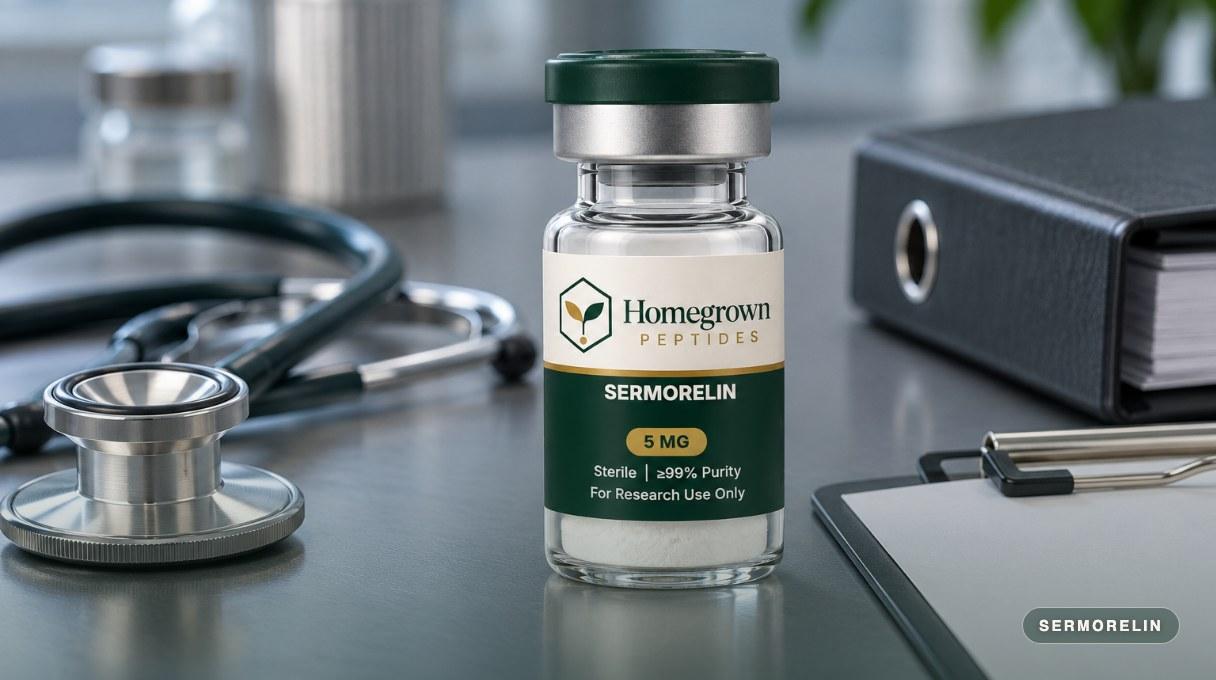
Published sermorelin (GHRH 1-29) trials most frequently recorded injection-site reactions, transient facial flushing, and headache among their adverse events, alongside routine monitoring of glucose tolerance and pituitary hormone panels. These are the events the trial papers themselves report, not a list of effects a reader should expect; the detail below describes what was monitored and found in the published record.
| Key fact | Detail | Source |
|---|---|---|
| Administration route studied | Subcutaneous injection in the trials discussed below, which is the route associated with injection-site findings in this literature | Walker, 2006 (PubMed PMID 18046908) |
| Most commonly recorded local finding | Mild, transient injection-site reactions at the subcutaneous administration site | Walker, 2006 (PubMed PMID 18046908) |
| Most commonly recorded systemic finding | Transient facial flushing and headache, consistent with the vasodilatory and central effects reported for GHRH-receptor activation | Corpas, Harman and Blackman, 1993 (PubMed PMID 8491152) |
| Routine safety monitoring used | Fasting glucose, pituitary hormone panels, and periodic clinical review during the multi-week older-adult trials | Corpas, Harman and Blackman, 1993 (PubMed PMID 8491152) |
| Overall tolerability characterization | Described in the secondary literature as generally favorable relative to direct growth hormone administration, because the pituitary retains feedback control over the amount of GH it ultimately releases | Walker, 2006 (PubMed PMID 18046908) |
What adverse events have sermorelin trials recorded?
The adverse-event record for GHRH(1-29) trials clusters into two categories. Local events are tied to the subcutaneous injection itself: mild erythema, induration, or discomfort at the injection site, typically self-limited within the trial observation window. Systemic events are tied to the hormone's pharmacology: transient facial flushing shortly after administration, and headache, both reported in a minority of participants across the controlled trials this literature discusses. Neither category was reported as severe or study-limiting in the trials summarized here.
Because GHRH(1-29) works by stimulating the patient's own pituitary rather than supplying growth hormone directly, the adverse-event profile researchers watched for differs from what direct GH-administration trials monitor. The feedback loop between GHRH, GH, and somatostatin limits how much the pituitary will release regardless of how much GHRH(1-29) is given, which is part of why the tolerability record for this class is described as more favorable than direct GH replacement in the secondary literature.
What was reported in the published trials?
| Event category | What trial papers recorded | Frequency as characterized in the literature | Source |
|---|---|---|---|
| Injection-site reactions | Mild erythema, induration, or local discomfort at the subcutaneous administration site | Reported as common but mild and self-limited across the subcutaneous-administration trials discussed in the secondary literature | Walker, 2006 (PMID 18046908) |
| Facial flushing | Transient warmth or flushing shortly after administration | Reported in a minority of participants, consistent with GHRH-receptor-linked vasodilatory activity | Corpas, Harman and Blackman, 1993 (PMID 8491152) |
| Headache | Transient headache reported during or shortly after the administration window | Reported in a minority of participants in the older-adult trials this review synthesizes | Corpas, Harman and Blackman, 1993 (PMID 8491152) |
| Glucose tolerance changes | Fasting glucose tracked as a routine safety parameter given GH's known counter-regulatory effect on insulin sensitivity | Monitored but not reported as a limiting finding in the trials this review summarizes | Corpas, Harman and Blackman, 1993 (PMID 8491152) |
| General tolerability over the study period | No study-limiting events reported across the multi-week older-adult administration trials summarized in this review | Characterized as well tolerated across the trial population | Corpas, Harman and Blackman, 1993 (PMID 8491152) |
| Tolerability in a primary elderly-trial report | Corpas et al., 1992, twice-daily subcutaneous GHRH(1-29) in older men | No study-limiting events reported in this primary trial over its multi-week administration period | Corpas et al., 1992 |
| Tolerability with single nightly injections | Vittone et al., 1997, single nightly subcutaneous GHRH(1-29) in healthy elderly men | No study-limiting events reported with this once-nightly regimen | Vittone et al., 1997 |
| Tolerability over long-term administration | Khorram et al., 1997, long-term subcutaneous GHRH(1-29)-NH2 in age-advanced men and women, with immune-function markers specifically tracked | Immune and endocrine markers shifted over the long-term administration period without a reported study-limiting event | Khorram et al., 1997 |
| Safety record in a pediatric multicenter trial | Thorner et al., 1996 (Geref International Study Group), once-daily subcutaneous GHRH(1-29) in children with growth hormone deficiency | Safety record described as consistent with the adult tolerability findings over the first year of therapy | Thorner et al., 1996 |
Why do these specific events occur?
Each event in the published record has a plausible mechanistic explanation tied to GHRH(1-29)'s own pharmacology rather than to an off-target action. Injection-site findings are a mechanical and immunological response to the subcutaneous delivery itself, the same category of local reaction seen with many injected peptides regardless of their specific receptor target, and are not unique to GHRH(1-29). Facial flushing is consistent with GHRH-receptor-linked vasodilatory signaling, a secondary pharmacologic action described in Frohman and Jansson's 1986 review of GHRH pharmacology and observed with other GHRH-pathway compounds, and is generally short-lived, resolving within the same administration window in the trials that reported it. The earliest human exposure data, from Thorner and colleagues' 1985 case series in two children, and from Evans and colleagues' 1985 comparison of intravenous, subcutaneous and intranasal GHRH(1-29) in healthy men, did not describe a distinct adverse-event signal beyond what later, larger trials would go on to characterize as injection-site and flushing findings. Headache is less mechanistically specific; the trial papers summarized here do not attribute it to a single pathway, and it is reported at a similar low frequency to what appears in placebo arms of comparable endocrine pharmacology studies, which is part of why it is characterized as a minor, non-specific finding rather than a hallmark effect of the compound.
None of the three events, injection-site reactions, flushing, or headache, were associated in the published trials with a change in trial continuation, meaning no participant was withdrawn from a study specifically because of one of these findings in the papers summarized here.
Did the adverse-event record differ between pediatric and older-adult trials?
The two populations that dominate the GHRH(1-29) literature were monitored with overlapping but not identical plans. Pediatric growth hormone deficiency trials prioritized growth velocity and bone age as primary outcomes, with local injection-site findings and general tolerability tracked as secondary safety data over study periods measured in months. Older-adult trials prioritized the hormonal and metabolic panels, GH pulse amplitude, IGF-1, and fasting glucose, because the central question in that population was whether restoring a more youthful GH pulse pattern carried any added metabolic risk. Across both populations, the published record does not describe a safety signal unique to either age group beyond the injection-site, flushing, and headache findings already summarized here.
What did researchers monitor for during these trials?
Beyond the events participants actually reported, the published trial designs describe a consistent monitoring plan. Fasting glucose and, where feasible, markers of insulin sensitivity were tracked because growth hormone physiologically opposes insulin action, so a GHRH-driven rise in endogenous GH could in principle move glucose handling even without a change in body weight. Pituitary hormone panels were checked to confirm that GHRH(1-29) administration was not producing unintended shifts in other anterior pituitary hormones. Injection sites were examined at follow-up visits for local reactions. In the pediatric growth hormone deficiency literature, growth parameters and bone age were tracked over the full study period as the primary efficacy endpoints, with adverse-event reporting running in parallel.
This monitoring structure is why the GHRH(1-29) literature reads differently from trials of agents with a narrower safety margin: the endpoints being watched are mostly the same hormonal and metabolic panels used to evaluate efficacy, examined from the safety side rather than the efficacy side.
How were these adverse events actually detected in the trials?
The published GHRH(1-29) trials used standard clinical-trial pharmacovigilance structure rather than anything specific to this compound class. Participants were examined at scheduled visits, with injection sites inspected directly by trial staff rather than relying only on self-report. Spontaneous reporting, where a participant volunteers a symptom between visits, was the mechanism for picking up transient events like flushing or headache that might not be present at a scheduled check. Laboratory panels, drawn at fixed intervals rather than only at the study's end, were what allowed the glucose and pituitary hormone findings to be tied to a specific point in the administration schedule rather than discovered only in a final summary measurement. This structure, scheduled physical review plus spontaneous reporting plus interval labs, is the same basic design used across most endocrine pharmacology trials, and it is why the adverse-event tables in this literature read as short, specific lists rather than long, vague ones.
A limitation worth naming directly: several of the adverse-event figures referenced in the secondary literature synthesized here are reported in aggregate across multiple older-adult trials rather than broken out trial by trial, which is a function of how a review article consolidates its source material rather than a feature of any single study's original design.
How does the GHRH(1-29) adverse-event record compare with other GH-axis peptides?
Growth Hormone Secretagogues in Research places sermorelin's adverse-event profile alongside ipamorelin, CJC-1295, and TH9507, each of which has its own distinct secondary findings in the literature, such as cortisol and prolactin changes reported for some ghrelin-receptor agonists that are not part of the GHRH(1-29) record. Sermorelin vs TH9507 vs CJC-1295 covers the structural differences between these GHRH analogs that influence how long each one's effects, including any local injection-site findings, persist after administration.
How is sermorelin handled in a research setting to avoid confounding adverse-event observations?
Because local injection-site findings can result from reconstitution or handling errors rather than the peptide itself, researchers rule out technique as a variable before attributing any observation to the compound. Reconstituting Lyophilized Peptides: The Math, Step by Step covers the diluent volumes and gentle-mixing steps that keep the reconstituted solution consistent from one preparation to the next. How to Read a Peptide Certificate of Analysis explains how to confirm that a given lot's identity, purity, and endotoxin status match what the certificate reports, which matters because an endotoxin or purity issue in a research material can itself produce a local reaction that has nothing to do with the peptide's own pharmacology. Homegrown's sermorelin listing carries lot-matched documentation for this reason.
Frequently asked questions
What is the most commonly recorded adverse event in sermorelin trials?
Mild, self-limited injection-site reactions at the subcutaneous administration site, followed by transient flushing and headache in a minority of participants.
Were any adverse events in these trials described as serious?
No. The trials summarized in the secondary literature describe the adverse-event record as mild and self-limited, with no study-limiting findings reported.
Why do researchers track glucose during GHRH(1-29) trials?
Because growth hormone physiologically opposes insulin's action, so a sustained rise in endogenous GH is a plausible mechanism for a shift in glucose handling, which is why fasting glucose is a standard safety parameter in this literature.
Does sermorelin's adverse-event record differ from direct growth hormone administration?
The secondary literature describes it as more favorable, attributed to the pituitary retaining feedback control over how much GH it ultimately releases in response to GHRH(1-29), unlike a fixed exogenous GH amount.
Do injection-site reactions reported in these trials relate to peptide purity?
The published trials do not attribute injection-site findings to purity issues, but any research material with an endotoxin or purity problem can independently produce a local reaction, which is why checking a certificate of analysis matters.
Were cardiovascular parameters monitored in these trials?
The older-adult trials summarized here monitored general clinical status and metabolic panels; the published secondary literature does not describe a distinct blood-pressure signal specific to GHRH(1-29) in this population.
How long were participants monitored after administration?
Monitoring windows varied by study design, from single-administration pharmacology sessions assessing acute events to multi-week administration trials with periodic clinical review throughout.
References
- Corpas E, Harman SM, Blackman MR. Human growth hormone and human aging. Endocrine Reviews. 1993;14(1):20-39. PubMed PMID 8491152.
- Walker RF. Sermorelin: a better approach to management of adult-onset growth hormone insufficiency? Clinical Interventions in Aging. 2006;1(4):307-308. PubMed PMID 18046908.
- Guillemin R, Brazeau P, Böhlen P, Esch F, Ling N, Wehrenberg WB. Growth hormone-releasing factor from a human pancreatic tumor that caused acromegaly. Science. 1982;218(4572):585-587. PubMed PMID 6812220.
- Corpas E, Harman SM, Pineyro MA, Roberson R, Blackman MR. Growth hormone (GH)-releasing hormone-(1-29) twice daily reverses the decreased GH and insulin-like growth factor-I levels in old men. Journal of Clinical Endocrinology and Metabolism. 1992;75(2):530-535. PubMed PMID.
- Vittone J, Blackman MR, Busby-Whitehead J, et al. Effects of single nightly injections of growth hormone-releasing hormone (GHRH 1-29) in healthy elderly men. Metabolism. 1997;46(1):89-96. PubMed PMID.
- Khorram O, Vu L, Yen SS. Activation of immune function by [GHRH(1-29)]-NH2 in age-advanced men and women. Journal of Gerontology: Biological Sciences. 1997;52(5):M267-M274. PubMed PMID.
- Thorner MO, Rochiccioli P, Colle M, Lanes R, Grunt J, Galazka A, Thompson MH, Mettler P. Once daily subcutaneous growth hormone-releasing hormone therapy accelerates growth in growth hormone-deficient children during the first year of therapy. Geref International Study Group. Journal of Clinical Endocrinology and Metabolism. 1996;81(3):1189-1196. PubMed PMID.
- Thorner MO, Reschke J, Chitwood J, et al. Acceleration of growth in two children treated with human growth hormone-releasing factor. Lancet. 1985;1(8419):4-6. PubMed PMID.
- Evans WS, Borges JL, Kaiser DL, Vance ML, Sellers RP, MacLeod RM, Vale W, Rivier J, Thorner MO. Effects of intravenous, subcutaneous, and intranasal administration of growth hormone-releasing hormone-(1-29) on serum growth hormone concentrations in normal men. Journal of Clinical Endocrinology and Metabolism. 1985;61(5):846-850. PubMed PMID.
- Frohman LA, Jansson JO. Growth hormone-releasing hormone. Endocrine Reviews. 1986;7(3):223-253. PubMed PMID.
Research use only. Homegrown Peptides products are for laboratory research and are not for human or animal use. Nothing in this article is medical advice.