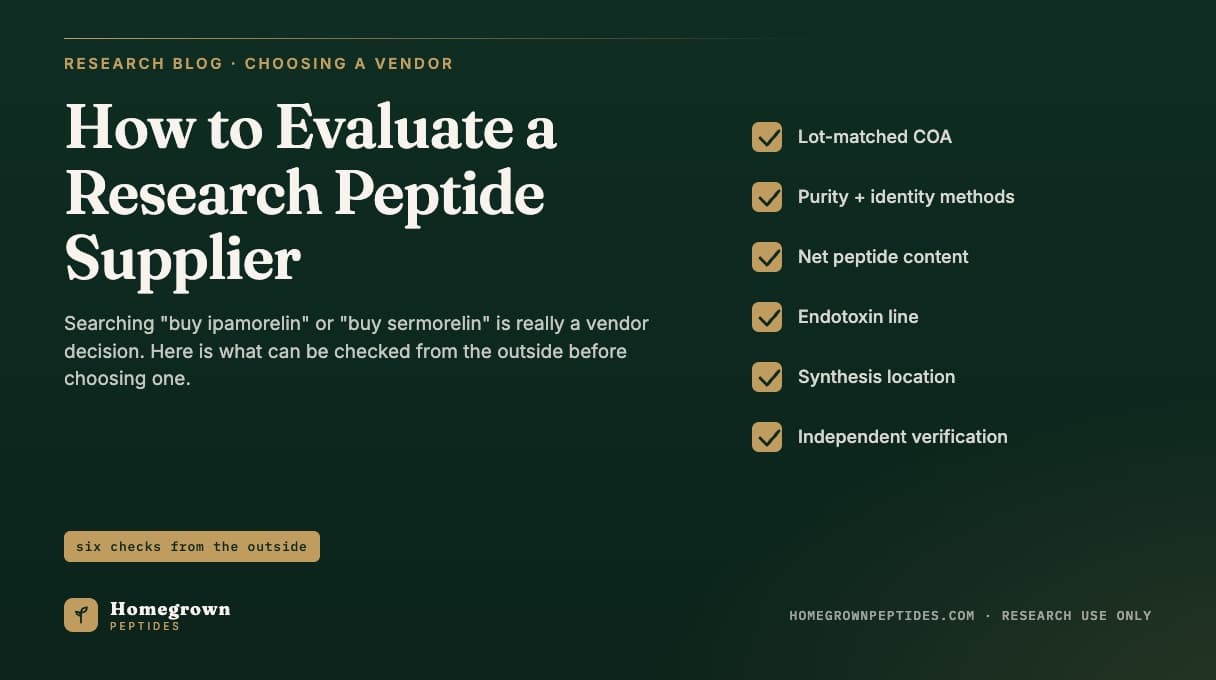
A search like "ipamorelin" or "sermorelin" is rarely a question about the molecule alone; it is a decision about which vendor to trust with a research order. Six things can be checked from the outside before that decision is made: a certificate matched to the specific lot shipped, with a real lot number and test date; both a purity method and an identity method named on that certificate; disclosure of net peptide content or counterion identity, not purity alone; a stated endotoxin result with its method; a synthesis location traced rather than asserted; and a way to verify a given lot independently, through outside testing or a vendor-hosted lookup. A credible supplier makes all six easy to find. A page that only says "third-party tested" without showing any of it is not.
| Item | What to look for | Red flag |
|---|---|---|
| Lot match | Lot number and test date on the certificate match the number printed on the vial label | One generic certificate reused across every order, or no lot number at all |
| Purity method | Reversed-phase HPLC purity stated with column type and detection wavelength, or at least named as RP-HPLC | A purity percentage with no method named anywhere on the document |
| Identity method | Mass spectrometry (typically ESI-MS or MALDI-TOF) confirming molecular weight against the expected sequence | No mass spec data, or a molecular weight with no stated analytical method |
| Net content or counterion | Net peptide content by weight, or at minimum the counterion (acetate or TFA) is named | Purity reported with no mention of counterion or net content, implying 99% purity equals 99% peptide by weight |
| Endotoxin | A bacterial endotoxin result with method (LAL, kinetic turbidimetric, or recombinant Factor C) and a numeric limit | "Endotoxin tested" with no number, method, or units |
| Synthesis origin | A traceable manufacturing location, ideally domestic, stated plainly rather than implied by a flag icon | Country of synthesis unstated or deliberately vague marketing language |
What makes a certificate of analysis lot-matched rather than generic?
A lot-matched certificate is generated from the specific batch that was synthesized, tested, and packaged together, carrying that batch's own lot number, manufacture date, and test date, matched to the number printed on the vial label the buyer actually receives. That match lets a researcher connect a specific chromatogram and mass spec trace to the material in hand rather than to some earlier batch of the same compound. For background on what each section of that document should contain, see how to read a peptide certificate of analysis. A vendor that cannot produce a lot number on request, or that sends the same PDF regardless of which batch shipped, has demonstrated only that testing happened on some unspecified occasion for some unspecified material.
What should a credible COA actually contain, line by line?
Most templates look professional at a glance. The difference shows up in the specific lines, not the layout.
| Line on the certificate | What a credible version states | What a template version does instead |
|---|---|---|
| Lot number | A unique alphanumeric code tied to one manufacturing run, cross-referenced on the vial | Omitted, or a format that looks generated rather than assigned per batch |
| Test date | A date reasonably close to the batch's manufacture and shipping window | No date, or the same date appearing across multiple "different" lots |
| Purity (HPLC) | A percentage with the method named, often with retention time or a chromatogram image specific to that lot | A bare percentage, or a chromatogram that is pixel-identical across every lot the vendor posts |
| Identity (MS) | Observed molecular weight compared against the theoretical weight for the stated sequence | No mass spectrometry data at all, just a purity figure standing in for identity |
| Net peptide content | Net content by weight, or an explicit counterion statement (acetate vs. trifluoroacetate), since residual counterion and bound water both reduce actual peptide mass relative to total vial weight | Silence on counterion, letting a reader assume 99% HPLC purity means 99% peptide by weight |
| Endotoxin | A numeric result in endotoxin units per milligram, the assay method, and the limit it was tested against | "Pass" with no number, or no endotoxin line at all |
| Appearance / solubility | A simple description consistent with a lyophilized peptide of that type | Boilerplate wording that reads the same for every compound in the catalog |
| Signatory / lab | An identifiable testing lab or in-house QC signoff | No attribution for who ran the tests or where |
Net peptide content is the line most templates skip entirely; for a deeper breakdown of why purity and net content are not the same number, see net peptide content vs. purity.
What are the clearest red flags on a template COA?
A few patterns show up repeatedly on documents built to look reassuring rather than to report a real test. Identical chromatogram images across lots is one of the most reliable tells, since chromatographic traces vary batch to batch even for a well-controlled synthesis. A purity figure with no analytical method named is another; a number alone proves nothing about how it was generated. A document with no mass spectrometry data at all is a third, because purity by HPLC only shows how clean a peak is, not whether the molecule inside it is the right one; impurities that co-elute with the main peak or shift only slightly in retention time are a known failure mode in peptide manufacturing, which is why mass spec identity confirmation exists as a separate check from HPLC purity (D'Hondt et al., 2014). A missing lot number, a test date that does not match the shipping window, and an endotoxin line reading "pass" with no number round out the list.
Why does domestic synthesis matter for chain of custody?
Chain of custody is the ability to trace a vial back through packaging, testing, and synthesis to one accountable site. Domestic synthesis shortens that chain: fewer customs transfers, fewer intermediaries repackaging material, and a shorter, more predictable transit window between lyophilization and the bench. Lyophilized peptides are relatively stable at room temperature for short periods, but repeated temperature excursions during a long international shipment are a real degradation risk a short domestic route avoids by default; see why USA-made matters for research peptides. Traceability matters for a more basic reason too: a vendor that names its synthesis site and backs that claim with documentation has something to lose if the claim is false. A vendor that keeps origin vague has nothing to be checked against.
How do you commission an independent test on a research peptide?
Independent verification means sending a sample of the actual material received, not a vendor-supplied reference standard, to a lab with no commercial relationship to the seller. A useful test generally requests what a credible in-house COA already reports: purity by reversed-phase HPLC, and identity by mass spectrometry comparing observed against theoretical molecular weight for the stated sequence. For counterion load specifically, ion chromatography for residual trifluoroacetate can be requested as a separate line item; TFA counterion content is now the subject of its own method-standardization work because lab-to-lab reporting has been inconsistent (Erckes et al., 2025). Fee schedules vary by method and turnaround; a general-purpose contract lab typically quotes HPLC purity and MS identity as separate line items, with LAL endotoxin quoted separately again. A walkthrough of what to send and which methods to name is in how to get a research peptide independently tested. The value here is not that most shipments are mislabeled; it is that a vendor whose published COAs match independent results lot after lot has demonstrated something a certificate alone cannot.
How do you read a lot-verification page?
Some vendors host a lookup tool where a lot number from a vial label pulls the certificate on file for that specific batch, rather than emailing a request and waiting. Homegrown Peptides maintains one of these at the path /verify. Reading one well means checking that the lot number entered returns a certificate whose test date, purity, identity, and endotoxin lines match what is printed on the physical label, not just that a page loads and shows a checkmark. A tool that cannot return a specific, dated, lot-matched document is functionally no tool at all.
What does research-use-only mean for how a vendor should act?
Research-use-only is not a disclaimer appended after the fact; it should be visible in how a vendor talks about its products. A supplier conducting itself consistently with that labeling describes what a compound's sequence is, what published cell and animal studies examined, and what a certificate reports, without outcome claims, without describing use in a person, and without marketing language built around physical transformation. A site that reads like a protocol guide for a person rather than a specifications sheet for a research reagent is signaling something about how seriously it treats its own labeling.
Frequently asked questions
Is a "third-party tested" claim on a product page enough on its own?
No. "Third-party tested" with no document, lot number, or named method is a claim, not evidence. It becomes useful only when attached to a specific, dated, lot-matched certificate a buyer can read.
Does 99% purity on a COA mean the vial is 99% peptide by weight?
No. HPLC purity measures how much of the detected material elutes as the main peak relative to other impurities; it says nothing about counterion mass or bound water. Net peptide content is the separate figure that addresses that question.
Why does a certificate need both a purity method and an identity method?
Purity by HPLC shows how clean the main peak is, not whether the molecule inside it is the correct sequence rather than a related byproduct that co-elutes. Mass spectrometry is the check that confirms identity independently of chromatographic purity.
What is the difference between acetate and TFA salt forms, and why does a COA need to say which one it is?
Both are counterions that bind to the peptide during synthesis and purification and can remain in the lyophilized powder at a measurable mass fraction. Since that mass counts toward total vial weight without being peptide, the salt form affects net peptide content and should be disclosed.
Is an endotoxin result required on every COA?
A rigorous certificate states an endotoxin result, its assay method, and the limit tested against. A document that only says "endotoxin tested: pass" with no number has not reported a result a reader can evaluate.
How do independent lab results and vendor COAs get compared?
Send the physical vial received, not a separately requested reference sample, to a lab with no commercial relationship to the seller, requesting the same purity and identity methods the vendor's certificate reports. A vendor whose numbers line up across multiple lots has demonstrated reliability a single certificate cannot.
Does domestic synthesis guarantee better quality than imported material?
Not automatically, but it shortens custody, reduces the intermediaries and customs transfers a peptide passes through, and makes the synthesis claim easier to verify. Quality still comes down to the testing behind a specific lot.
References
- McCarthy D, et al. Reference Standards to Support Quality of Synthetic Peptide Therapeutics. Pharm Res. 2023;40(6):1317-1328. PubMed 36949371.
- Stalmans S, et al. Quality control of cationic cell-penetrating peptides. J Pharm Biomed Anal. 2016;117:289-97. PubMed 26397208.
- Erckes V, et al. Towards a Consensus for the Analysis and Exchange of TFA as a Counterion in Synthetic Peptides and Its Influence on Membrane Permeation. Pharmaceuticals (Basel). 2025;18(8):1163. PubMed 40872554.
- D'Hondt M, et al. Related impurities in peptide medicines. J Pharm Biomed Anal. 2014;101:2-30. PubMed 25044089.
- Zou WB, et al. Advances in rapid drug detection technology. J Pharm Biomed Anal. 2018;147:81-88. PubMed 28844368.
- Bakker-'t Hart IME, et al. Current challenges in the detection and analysis of falsified medicines. J Pharm Biomed Anal. 2021;197:113948. PubMed 33582458.
- Deconinck E, et al. Chromatography in the detection and characterization of illegal pharmaceutical preparations. J Chromatogr Sci. 2013;51(8):791-806. PubMed 23377647.
- Bolden JS, et al. Endotoxin recovery using limulus amebocyte lysate (LAL) assay. Biologicals. 2016;44(5):434-40. PubMed 27470947.
- Ding JL, Ho B. Endotoxin detection from limulus amebocyte lysate to recombinant factor C. Subcell Biochem. 2010;53:187-208. PubMed 20593268.
- Ashraf AR, et al. Multifactor Quality and Safety Analysis of NN9535 Products Sold by Online Sellers Without a Prescription: Market Surveillance, Content Analysis, and Product Purchase Evaluation Study. J Med Internet Res. 2024;26:e65440. PubMed 39509151.
Lot-specific certificates, including the counterion and net-content lines described above, are posted with each batch; see our sermorelin lot page for an example.
Research use only. Homegrown Peptides products are for laboratory research and are not for human or animal use. Nothing in this article is medical advice.