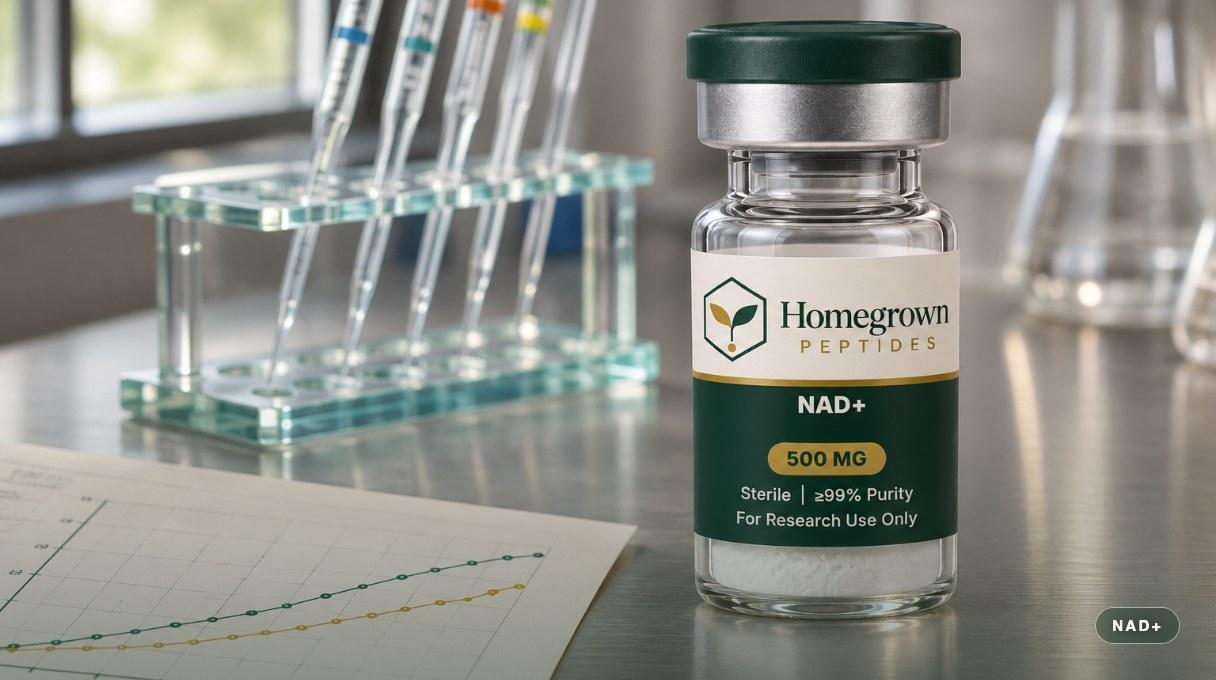
Published human data on NAD+ delivery are strongest for oral precursors (nicotinamide riboside and nicotinamide mononucleotide), which reliably raise whole-blood NAD+ in randomized trials, and for intravenous NAD+ infusion, which has one published human pharmacokinetic study. Intranasal NAD+ delivery has almost no controlled human pharmacokinetic literature behind it; the intranasal evidence base for this molecule is thin compared with the oral and intravenous routes.
| Key fact | Value | Source |
|---|---|---|
| Oral NR raises blood NAD+ in humans | Confirmed in a randomized, placebo-controlled trial of healthy middle-aged and older adults | Martens et al. 2018, Nat Commun |
| Oral NR bioavailability across species | Shown to be orally bioavailable in both mice and humans in the same study | Trammell et al. 2016, Nat Commun |
| Oral NMN human safety and metabolite data | Single-arm study in healthy Japanese men tracking NMN metabolites after oral administration | Irie et al. 2020, Endocr J |
| Intravenous NAD+ human pharmacokinetics | Measured in plasma and urine across a multi-hour infusion in a pilot study | Grant et al. 2019, Front Aging Neurosci |
| Intranasal NAD+ human pharmacokinetic studies | No controlled study identified in the indexed literature as of this review | Literature search for this article |
What happens to blood NAD+ levels after an intravenous infusion?
Grant and colleagues ran a pilot study giving healthy volunteers an intravenous NAD+ infusion over several hours while sampling plasma and urine for the NAD+ metabolome. The study reported measurable increases in several NAD+ pathway metabolites during and after the infusion window, along with the first published human pharmacokinetic description of what happens when NAD+ itself, rather than a precursor, is delivered directly into the bloodstream. Because the study was a small pilot without a placebo-controlled efficacy endpoint, it answers a pharmacokinetic question (what blood levels look like during and after infusion) rather than a clinical outcome question.
How well do oral NAD+ precursors raise blood levels?
The oral-route literature is built on two precursor molecules, nicotinamide riboside (NR) and nicotinamide mononucleotide (NMN), rather than NAD+ itself, since intact NAD+ is largely broken down in the gut before it could be absorbed as the whole molecule. Trammell and colleagues showed that NR survives oral administration and raises blood NAD+ in both mouse and human experiments within the same publication, establishing oral bioavailability for the precursor across species. Martens and colleagues then ran a randomized, double-blind, placebo-controlled trial in healthy middle-aged and older adults, giving oral NR daily for six weeks and showing a significant rise in whole-blood NAD+ in the treatment group relative to placebo, with the regimen reported as well tolerated. Separately, Irie and colleagues gave oral NMN to healthy Japanese men and tracked nicotinamide metabolite levels and routine clinical laboratory parameters, reporting that the metabolites rose in a pattern consistent with absorption and conversion toward NAD+.
Does the amount studied change how much blood NAD+ rises?
Across the oral precursor trials, studies compared more than one amount within the same design to see whether higher oral amounts produced a larger rise in blood NAD+. The amounts and schedules used in each specific trial are reported in the Study table below exactly as each paper states them; in general, the published oral trials describe a relationship where blood NAD+ rises with the amount administered up to the range tested, without claiming a maximum effective amount beyond what was directly studied.
What does the intranasal NAD+ evidence actually show?
This is the weakest part of the route comparison. Unlike the oral precursor literature, which includes multiple randomized controlled trials with blood NAD+ as a measured endpoint, a search of the indexed literature for this article did not surface a controlled human pharmacokinetic study of intranasal NAD+ specifically. General nasal drug delivery literature (not specific to NAD+) describes two structural barriers that any nasally delivered large, charged molecule has to cross: a mucociliary clearance system that moves material out of the nasal cavity within minutes, and a nasal epithelium that is a poor passive barrier for hydrophilic molecules above a few hundred daltons. NAD+ itself is a dinucleotide in that higher molecular weight, highly charged category, which is consistent with why intranasal delivery of the intact molecule faces a steeper absorption problem than the oral precursor route, where the gut handles a smaller, differently charged precursor molecule instead of NAD+ itself. Until a controlled pharmacokinetic study of intranasal NAD+ is published, claims about nasal NAD+ blood levels should be treated as unverified rather than established.
How does the oral route compare with the intravenous route for raising blood NAD+?
The two routes answer different questions in the literature rather than competing head to head in a single trial. The intravenous pilot study measured what an infusion does to plasma and urine metabolites over a single multi-hour session, while the oral precursor trials measured what repeated daily administration over weeks does to steady-state whole-blood NAD+. No published head-to-head trial directly compares intravenous NAD+ against oral NR or NMN using the same blood-level assay in the same subjects, so cross-route comparisons in this article describe what each route's own literature reports, not a controlled comparison between routes.
| Study | Model and n | Amount and route (as reported) | Endpoint | Finding |
|---|---|---|---|---|
| Trammell et al. 2016 (PubMed) | Mouse oral gavage study plus a human single-dose arm, healthy adults | Oral administration of nicotinamide riboside, single and repeated doses reported in the paper | Blood and tissue NAD+ and nicotinamide riboside metabolites | NR was orally bioavailable and raised NAD+ metabolites in both mice and humans |
| Martens et al. 2018 (PubMed) | Human, randomized double-blind placebo-controlled, healthy middle-aged and older adults, n=24 | Oral nicotinamide riboside taken daily for six weeks, amount escalated over the first week as reported in the paper | Whole-blood NAD+, blood pressure, safety labs | Whole-blood NAD+ rose significantly versus placebo; the regimen was reported as well tolerated |
| Irie et al. 2020 (PubMed) | Human, healthy Japanese men, single-arm | Single oral administration of nicotinamide mononucleotide, amount reported in the paper | Plasma nicotinamide metabolites, clinical chemistry, heart rate | Metabolites rose after administration with no clinically significant change in safety parameters |
| Grant et al. 2019 (PubMed) | Human, healthy volunteers, pilot pharmacokinetic study | Intravenous NAD+ infusion delivered over several hours, rate reported in the paper | Plasma and urine NAD+ metabolome across the infusion window | Multiple NAD+ pathway metabolites rose during and after the infusion, establishing a human intravenous pharmacokinetic profile |
| Dollerup et al. 2018 (PubMed) | Human, randomized placebo-controlled, obese men | Oral nicotinamide riboside taken daily for twelve weeks, amount reported in the paper | Insulin sensitivity, lipid handling, safety labs | Reported as safe and tolerated at the amount studied, with metabolic endpoints discussed separately from the NAD+ bioavailability question |
How is NAD+ handled in a research setting?
NAD+ research material is sensitive to heat, light and repeated freeze-thaw cycles, so lots are typically shipped lyophilized and reconstituted shortly before use, or supplied as a dissolving-strip format for bench convenience. The volume and concentration math for bringing a lyophilized vial to a working solution follows the same method used for other lyophilized research peptides, covered in reconstituting lyophilized peptides, and every lot should ship with a certificate of analysis reporting identity and purity, explained in how to read a peptide certificate of analysis.
How do NAD+ precursors compare with NAD+ itself for lab use?
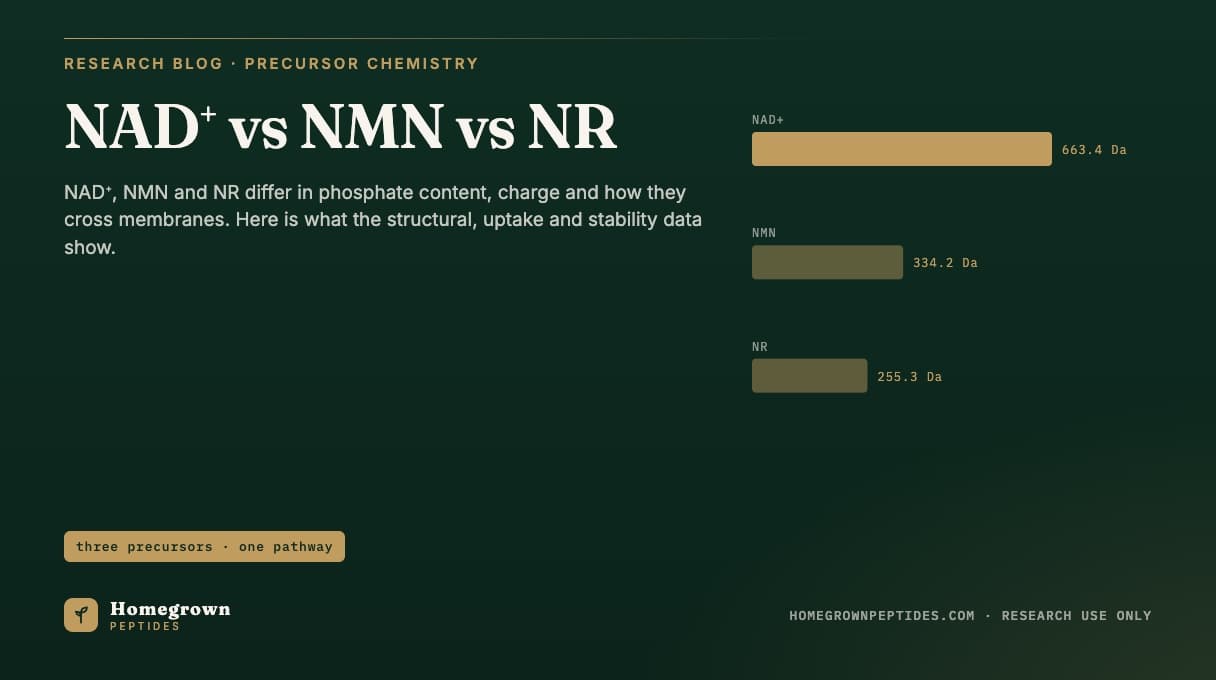
NR and NMN are precursor molecules that the cell converts into NAD+ through defined salvage-pathway steps, while NAD+ itself is the finished coenzyme. The structural and uptake differences between NAD+, NMN and NR are covered in detail in NAD+ vs NMN vs NR, and the general physical chemistry that governs how any peptide or nucleotide-like molecule crosses the gut, skin or nasal mucosa is covered in peptide bioavailability by route and intranasal peptide formulation science. NAD+ research material is available as NAD+ and as NAD+ dissolving strips for laboratory use.
Frequently asked questions
Is NAD+ itself absorbed intact when taken by mouth?
The published literature on oral administration works with precursor molecules (NR and NMN) rather than intact NAD+, because the coenzyme is broken down by gut enzymes before an intact molecule could cross the intestinal wall in meaningful amounts.
Which route has the strongest published human pharmacokinetic data?
The oral precursor route has the most published controlled human trials measuring blood NAD+ as an endpoint. The intravenous route has one published pilot pharmacokinetic study. The intranasal route has no controlled human pharmacokinetic study identified for this article.
Do NR and NMN raise blood NAD+ by the same amount?
Both precursors raised NAD+ pathway metabolites in their respective human studies, but the trials used different assays, populations and schedules, so the papers do not support a direct numeric comparison between the two precursors from existing data alone.
Why would a nasal spray format be harder to validate for NAD+ than for a small peptide like semax?
Intranasal formulation science generally favors smaller, more lipophilic molecules that can cross the nasal epithelium before mucociliary clearance removes them. NAD+ is a larger, highly charged dinucleotide, which is a structurally harder profile for nasal absorption than some of the smaller research peptides that already have published intranasal pharmacokinetic data.
Did the intravenous pilot study measure a clinical outcome?
No. The published intravenous study measured plasma and urine metabolite levels during and after the infusion. It was not designed or powered to test a disease-related clinical outcome.
Were the oral NR and NMN trials conducted in the same population?
No. The published trials used different populations, including healthy middle-aged and older adults, healthy Japanese men, and obese men in a metabolic-focused trial, so results should be read within the population each study enrolled.
References
- Trammell SA, Schmidt MS, Weidemann BJ, et al. Nicotinamide riboside is uniquely and orally bioavailable in mice and humans. Nat Commun. 2016;7:12948. PubMed PMID 27721479.
- Martens CR, Denman BA, Mazzo MR, et al. Chronic nicotinamide riboside supplementation is well tolerated and elevates NAD+ in healthy middle-aged and older adults. Nat Commun. 2018;9(1):1286. PubMed PMID 29599478.
- Irie J, Inagaki E, Fujita M, et al. Effect of oral administration of nicotinamide mononucleotide on clinical parameters and nicotinamide metabolite levels in healthy Japanese men. Endocr J. 2020;67(2):153-160. PubMed PMID 31685720.
- Grant R, Berg J, Mestayer R, et al. A pilot study investigating changes in the human plasma and urine NAD+ metabolome during a 6-hour intravenous infusion of NAD+. Front Aging Neurosci. 2019;11:257. PubMed PMID 31780925.
- Dollerup OL, Christensen B, Svart M, et al. A randomized placebo-controlled study of nicotinamide riboside in obese men: safety, insulin-sensitivity, and lipid-mobilizing effects. Am J Clin Nutr. 2018;108(2):343-353. PubMed PMID 30321282.
- Illum L. Nasal drug delivery: possibilities, problems and solutions. J Control Release. 2003;87(1-3):187-198. PubMed PMID 12618035.
Research use only. Homegrown Peptides products are for laboratory research and are not for human or animal use. Nothing in this article is medical advice.