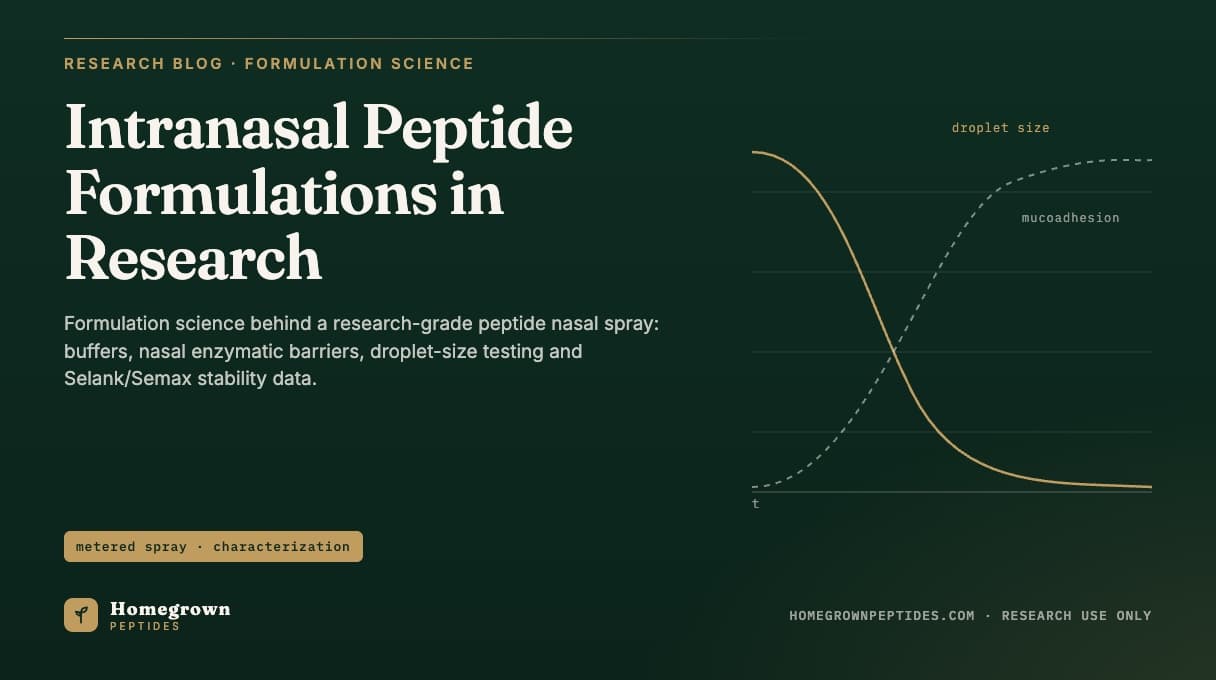
A research-grade Selank or Semax nasal spray is not a peptide dissolved in water and dropped into a pump bottle. Formulating a short peptide for metered intranasal delivery means solving three measurable problems: keeping the molecule intact in aqueous solution, limiting how fast nasal-mucosa enzymes cut it apart, and producing a reproducible droplet size and spray pattern from the pump. This article covers that formulation chemistry and analytical method, not outcomes in a person.
| Parameter | Reported value | Source |
|---|---|---|
| Semax sequence | Met-Glu-His-Phe-Pro-Gly-Pro, an ACTH(4-10) analog with a C-terminal Pro-Gly-Pro tripeptide | Magrì et al., 2016 |
| Selank sequence | Thr-Lys-Pro-Arg-Pro-Gly-Pro, a tuftsin analog carrying the same C-terminal Pro-Gly-Pro tripeptide | Ashmarin et al., 2008 |
| Brain tracer signal after intranasal dosing in rats | 0.093% of the administered tritium label per gram of brain tissue at 2 minutes; 80% of that signal was still intact Semax | Shevchenko et al., 2006 |
| Dominant nasal degradation fragment | The Pro-Gly-Pro tripeptide, the shared C-terminal motif cleaved from both peptides | Shevchenko et al., 2006; Ashmarin et al., 2008 |
| Nasal-spray droplet range measured by laser diffraction | Approximately 10 to 180 micrometers across four marketed nasal spray pumps | Lelong et al., 2014 |
| Pharmacopeial droplet-size cutoff for deep-lung deposition risk | Below roughly 10 to 14 micrometers aerodynamic diameter is treated as aerosol rather than nasal-spray behavior | Williams et al., 2018 |
| In vitro nasal epithelial barrier models used for formulation testing | RPMI 2650 and Calu-3 cell layers, shown to discriminate between formulation compositions | Sibinovska et al., 2022 |
Why were Selank and Semax originally studied as intranasal formulations?
Both peptides come out of the same Russian research program, centered at the Institute of Molecular Genetics of the Russian Academy of Sciences, which built short regulatory peptides from endogenous fragments: Semax from the ACTH(4-10) sequence, Selank from tuftsin plus an added Pro-Gly-Pro tripeptide. Linear peptides this short degrade quickly in the gastrointestinal tract, ruling out an oral formulation for most research purposes, and intranasal delivery was examined early as an alternative to parenteral routes for CNS-adjacent tissue access. A tritium-tracer study found Semax reaches rat brain tissue within minutes of intranasal dosing, with most of the signal still intact peptide rather than its Pro-Gly-Pro metabolite at that early timepoint (Shevchenko et al., 2006). A separate comparison of intraperitoneal, intranasal, intragastric and intravenous administration of Pro-Gly-Pro and Selank found intranasal delivery most efficient for reaching central nervous system tissue (Ashmarin et al., 2008). That comparative rationale, not a therapeutic claim, is why both peptides have an intranasal formulation literature; see peptide bioavailability by route for how delivery routes compare generally.
What barriers does the nasal epithelium present to a peptide formulation?
Three barriers dominate this literature. The first is mucociliary clearance: nasal mucus is continuously propelled toward the nasopharynx by ciliated epithelial cells, leaving a limited residence window before deposited material is swallowed rather than absorbed. The second is the enzymatic barrier: nasal mucus and the underlying epithelium carry aminopeptidase and other exopeptidase activity that attacks peptide bonds from the termini inward, consistent with what the Semax and Selank tracer work measured, where the Pro-Gly-Pro tripeptide, the shared C-terminal fragment of both molecules, was the dominant species recovered relative to the parent peptide (Shevchenko et al., 2006; Ashmarin et al., 2008). The third is the epithelium itself, where tight junctions between adjacent cells restrict paracellular movement of a polar peptide. This barrier is studied in vitro using RPMI 2650 cells, derived from human nasal septum tissue, and Calu-3 airway cells grown as confluent layers; a comparative evaluation found both lines discriminated the effect of formulation composition on measured permeability, tracking available bioavailability data closely enough to support use as a formulation-screening tool (Sibinovska et al., 2022). See what is Selank and what is Semax for background on the two molecules.
How is a peptide nasal spray formulation actually built?
An aqueous peptide spray formulation is a system of interacting variables, each chosen to manage one barrier above without destabilizing the peptide. Buffer selection sets solution pH, governing ionization state and hydrolysis and deamidation rate; a high-throughput screen of peptide liquid formulations found acetate and succinate buffers near pH 4.5 gave the best colloidal stability, with electrostatic repulsion between peptide molecules the main driver (Dauer et al., 2021). Tonicity agents, including glycerol and mannitol in that screen, bring the solution toward an osmotic range nasal mucosa tolerates without disrupting ciliary beat, and a preservative is added for multi-dose compatibility. A viscosity modifier sometimes extends mucosal contact time, kept low enough not to distort droplet size at the pump. Every choice is evaluated against the finished spray's analytical profile, not a subjective impression.
| Formulation parameter | What it controls | Typical analytical check |
|---|---|---|
| Buffer system and pH | Peptide ionization state, hydrolysis and deamidation rate | Potentiometric pH measurement |
| Tonicity agent | Osmotic balance against nasal mucosa, ciliary beat frequency | Freezing-point depression osmometry |
| Preservative system | Microbial control across the life of a multi-dose pump bottle | Antimicrobial effectiveness testing |
| Viscosity modifier | Mucosal residence time, droplet formation at the pump orifice | Rotational or capillary viscometry |
| Metered-dose pump output | Reproducibility of volume delivered per actuation | Gravimetric shot-weight testing across the labeled actuation count |
| Droplet size distribution | Where the spray deposits in the nasal cavity versus deeper airway | Laser diffraction (for example, a Spraytec- or Mastersizer-type instrument) |
| Spray pattern and plume geometry | Cone shape, ovality and impaction distance from the nozzle | High-speed imaging at defined distances from the actuator |
| Content uniformity | Peptide mass delivered per actuation, first shot to last | RP-HPLC assay of collected actuations against a reference standard |
How is nasal spray performance characterized analytically?
Droplet size distribution is the measurement most tied to where a spray deposits. Laser diffraction is the standard tool: a beam passes through the spray plume and the scattering pattern converts into a particle-size distribution. A comparison of two diffractometers, the Mastersizer X and the Spraytec, measured four marketed nasal spray pumps and found droplets spanning roughly 10 to 180 micrometers; agreement was poor for the largest droplets (R-squared of 0.37) and strong for smaller ones (R-squared of 0.97), with the newer instrument overestimating small-droplet median diameter by about 14% (Lelong et al., 2014). That distinction matters because droplets below roughly 10 to 14 micrometers aerodynamic diameter start behaving like an inhaled aerosol rather than a nasal spray, which is why a pharmacopeial inlet-geometry study quantified the mass fraction of droplets small enough to bypass the nasopharynx by cascade impaction alongside laser diffraction (Williams et al., 2018). Spray pattern and plume geometry are assessed separately by high-speed imaging at a fixed distance from the actuator, confirming a consistent cone rather than a narrow jet or uneven pattern. Content uniformity closes the loop: a reversed-phase HPLC assay quantifies peptide mass recovered from actuations across a bottle's labeled life, comparing peak area against a reference standard to confirm the pump is not under- or over-delivering as fill level drops.
How stable is a peptide in an aqueous intranasal formulation?
Once a peptide is in solution rather than lyophilized powder, it faces degradation pathways a dry formulation mostly avoids. pH away from the buffer's stability optimum accelerates hydrolysis and deamidation, and elevated temperature accelerates nearly every one of these pathways further, which is why peptide-solution stability studies run across a temperature range rather than one storage condition. Light is a separate concern for residues such as histidine and phenylalanine, both in the Semax sequence, which can undergo photo-oxidative side reactions. Semax also carries a feature Selank does not: an N-terminal methionine, whose thioether sulfur is a known site of oxidative chemistry in peptides generally. Work characterizing Semax's interaction with copper(II) traced a weak apical interaction between the metal center and the methionine sulfur, with the redox behavior of the resulting complex differing by whether the peptide's free amine terminus was acetylated (Magrì et al., 2016); that is formulation-relevant metal and redox chemistry, not a clinical finding, and one reason formulation screens for methionine-containing peptides track oxidation products alongside the parent peak. Enzymatic instability compounds this on mucosal contact: a stability study on acetylated Semax measured its resistance to proteolysis across several biological media, treating acetylation as a variable in how fast endogenous proteases cut the peptide apart (Shevchenko et al., 2013). Chemical degradation, oxidation at the methionine, and enzymatic cleavage are why an intranasal formulation gets a stability-testing schedule rather than an assumption that pure starting powder means a stable solution.
What has research examined comparing intranasal delivery with other routes for these peptides?
Route comparisons for Selank have reported pharmacological differences, not just pharmacokinetic ones. A study comparing intranasal and intraperitoneal Selank in two inbred mouse strains found the routes produced different receptor-binding changes in brain tissue, intranasal shifting NMDA receptor binding density while intraperitoneal shifted GABA receptor binding instead (Vasil'eva et al., 2016). The authors proposed route-dependent pharmacokinetics and biotransformation, not only circulating peptide levels, as the cause, consistent with the glyproline route-comparison data above, where intranasal administration gave the most efficient access to central nervous system tissue (Ashmarin et al., 2008). Lot-specific analytical data for a formulated spray, including identity, assay and endotoxin results, appear on the certificate of analysis for each batch; see the Selank nasal spray lot documentation for an example.
Frequently asked questions
Is a research nasal spray just a reconstituted peptide vial loaded into a spray bottle?
No. A formulated spray is engineered around a buffer, tonicity agent and preservative system, and the finished product is characterized for droplet size, spray pattern, content uniformity and stability, none of which apply to a lyophilized vial reconstituted for a different format.
Why does the Pro-Gly-Pro fragment keep showing up in degradation studies of both peptides?
Pro-Gly-Pro is the shared C-terminal tripeptide motif in Semax and Selank. Nasal and plasma exopeptidase activity cleaves from the termini inward, so this fragment accumulates as the common degradation product measured in biological samples after intranasal dosing.
What in vitro models do formulation scientists use to study nasal permeability?
RPMI 2650 cells, derived from human nasal septum tissue, and Calu-3 airway epithelial cells are the two most widely used layers. Comparative work has shown both can distinguish how different formulation compositions affect measured drug permeability.
Is Semax more prone to oxidative degradation than Selank?
Semax carries an N-terminal methionine, a residue whose thioether sulfur is a recognized site of oxidative chemistry in peptides generally; Selank has no methionine. This is one reason the two can show different degradation profiles in solution despite sharing a C-terminal tripeptide.
Has any of this formulation research been conducted in humans?
The studies cited here are cell-culture, rodent and analytical-chemistry work. This article describes published laboratory and instrumental methods, not a clinical protocol, and nothing here describes use in any subject.
References
- Shevchenko KV, Nagaev IY, Alfeeva LY, et al. Kinetics of Semax penetration into the brain and blood of rats after its intranasal administration. Bioorg Khim. 2006;32(1):64-70. PubMed 16523722.
- Shevchenko KV, Nagaev IY, Andreeva LA, et al. Stability of Semax acetyl to proteolysis in various biological media. Dokl Biol Sci. 2013;449:110-112. PubMed 23652441.
- Inozemtseva LS, Karpenko EA, Dolotov OV, et al. Intranasal administration of the peptide Selank regulates BDNF expression in the rat hippocampus in vivo. Dokl Biol Sci. 2008;421:241-243. PubMed 18841804.
- Vasil'eva EV, Kondrakhin EA, Salimov RM, Kovalev GI. Comparison of pharmacological effects of heptapeptide Selank after intranasal and intraperitoneal administration to BALB/c and C57BL/6 mice. Eksp Klin Farmakol. 2016;79(9):3-11. PubMed 29787664.
- Ashmarin IP, Baglikova KE, Edeeva SE, et al. A comparative analysis of distribution of glyprolines administered by various routes. Bioorg Khim. 2008;34(4):464-470. PubMed 18695718.
- Sibinovska N, Žakelj S, Trontelj J, Kristan K. Applicability of RPMI 2650 and Calu-3 Cell Models for Evaluation of Nasal Formulations. Pharmaceutics. 2022;14(2):369. PubMed 35214101.
- Lelong N, Junqua-Moullet A, Diot P, Vecellio L. Comparison of laser diffraction measurements by Mastersizer X and Spraytec to characterize droplet size distribution of medical liquid aerosols. J Aerosol Med Pulm Drug Deliv. 2014;27(2):94-102. PubMed 23668547.
- Williams G, Blatchford C, Mitchell JP. Evaluation of nasal inlet ports having simplified geometry for the pharmacopeial assessment of mass fraction of dose likely to penetrate beyond the nasopharynx: a preliminary investigation. AAPS PharmSciTech. 2018;19(8):3723-3733. PubMed 30225778.
- Magrì A, Tabbì G, Giuffrida A, et al. Influence of the N-terminus acetylation of Semax, a synthetic analog of ACTH(4-10), on copper(II) and zinc(II) coordination and biological properties. J Inorg Biochem. 2016;164:59-69. PubMed 27586814.
- Dauer K, Kamm W, Wagner KG, Pfeiffer-Marek S. High-throughput screening for colloidal stability of peptide formulations using dynamic and static light scattering. Mol Pharm. 2021;18(5):1939-1955. PubMed 33789055.
Research use only. Homegrown Peptides products are for laboratory research and are not for human or animal use. Nothing in this article is medical advice.