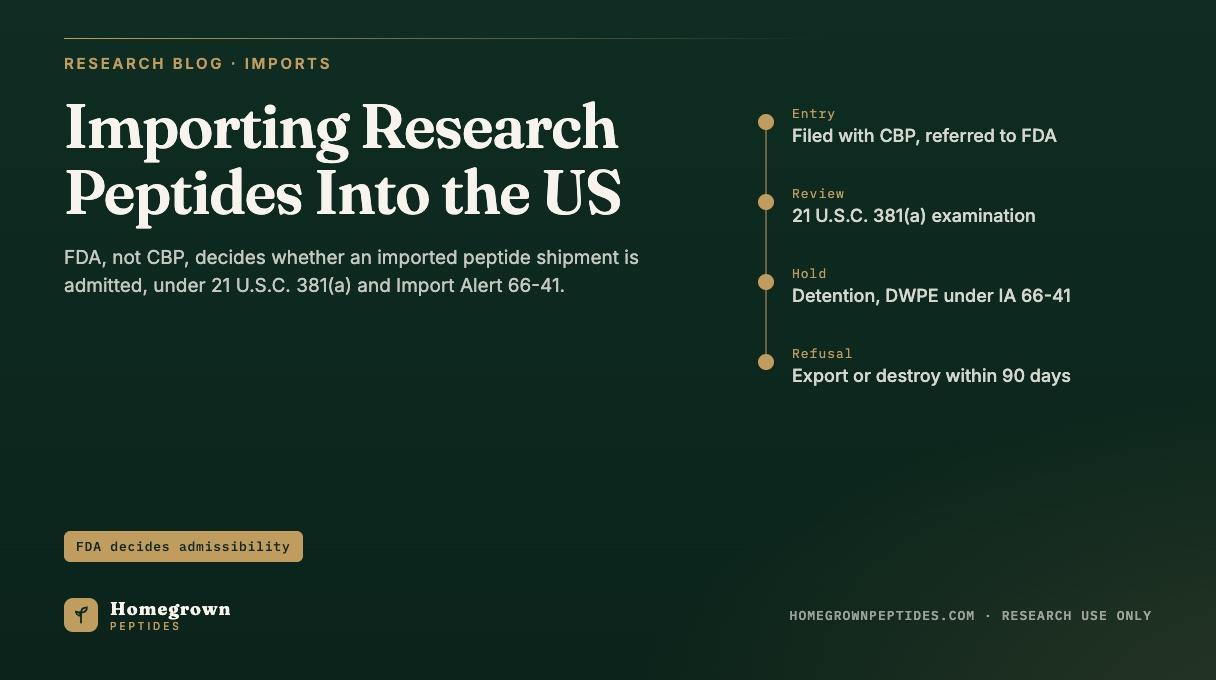
An imported research peptide is reviewed by the Food and Drug Administration at the port of entry under 21 U.S.C. 381(a). If the article appears adulterated, misbranded, or an unapproved new drug, it can be refused, and firms placed on Import Alert 66-41's Red List can have their shipments detained without physical examination. FDA's personal importation policy does not extend to unapproved research chemicals. Domestic synthesis with a lot matched certificate of analysis avoids this review process from the start.
As of November 7, 2026. This article describes United States federal law and published agency actions as of that date. It is general information, not legal advice; the rules differ by state and change over time, and anyone with a specific question should consult a lawyer licensed in their jurisdiction.
| Provision or document | What it does | Date or current as of | Source |
|---|---|---|---|
| 21 U.S.C. 381(a) | Lets FDA refuse entry of an imported article if it appears insanitary, restricted in its country of export, or adulterated, misbranded, or an unapproved new drug | Codified, in force | law.cornell.edu |
| Import Alert 66-41 | Authorizes detention without physical examination (DWPE) of identified products from firms on its Red List | Published November 6, 2026; revised May 19, 2026 | accessdata.fda.gov |
| FDA Personal Importation policy | Describes the narrow circumstances where enforcement discretion may apply to an individual bringing in a drug for personal use | Content current as of August 18, 2025 | fda.gov |
| CBP Prohibited and Restricted Items | States that unapproved foreign drug products have not been evaluated by FDA and may be stopped at the border | Current CBP guidance page | cbp.gov |
| 21 CFR 201.128 | Defines intended use and the kinds of evidence FDA may use to establish it | Codified, in force | law.cornell.edu |
| 21 U.S.C. 331(a) | Prohibits introducing an adulterated or misbranded drug into interstate commerce | Codified, in force | law.cornell.edu |
Who decides whether an imported research peptide enters the United States?
Two federal agencies touch an incoming package, but they do different jobs. U.S. Customs and Border Protection physically holds, flags and processes freight and mail at the port of entry. CBP's own guidance explains the scrutiny: drugs from other countries, including foreign versions of FDA-approved medications, "haven't been evaluated or approved by the FDA for use or sale in the U.S., so the FDA can't ensure that they're safe and effective." CBP's page adds that "The U.S. Food and Drug Administration prohibits the importation, by mail or in person, of fraudulent or counterfeit drugs and medical devices."
The legal decision about whether a specific article may be admitted belongs to FDA, acting under 21 U.S.C. 381(a). CBP enforces an FDA hold; it does not independently clear or deny a shipment on drug grounds. The manual that governs how an FDA import division processes a detained or refused shipment is the Regulatory Procedures Manual, Chapter 9, Import Operations and Actions, the operating reference for the process described in this article.
What does 21 U.S.C. 381(a) let FDA do?
Section 381(a) gives FDA authority to refuse admission to an imported article if "it appears from the examination of such samples or otherwise that" one of three things is true: the article was "manufactured, processed, or packed under insanitary conditions"; it is "forbidden or restricted in sale in the country in which it was produced or from which it was exported"; or it is "adulterated, misbranded, or in violation of section 355" (the new drug approval requirement at 21 U.S.C. 355(a), which bars introducing a new drug into interstate commerce without an effective approval).
Notice the standard: "appears," not "is proven beyond doubt." The statute lets FDA act on the examination of samples "or otherwise," which covers labeling and the circumstances around the shipment, not only a laboratory test of the contents. When an article is refused, the consequence is specific: it is destroyed unless it is "exported...within 90 days of the date of notice of such refusal or within such additional time as may be permitted pursuant to such regulations." The two paths the statute describes for a refused article are export or destruction.
What is Import Alert 66-41?
Import Alert 66-41 is formally titled "Detention Without Physical Examination of Unapproved New Drugs Promoted In The U.S." Its stated charge is that "The article is subject to refusal of admission pursuant to section 801(a)(3) in that it appears to be a new drug" without an approved application covering it. FDA's own page for the alert shows a Published Date of November 6, 2026, with a prior revision dated May 19, 2026, meaning the policy has been active and maintained for some time, not a one-time notice.
The operative mechanism is detention without physical examination, abbreviated DWPE. The alert states that "Divisions may detain without physical examination (DWPE), the identified products from the firms on the Red List." Once a firm is on the Red List, FDA's import division does not need to sample or test that firm's shipment before detaining it; detention attaches to the firm and product category identified in the alert, not to a result from that specific shipment.
Does the personal importation policy cover research peptides?
FDA's Personal Importation page states the general rule plainly: "In most circumstances, it is illegal for individuals to import drugs or devices into the U.S. for personal use because these products purchased from other countries often have not been approved by the FDA." The page then describes narrow circumstances where FDA may consider exercising enforcement discretion rather than enforcing that general rule: the product is not for a serious condition with no known significant health risk, or it is for a serious condition for which no effective domestic treatment exists, there is no promotion of the product to United States residents, the product presents no unreasonable risk, the individual provides written affirmation that it is for personal use, the quantity is "generally not more than a three month supply," and the individual supplies a U.S. physician's statement or documentation of foreign treatment.
Every part of that frame assumes a person bringing in medicine for their own diagnosed condition under a physician's involvement. A research chemical acquired for laboratory use is not medicine for a named individual's serious condition, there is no physician's statement attached to a laboratory order, and the "three month supply" language describes a patient's dosing timeline, not a lab's inventory. The policy was not written with that scenario in mind.
How do intended use and misbranding travel with the package?
21 CFR 201.128 defines intended use by reference to "the objective intent of the persons legally responsible for the labeling of an article." That intent "may be shown by" several kinds of evidence: "labeling claims, advertising matter, or oral or written statements," the article's "design or composition," and "circumstances surrounding the distribution of the article." The regulation also contains a limit: "a firm would not be regarded as intending an unapproved new use for an approved drug based solely on that firm's knowledge that such drug was being prescribed or used by health care providers for such use."
Misbranding travels alongside intended use. Under 21 U.S.C. 352(a)(1), a drug is misbranded "If its labeling is false or misleading in any particular," and under 352(f) it is misbranded unless its labeling bears "adequate directions for use" and "adequate warnings against use in those pathological conditions or by children where its use may be dangerous to health." Section 331(a) then prohibits introducing an adulterated or misbranded drug into interstate commerce, and section 331(d) prohibits introducing an article in violation of section 355, the new drug approval requirement.
A 2026 warning letter shows how this plays out. In a letter to Peptide Partners LLC dated August 24, 2026, FDA cited sections 201(g)(1), 201(p), 505(a) and 301(d) against a product line that included SS-31, a TH9507 product, PT-141, a reconstitution solution, and a line of GLP-1 class products, pointing to website statements about effects in people as evidence of intended use. FDA was explicit about what a research use disclaimer does not do: "Despite statements on your product labeling marketing your products 'for research use only' and 'not for human or veterinary use,' evidence obtained from your website establishes that your products are intended to be drugs for human use." Labeling is one input under 201.128; it does not override the rest of the evidence.
Why does domestic supply change the picture?
Everything above, the refusal grounds in 381(a), the Red List mechanism in Import Alert 66-41, the narrow personal importation carve out, applies to an article crossing into the United States from abroad. A peptide synthesized and tested inside the United States never presents itself for that entry review, because there is no port of entry step in its chain of custody. The product's record starts with domestic manufacture and testing, not a shipment a border agency has to evaluate.
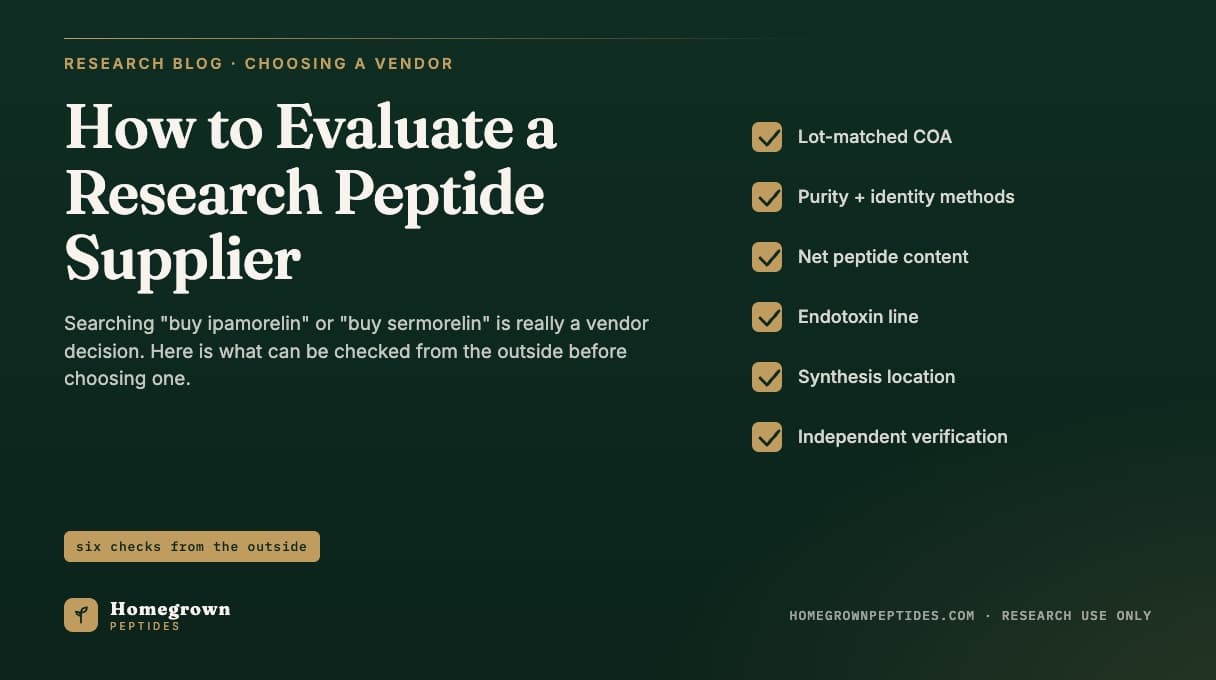
That is also what a lot matched certificate of analysis is for: it ties one vial back to the specific batch that was manufactured and tested domestically. Why USA-made matters for research peptides covers that traceability in more depth, and cold chain shipping for lyophilized peptides covers what happens to the material in transit once it is already domestic. A product such as BPC-157 ships with a certificate tied to that specific lot. For the broader legal status question, see are research peptides legal in the United States, and for weighing a supplier's sourcing claims, see how to evaluate a research peptide supplier.
| Review step | Who | What can happen |
|---|---|---|
| Entry review | FDA, under 21 U.S.C. 381(a) | Refusal if the article appears insanitary, restricted abroad, adulterated, misbranded, or an unapproved new drug |
| Customs hold | CBP | Physically holds and enforces an FDA determination; FDA decides admissibility on drug grounds, not CBP |
| Red List detention | FDA import division | Can detain without physical examination under Import Alert 66-41 if the firm is on the Red List |
| Disposition after refusal | Importer | Article is destroyed unless exported within 90 days of the refusal notice, or an FDA-permitted extension |
| Domestic manufacture and testing | Manufacturer and laboratory | No port of entry review; the certificate of analysis documents identity and purity for that lot instead |
Frequently asked questions
Does CBP seize peptides mailed or shipped into the US?
CBP enforces holds on shipments that FDA has flagged or that fall under an active import alert, and its own guidance says foreign drug products have not been evaluated or approved by FDA for use or sale in the United States. The legal basis for refusing admission on drug grounds comes from 21 U.S.C. 381(a); CBP is the enforcement partner at the border, not the agency deciding whether the article qualifies as adulterated, misbranded or an unapproved new drug.
What happens to a shipment that FDA refuses entry?
Under 21 U.S.C. 381(a), a refused article is destroyed unless it is exported within 90 days of the date of the refusal notice, or within any additional time FDA's regulations permit. The statute does not describe any other outcome for a refused shipment.
Is it a crime to import a peptide for research use?
The statute text addresses two separate things: entry can be refused and the article destroyed or exported under 21 U.S.C. 381(a), and separately, 21 U.S.C. 331 lists prohibited acts, including introducing an adulterated or misbranded drug into interstate commerce under 331(a) and introducing an article in violation of section 355 under 331(d). This article does not describe or speculate about whether any particular import would be prosecuted; that depends on facts outside what the statute itself states.
Can a laboratory import a peptide under an investigational new drug application?
Investigational use of a new drug has its own separate pathway under 21 U.S.C. 355, distinct from the import review described in this article. This article does not cover the investigational new drug process itself.
What is a Red List?
The Red List is the list of firms identified in an FDA import alert, such as Import Alert 66-41, whose identified products FDA's import divisions may detain without physical examination under the DWPE mechanism described above.
Does marking a customs form "research use only" change how a shipment is reviewed?
Labeling language is one piece of evidence FDA can weigh under 21 CFR 201.128, alongside advertising, the product's design or composition, and the circumstances of distribution. FDA's August 2026 warning letter to Peptide Partners LLC shows the agency reaching past a research use disclaimer to other evidence of intended use. A label or form entry does not control the outcome of an admissibility or intended use determination by itself.
References
- Cornell Law School Legal Information Institute. 21 U.S.C. 331, Prohibited acts. law.cornell.edu.
- Cornell Law School Legal Information Institute. 21 U.S.C. 352, Misbranded drugs and devices. law.cornell.edu.
- Cornell Law School Legal Information Institute. 21 U.S.C. 355, New drugs. law.cornell.edu.
- Cornell Law School Legal Information Institute. 21 U.S.C. 381, Imports and exports. law.cornell.edu.
- Cornell Law School Legal Information Institute. 21 CFR 201.128, Meaning of intended uses. law.cornell.edu.
- U.S. Food and Drug Administration. Import Alert 66-41, Detention Without Physical Examination of Unapproved New Drugs Promoted In The U.S. Published November 6, 2026; revised May 19, 2026. accessdata.fda.gov.
- U.S. Food and Drug Administration. Personal Importation. Content current as of August 18, 2025. fda.gov.
- U.S. Customs and Border Protection. Prohibited and Restricted Items. cbp.gov.
- U.S. Food and Drug Administration. Regulatory Procedures Manual, Chapter 9, Import Operations and Actions. fda.gov.
- U.S. Food and Drug Administration. Warning Letter to Peptide Partners LLC. August 24, 2026. fda.gov.
Research use only. Homegrown Peptides products are for laboratory research and are not for human or animal use. Nothing in this article is medical advice.