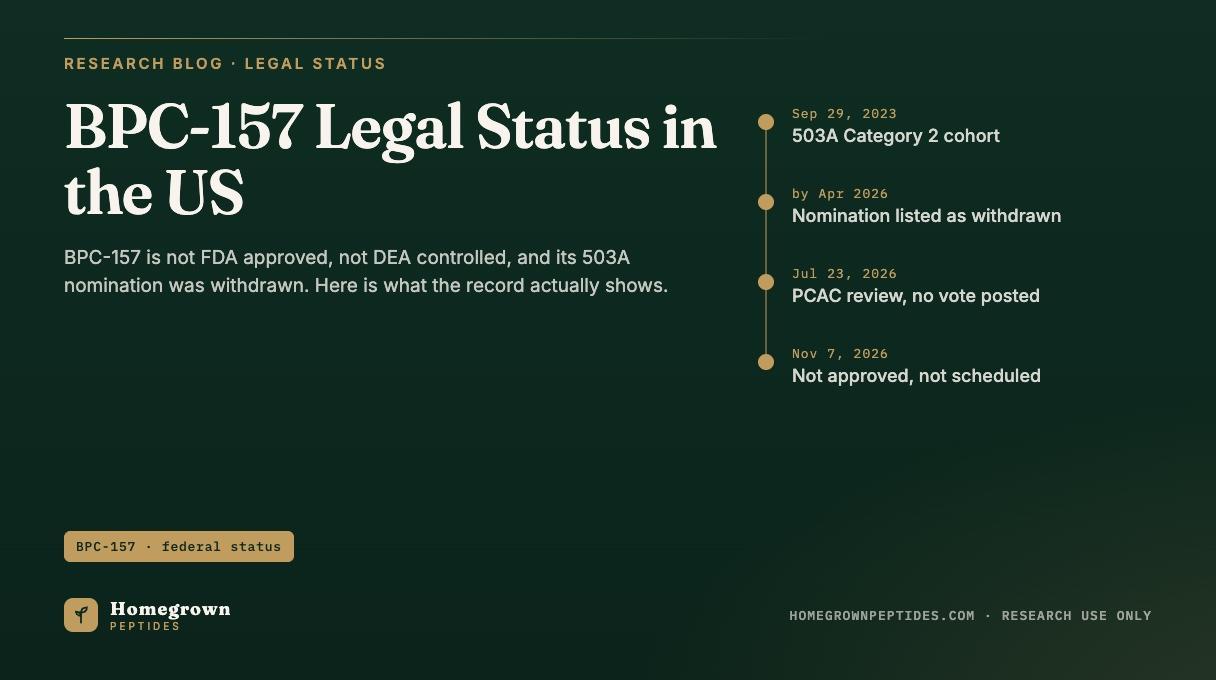
BPC-157 is not FDA approved for any use, is not a federally controlled substance, and is lawful to sell and possess as a laboratory reagent. It becomes an unapproved new drug the moment it is intended for human use. Its 503A compounding nomination was placed in Category 2 in September 2023 and has since been withdrawn. FDA's advisory committee discussed the compound again in July 2026, and no vote or outcome has been posted.
As of November 7, 2026. This article describes United States federal law and published agency actions as of that date. It is general information, not legal advice; the rules differ by state and change over time, and anyone with a specific question should consult a lawyer licensed in their jurisdiction.
| Question | Status as of November 7, 2026 | Source |
|---|---|---|
| Is BPC-157 approved by FDA for any use? | No. No application under 21 U.S.C. 355(a) is effective for it. | 21 U.S.C. 355(a) |
| Is BPC-157 a controlled substance? | No. It does not appear on DEA's alphabetical list of controlled substances. | DEA Controlled Substances, Alphabetical Order |
| Is BPC-157 currently on FDA's 503A Category 2 list? | No. It was listed, then its nomination was withdrawn (page current as of April 22, 2026). | FDA 503A Category 2 page |
| Has FDA's compounding committee reviewed it recently? | Yes, July 23, 2026, for ulcerative colitis; no votes posted on the page. | PCAC meeting page |
| Is it prohibited in Olympic and other WADA-code sport? | Yes, under the S0 Non-Approved Substances category. | USADA |
Is BPC-157 approved by FDA?
No. Under 21 U.S.C. 355(a), "No person shall introduce or deliver for introduction into interstate commerce any new drug, unless an approval of an application filed pursuant to subsection (b) or (j) is effective with respect to such drug." No such approval has ever been effective for BPC-157. Under 21 U.S.C. 321(p)(1), a "new drug" is one "not generally recognized, among experts qualified by scientific training and experience to evaluate the safety and effectiveness of drugs, as safe and effective for use under the conditions prescribed, recommended, or suggested in the labeling thereof." A substance needs no history of controversy to fall into that category, only a lack of effective approval for the use in question.
What turns a chemical into a drug legally is not the molecule but the intended use attached to it. Under 21 CFR 201.128, intended use is "the objective intent of the persons legally responsible for the labeling of an article," shown by labeling claims, advertising, written or oral statements, or "circumstances surrounding the distribution of the article." A 2026 warning letter to a research-peptide seller (Peptide Partners LLC, August 24, 2026) shows how FDA applies that standard: "Despite statements on your product labeling marketing your products 'for research use only' and 'not for human or veterinary use,' evidence obtained from your website establishes that your products are intended to be drugs for human use." A disclaimer does not control the analysis if the surrounding marketing points the other way. See what BPC-157 is and where it comes from for structure and research history.
Is BPC-157 a controlled substance?
No. The Controlled Substances Act, at 21 U.S.C. 812(a), establishes "five schedules of controlled substances," and Schedule I placement requires findings that a substance has "a high potential for abuse" and "no currently accepted medical use in treatment in the United States." A text search of DEA's "Controlled Substances, Alphabetical Order" list found that none of these names appears on DEA's alphabetical list of federally controlled substances: BPC-157, TB-500, ipamorelin, CJC-1295, melanotan, selank, semax and several related research peptides.
Not being scheduled is a narrower fact than it sounds. It means no federal mandatory minimum attaches to simple possession and no DEA registration is required to handle it. It does not override the separate 355(a) requirement that a new drug have an effective approval before it moves in commerce for a drug use. The CSA asks whether a substance is scheduled for abuse potential; the FD&C Act asks whether a drug use has an effective approval. BPC-157 fails the second test regardless of the first.
What is BPC-157's 503A compounding history?
A compounding pharmacy may use a bulk drug substance under Section 503A only if it complies with a USP or NF monograph, is a component of an FDA-approved drug, or appears on FDA's 503A bulks list. FDA sorts nominations into three categories: Category 1 "may be eligible for inclusion on the 503A bulks list"; Category 2 covers "significant safety risks relating to the use of these substances in compounding pending further evaluation"; Category 3 was nominated with insufficient information to evaluate.
BPC-157 was added to Category 2 on September 29, 2023, with other research peptides including GHRP-2, GHRP-6 and kisspeptin-10. FDA's Category 2 page, current as of April 22, 2026, now lists it under nominations withdrawn by the nominator, alongside AOD-9604, TB-500, CJC-1295, GHK-Cu, KPV, MOTS-c and Semax. FDA frames this plainly: "A withdrawn nomination is not a safety finding in either direction." It is not an approval, nor a statement that the substance would qualify for the bulks list if renominated.
The Pharmacy Compounding Advisory Committee, which advises FDA on these lists, met July 23 and 24, 2026. The July 23 agenda included BPC-157 (free base and acetate) for ulcerative colitis, alongside KPV, TB-500 and MOTS-c for other conditions. The page, current as of August 6, 2026, lists briefing documents, but no votes are posted. Committee advice is non-binding; adding a substance to the bulks list requires further rulemaking. See what the 503A bulk drug substances lists mean for research peptides for more on the category system.
So is it legal to purchase BPC-157 for research?
Yes, as a laboratory reagent sold and labeled for research use, with the caveat that applies to every unapproved compound: the analysis follows intended use, not the molecule. "Research Use Only" has a formal regulatory definition only at 21 CFR 809.10(c), written for in vitro diagnostic products, not chemical reagents generally. FDA's 2013 RUO guidance describes conduct it treats as inconsistent with that labeling, including "soliciting or marketing the product for clinical diagnostic use." Applied by analogy, a label is not a shield if the rest of a seller's conduct signals a different intended use, as the two 2026 warning letters below show.
In the Peptide Partners letter (August 24, 2026), FDA pointed to website statements describing effects in people as evidence of intended use, citing 201(g)(1), 201(p), 505(a) and 301(d). A letter to Wholesale Peptide (June 17, 2026) used nearly identical language: "Despite statements on your product labeling marketing your products for, 'RESEARCH USE ONLY' and 'not for human consumption,' evidence obtained from your product labeling, including your website establishes that your products are intended to be drugs for human use." Neither letter named BPC-157, but both describe the mechanism that would apply to any BPC-157 listing marketed the same way. A lot-specific certificate, such as the one referenced on a BPC-157 product and lot page, speaks to identity and purity, not to intended use.
Importation adds a separate layer. FDA's Import Alert 66-41 authorizes detention without physical examination of products that "appear to be" unapproved new drugs promoted in the United States. FDA's personal importation guidance states that "it is illegal for individuals to import drugs or devices into the U.S. for personal use" in most circumstances.
What does WADA and USADA status mean, and not mean?
BPC-157 sits on the World Anti-Doping Agency's Prohibited List under the S0 category, Non-Approved Substances. USADA states this directly: "Yes, BPC-157 is prohibited under the S0 Non-Approved Substances category of the List." USADA explains the basis: "this substance is not approved for human clinical use by the U.S. Food and Drug Administration (FDA) or any other global health authority." The S0 category covers substances that have not cleared a regulatory approval anywhere, a lower bar than proving a performance effect.
This status is a sport governance rule binding athletes under a signatory federation's code; a positive test can end a season inside that system. It is not a criminal law and does not make possession or purchase illegal for a non-athlete. Both systems respond to the same fact (no FDA approval) but operate on separate authority with separate consequences.
Does state law differ from federal law?
Most states maintain their own food, drug and cosmetic act and controlled substances act, layered on top of federal law. Florida's version, at Florida Statutes 499.003, defines "drug" nearly identically to the federal definition, extending expressly to "active pharmaceutical ingredients," and Section 499.005 prohibits sale of a misbranded drug and "any false or misleading advertisement of a drug, device, or cosmetic." Florida's Attorney General can also add substances to the state's own schedules by rule, at Florida Statutes 893.035, independent of federal scheduling; BPC-157 has not been documented as added that way.
Illinois runs a parallel structure under its Food, Drug and Cosmetic Act (410 ILCS 620), prohibiting "the manufacture, sale or delivery, holding or offering for sale of any food, drug, device or cosmetic that is adulterated or misbranded," nearly the same language as the federal statute. A federal answer of "not scheduled, not approved" does not settle the state-level question; check your own state's law rather than assume Florida's or Illinois's framework applies elsewhere. See whether research peptides are legal in the United States for the broader picture.
What is settled and what is still unsettled
| Settled | Unsettled or pending |
|---|---|
| No effective FDA approval under 355(a) | Whether any future application could be approved |
| Not on DEA's controlled substances list | Whether any state has scheduled it independently; not documented in the sources reviewed here |
| 503A Category 2 nomination withdrawn (page current April 22, 2026) | The exact withdrawal date is not published |
| PCAC discussed it for ulcerative colitis July 23, 2026 | No vote or rulemaking outcome posted |
| Listed under WADA's S0 category per USADA | Which other research peptides join or leave S0 or S2 in future List updates |
Dated timeline of BPC-157 regulatory events
| Date | Event | Source |
|---|---|---|
| September 29, 2023 | BPC-157 added to FDA's 503A Category 2 list, pending further evaluation | FDA 503A Category 2 page |
| Not published on the page | Category 2 nomination withdrawn by the nominator; listed as withdrawn on the page current as of April 22, 2026 | FDA 503A Category 2 page |
| June 17, 2026 | Warning letter to a peptide seller applies the intended-use standard to RUO-labeled products generally | FDA warning letter |
| July 23, 2026 | PCAC discusses BPC-157 (free base and acetate) for ulcerative colitis; no votes posted | PCAC meeting page |
| August 24, 2026 | Warning letter to a different peptide seller applies the same standard to another product lineup | FDA warning letter |
| Ongoing | BPC-157 remains listed under WADA's S0 category per USADA | USADA |
Frequently asked questions
Is BPC-157 banned in the US?
Not as a federal ban on possessing or selling the raw substance. It is not controlled, and no statute names it specifically. It is an unapproved new drug under 355(a) whenever intended for human use, exposing a seller to the prohibited-acts provisions FDA used in its 2026 warning letters. "Not banned" and "not approved for a drug use" are different statements, both true at once.
Is BPC-157 FDA approved in 2026?
No. No application for BPC-157 has an effective approval under 21 U.S.C. 355(a). Its only formal appearance in an FDA process in 2026 is the July 23 PCAC discussion of a compounding use for ulcerative colitis, a committee discussion with no posted outcome.
Can a vendor sell BPC-157?
A vendor can lawfully sell BPC-157 as a research chemical. What it cannot do, per the 2026 warning letters, is market it with claims about effects in people while relying on a research-use label to avoid the drug definition. The label does not control the outcome if the surrounding marketing points toward human use.
Is it illegal to have BPC-157?
Simple possession is not a federal crime, because BPC-157 is not scheduled. FD&C Act exposure attaches to introducing an unapproved new drug into commerce for a drug use, a different act than personal possession. State acts may reach distribution and misbranding separately; consult a licensed attorney in your state for a specific situation.
Was BPC-157 ever a scheduled controlled substance?
No. A search of DEA's alphabetical list found no entry for BPC-157 in the sources reviewed for this article. Its only formal federal listing has been FDA's 503A Category 2 bulk substances list, a compounding safety category, not a controlled substance schedule.
Why was BPC-157 on FDA's Category 2 list, and why does withdrawal matter?
Category 2 covers bulk substances FDA considers to carry significant safety risks pending further evaluation; BPC-157 was added September 29, 2023, with other research peptides. The nomination was later withdrawn by the nominator, which FDA's own page frames as neither a safety finding against it nor a clearance of it.
What should I check on a supplier's BPC-157 page?
Look for research-use labeling that stays consistent throughout the page, not contradicted by claims about effects in people, and for a lot-specific certificate of analysis rather than a generic description. Our guide on evaluating a research peptide supplier covers the verification steps, and the BPC-157 reference page carries current lot and certificate details.
References
- Cornell Law School, Legal Information Institute. 21 U.S.C. 321, definitions, including "new drug." law.cornell.edu.
- Cornell Law School, Legal Information Institute. 21 U.S.C. 355, new drug approval requirement. law.cornell.edu.
- Cornell Law School, Legal Information Institute. 21 U.S.C. 812, establishment of controlled substance schedules. law.cornell.edu.
- Drug Enforcement Administration. Controlled Substances, Alphabetical Order. deadiversion.usdoj.gov.
- Cornell Law School, Legal Information Institute. 21 CFR 201.128, meaning of intended uses. law.cornell.edu.
- U.S. Food and Drug Administration. Certain Bulk Drug Substances for Use in Compounding That May Present Significant Safety Risks. Content current as of April 22, 2026. fda.gov.
- U.S. Food and Drug Administration. July 23-24, 2026 Meeting of the Pharmacy Compounding Advisory Committee. Content current as of August 6, 2026. fda.gov.
- U.S. Food and Drug Administration, Center for Drug Evaluation and Research. Warning Letter to Peptide Partners LLC. August 24, 2026. fda.gov.
- U.S. Anti-Doping Agency. BPC-157: Experimental Peptide Creates Risk for Athletes. usada.org.
Research use only. Homegrown Peptides products are for laboratory research and are not for human or animal use. Nothing in this article is medical advice.