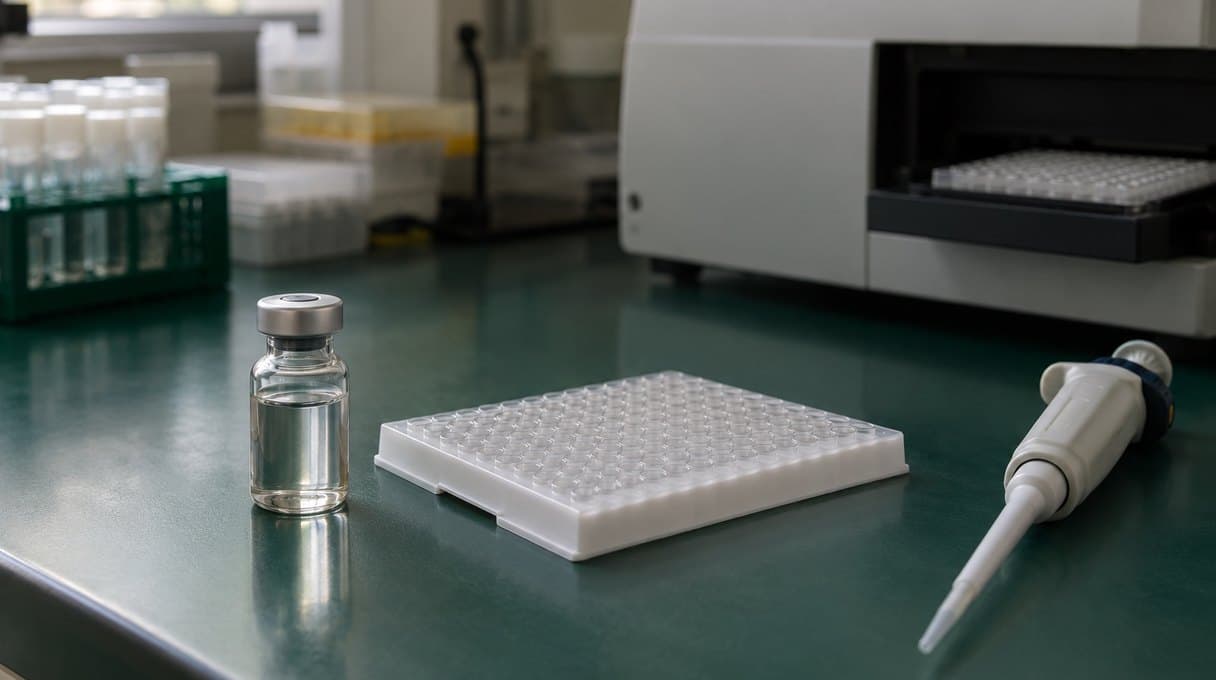
Endotoxin testing measures the amount of bacterial endotoxin, a component of the outer membrane of gram-negative bacteria, present in a research material or its reconstitution water. The long-standing method is the Limulus Amebocyte Lysate (LAL) assay, which uses a reagent derived from horseshoe crab blood cells to detect endotoxin through a clotting or color-change reaction; recombinant alternatives that do not depend on the horseshoe crab-derived reagent have since been developed and validated. On a peptide certificate of analysis, the result is reported in endotoxin units, a way of standardizing potency across different bacterial sources rather than reporting a raw mass. This article covers how the assay works, the units it reports in, and why research vendors test for this at all.
| Attribute | Detail |
|---|---|
| What is measured | Bacterial endotoxin (lipopolysaccharide) from the outer membrane of gram-negative bacteria |
| Classic method | Limulus Amebocyte Lysate (LAL) assay: gel-clot, turbidimetric, or chromogenic format |
| Newer alternative methods | Recombinant Factor C (rFC) and recombinant cascade reagent (rCR) assays, which do not rely on lysate from horseshoe crab blood |
| Reporting unit | Endotoxin Units (EU), a standardized potency unit rather than a mass measurement |
| Governing reference | USP General Chapter 85 (Bacterial Endotoxins Test) and related FDA guidance |
What is bacterial endotoxin, and why test for it?
Endotoxin, chemically lipopolysaccharide (LPS), is a structural component of the outer membrane of gram-negative bacteria that is released when those cells die or divide. It is heat-stable and can survive processes, such as standard autoclaving, that would otherwise sterilize a solution, which is part of why endotoxin testing is treated as a separate quality attribute from sterility testing rather than something covered by proving a sample is free of live organisms. For research material intended for use in cell culture and other laboratory assays, endotoxin contamination is a known confounder because it can activate immune-related signaling pathways in cultured cells independent of whatever the peptide under study is meant to do, making a clean endotoxin result relevant to the integrity of downstream experimental results, not only to a general quality claim.
How does the LAL assay actually detect endotoxin?
The LAL assay uses lysate from the blood cells (amebocytes) of the horseshoe crab, which contains a clotting cascade that is naturally triggered by the presence of endotoxin. A review tracing the history of endotoxin detection describes how this reaction, originally observed as a diagnostic curiosity, was developed into a standardized laboratory test, and outlines the three common assay formats built on the same underlying chemistry: gel-clot (a simple pass/fail clot formation), turbidimetric (measuring the reaction's effect on solution turbidity over time), and chromogenic (measuring a colored product released during the reaction) (Ding and Ho, 2010). A comparative study evaluating these LAL test formats side by side for endotoxin measurement in protein solutions reported that results could differ meaningfully between formats depending on the sample matrix, which is part of why the assay format used is a relevant detail on a COA, not an interchangeable footnote (Chen and Mozier, 2013).
What are recombinant alternatives, and why were they developed?
Because the classic LAL assay depends on lysate harvested from horseshoe crabs, recombinant alternatives have been developed that reproduce the same clotting-cascade chemistry using recombinant proteins, most notably recombinant Factor C (rFC) and, more recently, recombinant cascade reagent (rCR) assays that reconstruct more of the natural cascade using recombinant components. A review of recombinant bacterial endotoxin testing describes rFC and related recombinant methods as having been validated against the classic LAL assay across a range of sample types, framing them as a proven, non-animal-derived alternative for routine endotoxin testing (Tindall et al., 2021). A more recent comparative study evaluating LAL and recombinant cascade reagent methods head to head for bacterial endotoxin testing in pharmaceutical products reported that the recombinant method performed comparably to LAL across the samples tested, supporting its use as a like-for-like substitute in a quality control setting (Thota et al., 2026). A separate evaluation comparing LAL and recombinant assay formats specifically for detection specificity reported differences in how the assays responded to certain endotoxin preparations, which is a reminder that "recombinant" and "LAL" are related but not chemically identical tests, even when both report results in the same endotoxin units (Dubczak et al., 2021).
What does the "endotoxin unit" on a COA actually mean?
Endotoxin potency is reported in Endotoxin Units (EU) rather than a mass unit, because different bacterial sources and preparations of endotoxin do not have identical potency per unit mass. An EU is defined relative to a reference endotoxin standard, which allows results generated in different labs, using different assay formats, to be compared on a common scale. USP General Chapter 85, the Bacterial Endotoxins Test, sets out the reference methodology and acceptance-criteria framework that most pharmaceutical and research-grade endotoxin testing is built around, and FDA guidance on pyrogen and endotoxin testing addresses how these limits are applied in practice (FDA, Pyrogen and Endotoxins Testing: Questions and Answers). A COA reporting a result such as a given EU figure per milligram or per vial is expressing the sample's endotoxin content relative to that standardized scale, not a direct weight of contaminating bacterial material.
Can endotoxin be "hidden" from the assay in a sample?
Yes, a phenomenon generally called low endotoxin recovery (LER) or endotoxin masking has been documented in some biologic formulations, where endotoxin present in a sample is detected at a lower level than expected, apparently because formulation components can alter how endotoxin aggregates or presents itself to the assay's detection chemistry. One study specifically examining this question in biologic drug products reported evidence against a masking effect under the conditions tested, illustrating that this is an active area of investigation rather than a settled universal phenomenon, and that its presence or absence depends on the specific formulation being tested (Bolden et al., 2014). This is one reason endotoxin testing methodology, including how a sample is diluted and handled before assay, is treated as a real variable in test design rather than a fixed, one-size-fits-all procedure.
How does endotoxin testing fit alongside a peptide's other COA specifications?
Endotoxin is one of several quality attributes, alongside identity, purity, and sterility, that a thorough peptide COA can report, and each addresses a different failure mode. Our broader guide, beyond purity: endotoxin, sterility and heavy-metal testing, covers how these tests fit together on a complete COA; this article focuses specifically on how the endotoxin figure itself is generated and expressed. For a worked example of a COA that reports this alongside purity and identity testing, see reading a LY3437943 certificate of analysis, and the current lot documentation on our LY3437943 lot page for a live example of the same fields in practice.
Frequently asked questions
Is the LAL assay the same as a sterility test?
No. Sterility testing checks for the presence of viable microorganisms. Endotoxin testing measures a heat-stable bacterial component that can persist even after organisms have been killed, so the two tests address different failure modes and are typically reported separately on a COA.
Why does an endotoxin result use "EU" instead of a weight unit?
Endotoxin potency varies by bacterial source and preparation, so results are standardized against a reference endotoxin using Endotoxin Units, allowing comparison across labs and assay formats rather than reporting a raw, source-specific mass.
Are recombinant endotoxin assays considered equivalent to the LAL assay?
Recombinant methods such as rFC and rCR have been validated against classic LAL testing and reported as comparable across the sample types studied, though published comparisons have also noted format-specific differences in specificity, so equivalence is generally assessed method by method rather than assumed universally.
What does USP General Chapter 85 cover?
USP General Chapter 85, the Bacterial Endotoxins Test chapter, describes the reference methodology and acceptance criteria used to test pharmaceutical and research-grade materials for bacterial endotoxin using the LAL assay and related methods.
Can a sample still contain endotoxin the assay does not detect?
Under certain formulation conditions, a phenomenon called low endotoxin recovery or endotoxin masking has been reported in the literature, where a sample's true endotoxin content is not fully reflected in the assay result. This has been studied specifically because it is not a universal effect and depends on the sample matrix.
References
- Ding JL, Ho B. Endotoxin detection, from limulus amebocyte lysate to recombinant factor C. Subcell Biochem. 2010;53:187-208. PubMed 20593268.
- Chen L, Mozier N. Comparison of Limulus amebocyte lysate test methods for endotoxin measurement in protein solutions. J Pharm Biomed Anal. 2013;80:180-5. PubMed 23584077.
- Dubczak J, Reid N, Tsuchiya M. Evaluation of limulus amebocyte lysate and recombinant endotoxin alternative assays for an assessment of endotoxin detection specificity. Eur J Pharm Sci. 2021;159:105716. PubMed 33454378.
- Tindall B, Demircioglu D, Uhlig T. Recombinant bacterial endotoxin testing: a proven solution. BioTechniques. 2021;70(5):290-300. PubMed 33956506.
- Thota P, Kumar P, Teotia AK, et al. Study of LAL and Recombinant Cascade Reagents Methods for Bacterial Endotoxin Testing in Pharmaceutical Products. PDA J Pharm Sci Technol. 2026;80(3):288-297. PubMed 41844320.
- Bolden JS, Claerbout ME, Miner MK, et al. Evidence against a bacterial endotoxin masking effect in biologic drug products by limulus amebocyte lysate detection. PDA J Pharm Sci Technol. 2014;68(5):472-7. PubMed 25336418.
- FDA. Pyrogen and Endotoxins Testing: Questions and Answers (guidance for industry). FDA guidance.
Research use only. Homegrown Peptides products are for laboratory research and are not for human or animal use. Nothing in this article is medical advice.