Published clinical research on thymosin alpha-1 clusters around four areas: chronic hepatitis B, chronic hepatitis C, adjunct therapy in severe sepsis, and mechanistic work on immune markers and vaccine response. Across these trials, investigators most often used a subcutaneous regimen reported as 900 micrograms per square meter (or a flat 1.6 milligrams) given twice weekly, with endpoints ranging from HBV DNA clearance to 28-day mortality to dendritic-cell signaling.
| Fact | Value | Source |
|---|---|---|
| Peptide identity | 28-residue, N-acetylated fragment of prothymosin alpha | /blog/what-is-thymosin-alpha-1 |
| Common trial regimen | 900 micrograms per square meter, subcutaneous, twice weekly (reported across most hepatitis trials) | Chan HL, et al. Aliment Pharmacol Ther. 2001 (PubMed PMID 11736720) |
| Hepatitis C combination result | No statistically significant advantage over interferon alone for sustained response | Sherman KE, et al. Hepatology. 1998 (PubMed PMID 9537454) |
| Hepatitis B pooled signal | Meta-analysis reported a significant increase in HBV DNA clearance versus untreated controls | Chan HL, et al. Aliment Pharmacol Ther. 2001 (PubMed PMID 11736720) |
| Sepsis trial design | Multicenter, randomized, adjunct to standard ICU care, 28-day mortality as primary endpoint | Wu J, et al. Crit Care. 2013 (ETASS trial) |
What did the hepatitis B trials examine?
The earliest controlled human work on thymosin alpha-1 in chronic hepatitis B used small, placebo-controlled pilot designs. Mutchnick and colleagues ran one of the first US trials, comparing subcutaneous thymosin alpha-1 against placebo in adults with chronic hepatitis B, with HBV DNA clearance and ALT normalization as the measured endpoints over roughly six months. A subsequent randomized trial by Andreone and colleagues compared thymosin alpha-1 directly against interferon alfa in HBeAg-positive chronic hepatitis B, tracking HBeAg seroconversion at one year.
Because the individual trials were small, the field leaned heavily on a 2001 meta-analysis by Chan and colleagues that pooled multiple randomized trials of thymosin alpha-1 against an untreated or placebo control group in chronic hepatitis B. That pooled analysis reported a significant increase in HBV DNA clearance in the thymosin alpha-1 arms relative to controls, while noting that individual trial quality and follow-up length varied considerably. This meta-analysis remains the most commonly cited summary of the hepatitis B literature for this compound, and it is the reason most later papers report hepatitis B amounts using the same regimen: a twice-weekly subcutaneous schedule continued for several months rather than weeks.
What did the hepatitis C trial find, and why did interest decline?
The largest and most rigorously controlled thymosin alpha-1 trial in viral hepatitis is a four-arm, randomized, placebo-controlled, double-blind study in chronic hepatitis C led by Sherman and colleagues. The trial design is unusually clean for this literature: patients were randomized to interferon alone, thymosin alpha-1 alone, the combination, or placebo, with sustained ALT normalization and HCV RNA clearance as endpoints after a year of follow-up. The headline finding was a negative one for the combination hypothesis: adding thymosin alpha-1 to interferon did not produce a statistically significant improvement in sustained response over interferon alone. That result, from a trial large enough to detect a meaningful difference, is the main reason hepatitis C research on thymosin alpha-1 largely wound down once direct-acting antivirals became the field's dominant research question.
What did the sepsis trials measure, and what changed with the multicenter data?
The best-known sepsis work is the ETASS trial (Efficacy of Thymosin alpha 1 for Severe Sepsis), a multicenter, randomized, controlled study in Chinese ICUs led by Wu and colleagues. The design added thymosin alpha-1 to standard sepsis management and tracked 28-day mortality alongside markers of cell-mediated immunity, including monocyte HLA-DR expression, a marker investigators use as a proxy for sepsis-associated immunosuppression. The trial reported lower mortality in the thymosin alpha-1 arm relative to standard care alone, concentrated in patients with evidence of more severe immune suppression at enrollment.
Later systematic reviews and pooled analyses of multiple Chinese multicenter sepsis trials extended this work through the early 2020s, generally reinforcing the HLA-DR recovery signal while flagging that individual trial sizes remained modest and that blinding was inconsistent across sites. Readers should regard the sepsis literature as a converging but not fully settled body of evidence: the direction of effect on immune marker recovery is consistent across trials, while the mortality signal is more sensitive to which trials a given review includes.
| Study | Model and n | Amount and route (as reported) | Endpoint | Finding |
|---|---|---|---|---|
| Mutchnick MG, et al., 1991 | Human trial, chronic hepatitis B, placebo-controlled pilot | 900 micrograms per square meter, subcutaneous, twice weekly, 6 months | HBV DNA clearance, ALT normalization | Higher virologic/biochemical response rate than placebo at pilot scale |
| Andreone P, et al., 1996 | Human RCT, HBeAg-positive chronic hepatitis B | 900 micrograms per square meter, subcutaneous, twice weekly, versus interferon alfa | HBeAg seroconversion at 1 year | Seroconversion rates broadly comparable between thymosin alpha-1 and interferon arms |
| Chan HL, et al., 2001 (PubMed PMID 11736720) | Meta-analysis of randomized trials, chronic hepatitis B | 900 micrograms per square meter, subcutaneous, twice weekly, typically 6 months (pooled regimen) | HBV DNA clearance, HBeAg loss | Significant increase in HBV DNA clearance versus controls across pooled trials |
| Sherman KE, et al., 1998 (PubMed PMID 9537454) | Human RCT, 4-arm, chronic hepatitis C, n=213 | 900 micrograms per square meter, subcutaneous, twice weekly, plus interferon versus interferon alone versus thymosin alone versus placebo, 1 year | Sustained ALT normalization, HCV RNA clearance | No significant advantage of the combination over interferon alone |
| Wu J, et al., 2013 (ETASS) | Multicenter human RCT, severe sepsis, ICU patients | 1.6 milligrams, subcutaneous, twice daily, 7 days, adjunct to standard care | 28-day mortality, monocyte HLA-DR expression | Lower mortality and faster HLA-DR recovery in the thymosin alpha-1 arm |
| Romani L, et al., 2006 | Mouse model and dendritic cell culture | Intraperitoneal administration in mouse experiments; direct culture exposure in cell assays | Indoleamine 2,3-dioxygenase activation, regulatory T-cell induction | Thymosin alpha-1 activated tryptophan catabolism in dendritic cells and expanded regulatory T-cell populations |
| Gravenstein S, et al., 1989 | Human RCT, elderly men, influenza vaccination | Subcutaneous amount given alongside standard influenza vaccination | Post-vaccination antibody titer | Augmented antibody response relative to vaccine alone in this cohort |
What do the immune-marker and vaccine-response studies show?
Separate from the hepatitis and sepsis trials, a line of mechanistic and small human studies examines how thymosin alpha-1 shifts measurable immune markers rather than disease endpoints directly. The most influential mechanistic paper, from Romani and colleagues, used mouse and dendritic-cell culture models to show that thymosin alpha-1 activates the indoleamine 2,3-dioxygenase pathway in dendritic cells and increases the population of regulatory T cells, a finding researchers use to explain both the tolerance-promoting and the anti-infective effects reported in other models.
In human subjects, the Gravenstein trial paired thymosin alpha-1 with influenza vaccination in elderly men and measured post-vaccination antibody titers against a vaccine-alone control group, reporting an augmented antibody response in the thymosin alpha-1 group. This vaccine-adjuvant design, pairing a fixed vaccination schedule with thymosin alpha-1 and measuring the serologic response, is the template most later immune-marker studies in older or immunocompromised cohorts have followed, including monocyte HLA-DR panels used in the sepsis trials above.
What was reported for adverse events and tolerability?
Across the trials summarized here, investigators generally characterized thymosin alpha-1 as well tolerated at the regimens studied. The ETASS investigators recorded no significant difference in adverse events between the thymosin alpha-1 and standard-care arms, with mild injection-site reactions noted infrequently in the active arm. In the hepatitis C combination trial, the adverse events recorded were concentrated in the interferon-containing arms (fatigue, flu-like symptoms, and reduced neutrophil counts), the pattern expected from interferon itself, with no additional adverse event signal attributed specifically to thymosin alpha-1 beyond occasional, mild injection-site irritation. The hepatitis B pilot and comparator trials similarly reported tolerability consistent with a subcutaneous peptide, without a distinct adverse event pattern separating thymosin alpha-1 from placebo or from interferon comparators.
How is thymosin alpha-1 handled in a research setting?
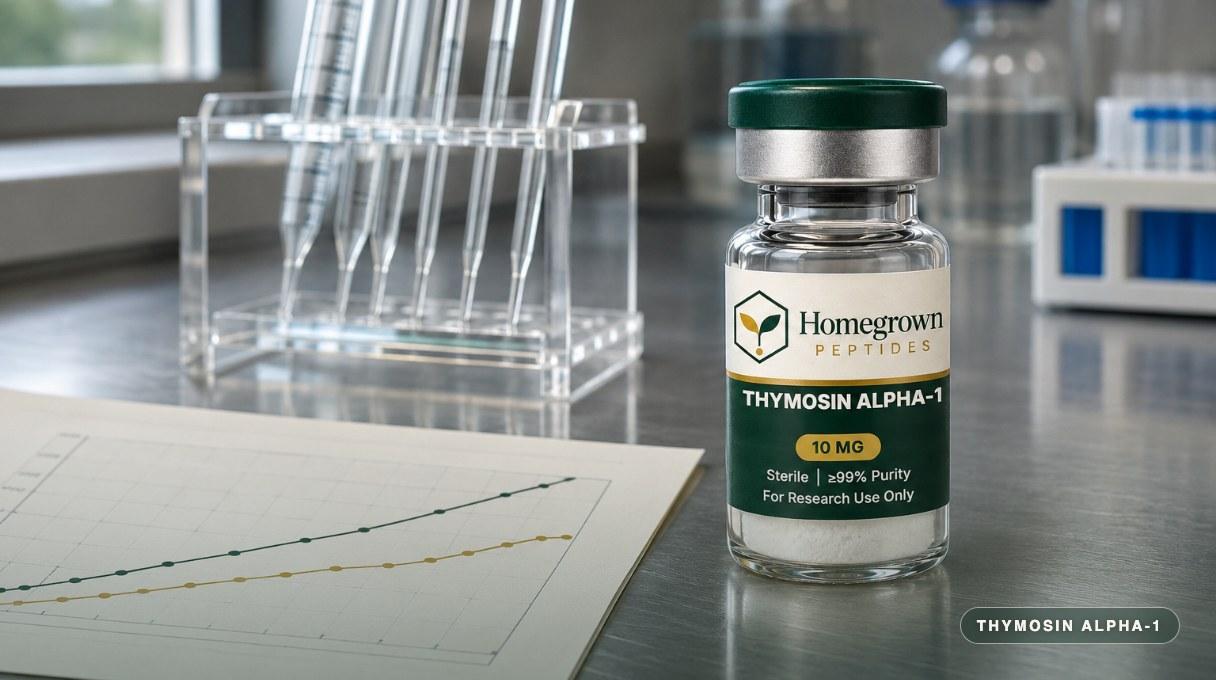
Thymosin alpha-1 ships as a lyophilized powder and is reconstituted with bacteriostatic water before use in cell or animal work, following the same concentration math used for other short peptides; see reconstituting lyophilized peptides for the step-by-step calculation. Each lot should arrive with a certificate of analysis reporting identity, purity, and endotoxin result; how to read a peptide certificate of analysis walks through what each section of that document actually proves. Reconstituted material is stored refrigerated and used within the window the certificate specifies, consistent with general peptide stability data.
For laboratory work, the thymosin alpha-1 listing carries the lot-matched certificate of analysis described above.
Frequently asked questions
Is thymosin alpha-1 the same molecule as thymosin beta-4 or TB-500?
No. Thymosin alpha-1 and thymosin beta-4 are distinct peptides from different thymosin families with different sequences and different research literatures; TB-500 is a synthetic fragment derived from thymosin beta-4, not from thymosin alpha-1. See thymosin beta-4 vs TB-500 for the structural comparison.
What amount did the hepatitis trials use most often?
Most of the hepatitis B and hepatitis C trials summarized above converged on the same subcutaneous schedule: 900 micrograms per square meter (commonly expressed as a flat 1.6 milligram amount) given twice weekly, typically for six months to a year depending on the study.
Did the sepsis trial show a mortality effect?
The ETASS trial reported lower 28-day mortality in the thymosin alpha-1 arm compared with standard care alone, alongside faster recovery of monocyte HLA-DR expression. Later pooled reviews of multiple multicenter sepsis trials reinforced the immune-marker signal while noting that individual trial sizes remained modest.
Is thymosin alpha-1 the same compound as thymalin?
No. Thymalin is a short-peptide thymic complex studied in a separate line of bioregulator research, while thymosin alpha-1 is a single 28-residue peptide with its own, largely distinct clinical literature. See what is thymalin and bioregulator peptides explained for how the two research traditions differ.
What immune markers changed in the research studies?
The markers tracked most consistently across these trials are monocyte HLA-DR expression (used as a sepsis-immunosuppression marker), HBV DNA and HBeAg status in hepatitis B, HCV RNA and ALT in hepatitis C, and vaccine antibody titers in the vaccine-response studies. Mechanistic work additionally measured indoleamine 2,3-dioxygenase activity and regulatory T-cell counts in dendritic-cell models.
Why did hepatitis C research on thymosin alpha-1 decline?
The largest controlled trial in hepatitis C, led by Sherman and colleagues, found no statistically significant advantage to adding thymosin alpha-1 to interferon over interferon alone. That negative result, combined with the later arrival of direct-acting antivirals, shifted hepatitis C research attention away from thymosin alpha-1.
Are the sepsis and immune-marker findings consistent across different research groups?
The direction of effect on immune markers, principally HLA-DR recovery, has been reasonably consistent across the multicenter sepsis trials pooled in later reviews. The mortality finding is more sensitive to which trials a given analysis includes, so it should be read as a consistent immune-marker signal with a less settled mortality signal.
References
- Sherman KE, Sjogren M, Creager RL, et al. Combination therapy with thymosin alpha1 and interferon for the treatment of chronic hepatitis C infection: a randomized, placebo-controlled double-blind trial. Hepatology. 1998;27(4):1128-1135. PubMed PMID 9537454.
- Chan HL, Tang JL, Tam W, Sung JJ. The efficacy of thymosin in the treatment of chronic hepatitis B virus infection: a meta-analysis. Aliment Pharmacol Ther. 2001;15(12):1899-1905. PubMed PMID 11736720.
- Mutchnick MG, Appelman HD, Chung HT, et al. Thymosin treatment of chronic hepatitis B: a placebo-controlled pilot trial. Hepatology. 1991;14(3):409-415. PubMed PMID.
- Andreone P, Cursaro C, Gramenzi A, et al. A randomized controlled trial of thymosin-alpha1 versus interferon alfa treatment in patients with hepatitis B e antigen antibody and hepatitis B virus DNA positive chronic hepatitis B. Hepatology. 1996;24(4):774-777. PubMed PMID.
- Wu J, Zhou L, Liu J, et al. The efficacy of thymosin alpha 1 for severe sepsis (ETASS): a multicenter, single-blind, randomized and controlled trial. Crit Care. 2013;17(1):R8. PubMed PMID.
- Romani L, Bistoni F, Perruccio K, et al. Thymosin alpha1 activates dendritic cell tryptophan catabolism and the generation of regulatory T cells. Blood. 2006;108(7):2265-2274. PubMed PMID.
- Gravenstein S, Duthie EH, Miller BA, et al. Augmentation of influenza antibody response in elderly men by thymosin alpha 1: a double-blind placebo-controlled clinical study. J Am Geriatr Soc. 1989;37(1):1-6. PubMed PMID.
Research use only. Homegrown Peptides products are for laboratory research and are not for human or animal use. Nothing in this article is medical advice.