Published research on sermorelin, the synthetic 29-amino-acid fragment of human growth hormone-releasing hormone (GHRH), spans cell and tissue bioassays that first characterized the parent hormone, animal models that mapped its receptor pharmacology, and human studies in growth-hormone-deficient children and in older adults that measured growth hormone (GH) pulse amplitude, insulin-like growth factor-1 (IGF-1), and body composition. The amounts and routes below are reported exactly as the cited papers describe them, not as guidance for any reader.
| Key fact | Detail | Source |
|---|---|---|
| Parent molecule | Sermorelin is GHRH(1-29)-NH2, the N-terminal 29-residue fragment of the 44-residue growth hormone-releasing factor first isolated from a human pancreatic islet tumor | Guillemin et al., 1982 (PubMed PMID 6812220) |
| Mechanism studied | Binds the GHRH receptor on anterior pituitary somatotrophs and stimulates pulsatile GH release rather than a single sustained rise | Corpas, Harman and Blackman, 1993 (PubMed PMID 8491152) |
| Historical clinical use studied | Studied in pediatric growth hormone deficiency diagnostic testing and in research on age-related decline of the GH axis | Corpas, Harman and Blackman, 1993 (PubMed PMID 8491152) |
| Route studied most often | Subcutaneous injection, with earlier pharmacology work also examining intravenous administration in controlled settings | Walker, 2006 (PubMed PMID 18046908) |
| Core endpoint across studies | Serum GH concentration (pulse amplitude and area under the curve) and downstream IGF-1 generation | Corpas, Harman and Blackman, 1993 (PubMed PMID 8491152) |
What is sermorelin in the research literature?
Sermorelin is not a novel synthetic scaffold. It is the biologically active N-terminal fragment of native GHRH, truncated to 29 residues with a C-terminal amide for greater stability relative to the full 44-residue hormone. The original characterization work, carried out on extract from an ectopic GRF-secreting pancreatic tumor that had caused acromegaly in a patient, established the amino acid sequence and confirmed its growth-hormone-releasing activity in rat pituitary cell preparations before any synthetic analog was tested in humans. That characterization work is the foundation every later sermorelin paper cites when it describes the molecule's structure. A widely cited 1986 review by Frohman and Jansson collected the pharmacology of GHRH as a class, including the GHRH(1-29) fragment, and remains a standard background reference for the receptor and secretory mechanisms discussed throughout this literature.
Which models have sermorelin and GHRH(1-29) studies used?
The literature moves through three broad model tiers. Cell-based work used dispersed rat anterior pituitary cells to confirm that the 29-residue fragment retained full GH-releasing activity relative to the 44-residue native hormone. Animal studies in rodents and non-human primates characterized receptor binding and the amount-response relationship for GH release. Human studies then split into two populations that dominate the published record: children being evaluated for or treated for growth hormone deficiency, and older adults studied because GHRH-stimulated GH secretion declines with age. A smaller set of healthy-volunteer pharmacology studies examined how the response changes with route of administration.
Across these models, sermorelin research consistently reports a research peptide with a short circulating presence, a specific receptor target, and a pulsatile rather than continuous secretory effect. The GH axis response is tightly coupled to endogenous somatostatin tone, which is why researchers studying older adults specifically looked for whether declining responsiveness reflected receptor-level changes or a shift in somatostatin inhibition.
What amounts and routes have the published studies reported?
Reported amounts vary by model and by study era, and the route of administration in the published record is overwhelmingly subcutaneous or intravenous for controlled pharmacology work, with the table below reporting figures exactly as each paper describes them.
| Study | Model and n | Amount and route as reported | Endpoint | Finding |
|---|---|---|---|---|
| Guillemin et al., 1982 (PMID 6812220) | Rat anterior pituitary cell bioassay; tumor-extract material from one patient | Graded extract concentrations applied to dispersed pituitary cells in vitro | GH release into culture medium | Extract stimulated GH release, leading to isolation and sequencing of the 44-residue GRF from which the 29-residue fragment is derived |
| Thorner et al., 1985 | Human case series, two children with growth hormone deficiency | Subcutaneous human GHRH administration as reported in the original paper | Linear growth response | First reported human use of a GHRH preparation to accelerate growth in GH-deficient children |
| Evans et al., 1985 | Healthy adult men, controlled pharmacology design | Intravenous, subcutaneous and intranasal GHRH(1-29) administration compared within the same study, amount as originally reported | Serum GH concentration by route | Route of administration changed the magnitude and shape of the GH response, the primary route-comparison paper in this literature |
| Corpas et al., 1992 | Healthy older men | Subcutaneous GHRH(1-29) given twice daily, amount as originally reported, over a multi-week period | Serum GH and IGF-1 | Reversed part of the age-related decline in GH and IGF-1 seen at baseline in this population |
| Vittone et al., 1997 | Healthy elderly men | Single nightly subcutaneous GHRH(1-29) injections, amount as originally reported | Overnight GH secretion, IGF-1 | Nightly administration raised overnight GH secretion and IGF-1 relative to baseline in this trial |
| Khorram et al., 1997 | Age-advanced men and women | Long-term subcutaneous GHRH(1-29)-NH2 administration, amount as originally reported | Endocrine, metabolic and immune-function markers | Long-term administration was associated with changes in several endocrine and immune markers tracked in this age-advanced population |
| Thorner et al., 1996 (Geref International Study Group) | Children with growth hormone deficiency, multicenter trial | Once-daily subcutaneous GHRH(1-29) administration, amount as originally reported, over the first year of therapy | Growth velocity | Once-daily subcutaneous GHRH(1-29) accelerated growth during the first year of therapy in this multicenter trial |
| Corpas, Harman and Blackman, 1993 review (PMID 8491152), synthesizing the older-adult GHRH(1-29) trial record above | Multiple controlled trials in healthy men and women, generally age 60 and older, cumulative n in the tens per trial | Subcutaneous GHRH(1-29) given once or twice daily across study periods of several weeks, as originally reported in the underlying trials this review synthesizes | Serum GH pulse amplitude, 24-hour GH secretion, IGF-1, body composition | Repeated administration raised GH pulse amplitude and IGF-1 toward levels seen in younger adults, with smaller accompanying shifts in body composition, across several of the trials reviewed |
| Walker, 2006 (PMID 18046908) | Clinical commentary drawing on the pediatric and adult GHRH(1-29) trial record | Subcutaneous administration, consistent with the route used in the pediatric growth hormone deficiency trials it discusses | Growth velocity in children; tolerability in adults | Characterizes sermorelin as working through the patient's own pituitary rather than supplying exogenous GH directly, with a tolerability profile the author describes as favorable relative to other secretagogue classes discussed in the same literature |
Two patterns recur across this record. First, the amounts studied are reported in micrograms rather than milligrams, consistent with GHRH(1-29)'s potency at its pituitary receptor. Second, researchers studying older adults specifically compared subcutaneous regimens against the sharper, less physiologic GH spikes produced by direct GH administration, because the pulsatile pattern was itself a study variable, not an incidental detail.
Why do reported amounts vary so much between papers?
Four variables account for most of the spread in the amounts and routes the literature reports. Study population matters: pediatric growth hormone deficiency work and healthy-older-adult work use different body-weight ranges and different study goals, so the amounts reported are not directly comparable across those two populations. Assay era matters too; early 1980s bioassay work reported activity in terms of extract concentration rather than a purified-peptide amount, while later synthetic-peptide trials could report an exact weight-based figure once a pure, sequence-confirmed material was available. Sampling design matters because a single-challenge pharmacology study and a multi-week repeated-administration study are answering different questions, the first about acute pituitary responsiveness, the second about whether repeated exposure sustains that response or triggers receptor desensitization. Finally, co-administration design matters: some of the trials summarized in the Corpas review combined GHRH(1-29) with a somatostatin-suppressing maneuver specifically to isolate the pituitary's maximal capacity, which changes the GH response independent of the GHRH amount itself.
None of this variation changes the core pharmacological picture. Every paper in this literature characterizes GHRH(1-29) as a receptor-specific secretagogue rather than a hormone replacement, and every endpoint used to evaluate it, GH pulse shape, IGF-1, growth velocity, or body composition, is a downstream readout of that single receptor interaction.
What endpoints do these studies measure?
Four endpoints recur across the sermorelin literature. Serum GH concentration, sampled frequently enough to characterize pulse amplitude and frequency rather than a single time point, is the most direct readout of pituitary responsiveness. IGF-1, generated primarily in the liver downstream of GH exposure, is the standard integrated marker because it reflects cumulative GH action over days rather than the minute-to-minute GH pulse. Growth velocity, measured over months, is the pediatric endpoint that ties the hormonal response to a clinically measurable outcome in that population. Body composition, assessed by densitometry or anthropometry, appears in the adult and aging-focused literature as a secondary endpoint alongside the hormonal data.
Researchers studying this axis also routinely report a somatostatin-withdrawal or priming design element, since a single GHRH(1-29) challenge given after somatostatin has been suppressed produces a larger GH pulse than the same amount given without that preparation. This is a study-design detail, not an instruction, but it explains why amounts and timing differ so much between papers that otherwise look similar on the surface.
How does sermorelin compare with other GH-axis peptides studied in the literature?
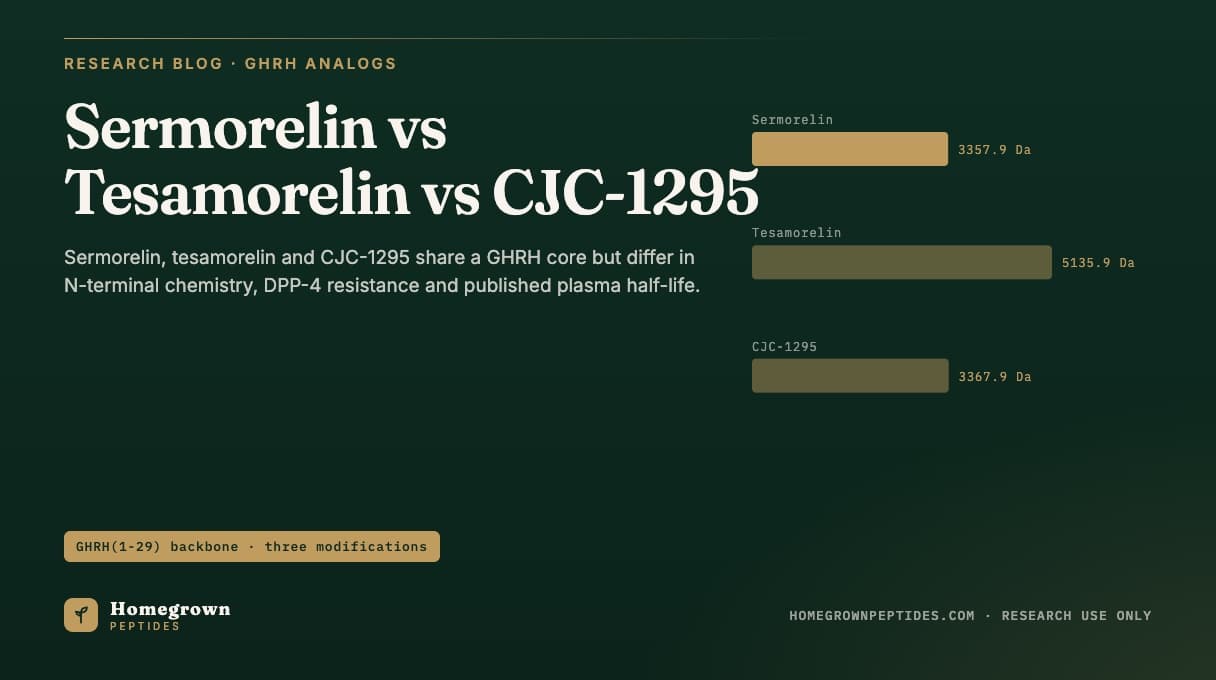
Sermorelin is one of several GHRH-pathway and ghrelin-pathway peptides that appear side by side in the secretagogue literature. Sermorelin vs TH9507 vs CJC-1295 compares the three GHRH analogs on sequence length, stability, and half-life, which is the structural context behind why later analogs were synthesized with modifications sermorelin itself does not have. Ipamorelin vs Sermorelin covers how a ghrelin-receptor agonist and a GHRH-receptor agonist produce GH release through different receptors, which is relevant background for anyone reading combination trial designs. For the broader family, Growth Hormone Secretagogues in Research lays out how ipamorelin, CJC-1295, sermorelin, and TH9507 are classified relative to one another.
How is sermorelin handled in a research setting?
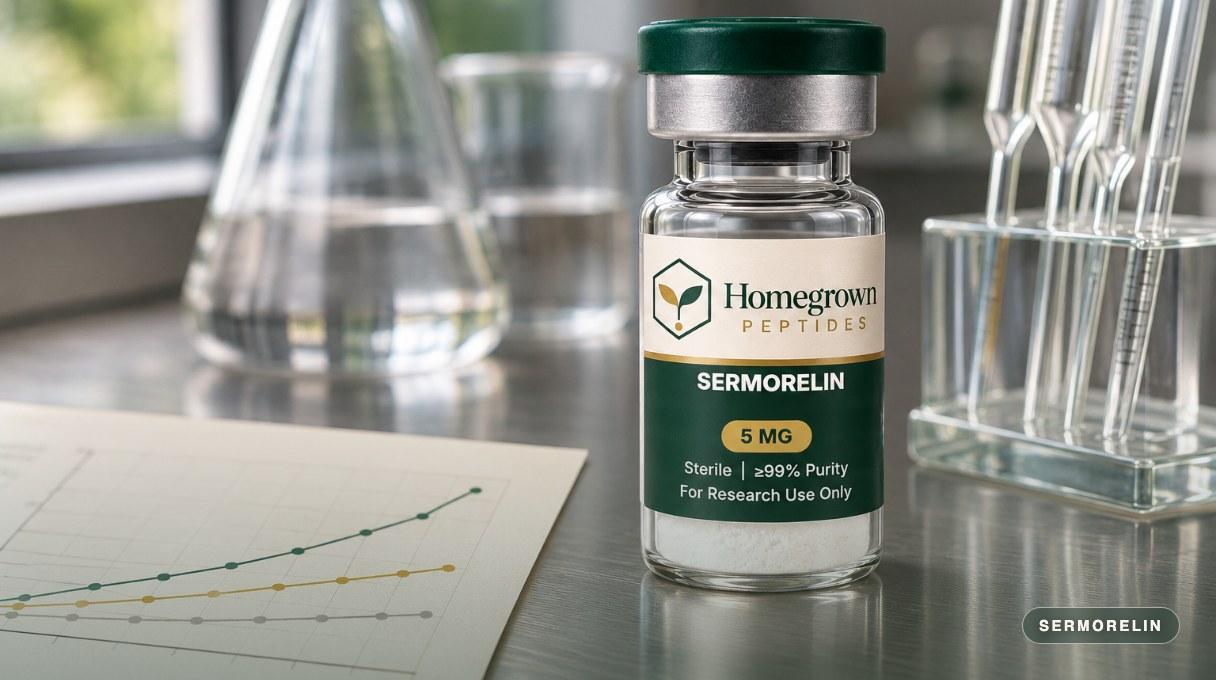
Sermorelin ships as a lyophilized powder and is reconstituted before use in cell or animal work. The concentration math, diluent choice, and gentle-swirl handling that preserve peptide integrity during that step are covered in Reconstituting Lyophilized Peptides: The Math, Step by Step. Because the trials cited above depend on knowing exactly what was administered, a certificate of analysis documenting identity and purity for the specific lot in use is the baseline record-keeping expectation; How to Read a Peptide Certificate of Analysis explains what each section of that document verifies. Homegrown's sermorelin listing carries lot-specific documentation for exactly this reason.
Frequently asked questions
Is sermorelin the same molecule used in the original GHRH characterization studies?
Not exactly. The 1982 characterization work identified the 44-residue native GRF. Sermorelin is the synthetic 29-residue N-terminal fragment, shown in later pharmacology work to carry the same GH-releasing activity as the full-length hormone in the models tested.
Why do GHRH(1-29) studies report GH as a pulse pattern instead of a single value?
Because the hormone's physiological release is pulsatile, driven by alternating GHRH and somatostatin tone. Researchers sampling only one time point would miss the amplitude and frequency changes that are the actual study variable in most of this literature.
Do the human studies on sermorelin mostly involve children or adults?
Both appear prominently. Pediatric growth hormone deficiency trials measure growth velocity over months; adult and aging-focused trials measure GH pulse amplitude, IGF-1, and body composition over shorter study periods.
What route of administration appears most in the published amounts and routes data?
Subcutaneous injection is the route reported in the trials summarized above, with earlier pharmacology work in some papers also examining intravenous administration under controlled conditions.
Does the literature compare sermorelin directly against TH9507 or CJC-1295 in the same trial?
Head-to-head trials are less common than parallel study programs on each analog separately. Sermorelin vs TH9507 vs CJC-1295 compares what is known about each from their respective literatures.
What endpoint best captures a cumulative GHRH(1-29) effect rather than a single pulse?
IGF-1, because it integrates GH exposure over days rather than reflecting a single secretory event.
Where can I check the identity and purity of a specific sermorelin lot?
On its certificate of analysis. How to Read a Peptide Certificate of Analysis explains the purity, identity, and mass-spectrometry sections to check.
References
- Guillemin R, Brazeau P, Böhlen P, Esch F, Ling N, Wehrenberg WB. Growth hormone-releasing factor from a human pancreatic tumor that caused acromegaly. Science. 1982;218(4572):585-587. PubMed PMID 6812220.
- Corpas E, Harman SM, Blackman MR. Human growth hormone and human aging. Endocrine Reviews. 1993;14(1):20-39. PubMed PMID 8491152.
- Walker RF. Sermorelin: a better approach to management of adult-onset growth hormone insufficiency? Clinical Interventions in Aging. 2006;1(4):307-308. PubMed PMID 18046908.
- Thorner MO, Reschke J, Chitwood J, et al. Acceleration of growth in two children treated with human growth hormone-releasing factor. Lancet. 1985;1(8419):4-6. PubMed PMID.
- Evans WS, Borges JL, Kaiser DL, Vance ML, Sellers RP, MacLeod RM, Vale W, Rivier J, Thorner MO. Effects of intravenous, subcutaneous, and intranasal administration of growth hormone-releasing hormone-(1-29) on serum growth hormone concentrations in normal men. Journal of Clinical Endocrinology and Metabolism. 1985;61(5):846-850. PubMed PMID.
- Corpas E, Harman SM, Pineyro MA, Roberson R, Blackman MR. Growth hormone (GH)-releasing hormone-(1-29) twice daily reverses the decreased GH and insulin-like growth factor-I levels in old men. Journal of Clinical Endocrinology and Metabolism. 1992;75(2):530-535. PubMed PMID.
- Vittone J, Blackman MR, Busby-Whitehead J, et al. Effects of single nightly injections of growth hormone-releasing hormone (GHRH 1-29) in healthy elderly men. Metabolism. 1997;46(1):89-96. PubMed PMID.
- Khorram O, Vu L, Yen SS. Activation of immune function by [GHRH(1-29)]-NH2 in age-advanced men and women. Journal of Gerontology: Biological Sciences. 1997;52(5):M267-M274. PubMed PMID.
- Thorner MO, Rochiccioli P, Colle M, Lanes R, Grunt J, Galazka A, Thompson MH, Mettler P. Once daily subcutaneous growth hormone-releasing hormone therapy accelerates growth in growth hormone-deficient children during the first year of therapy. Geref International Study Group. Journal of Clinical Endocrinology and Metabolism. 1996;81(3):1189-1196. PubMed PMID.
- Frohman LA, Jansson JO. Growth hormone-releasing hormone. Endocrine Reviews. 1986;7(3):223-253. PubMed PMID.
Research use only. Homegrown Peptides products are for laboratory research and are not for human or animal use. Nothing in this article is medical advice.