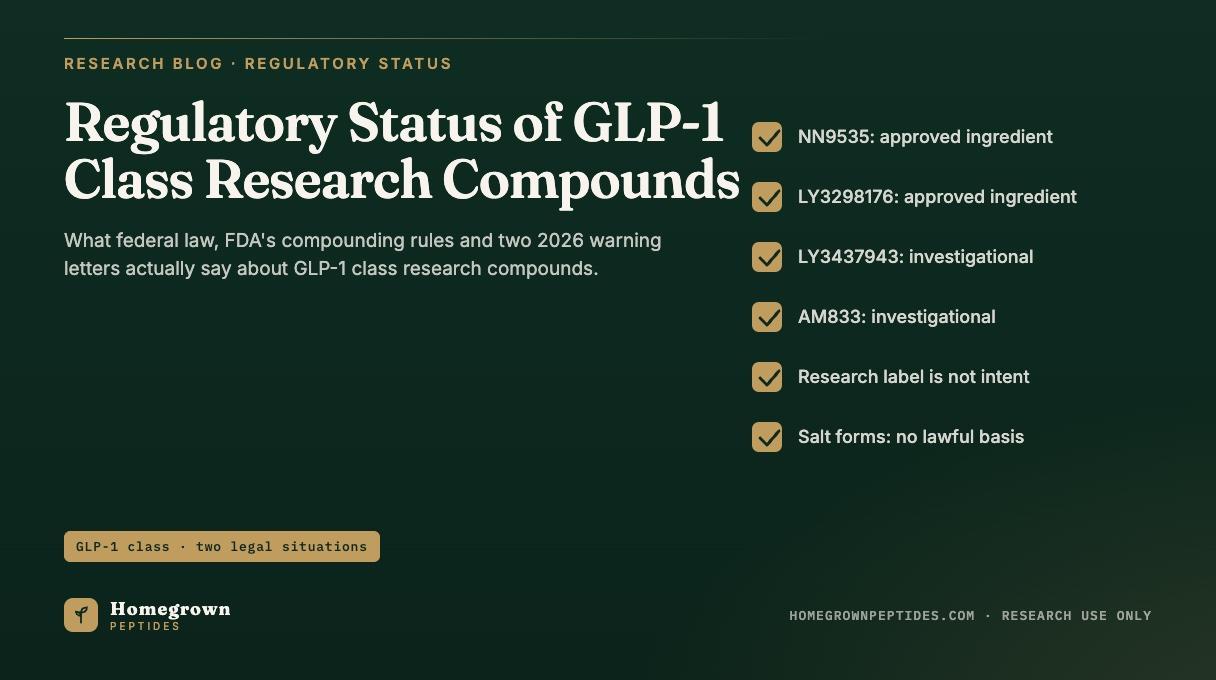
The GLP-1 class splits into two legal situations. NN9535 and LY3298176 are the active ingredients of FDA-approved prescription drugs, so a vial sold for human use outside the approved product or lawful compounding is an unapproved new drug; LY3437943 and AM833 have no approved product at all. As laboratory reagents, all are lawful to supply when intended use is genuinely research, and FDA has said plainly that "research" labels on products sold to consumers with dosing instructions do not change that analysis.
As of November 7, 2026. This article describes United States federal law and published agency actions as of that date. It is general information, not legal advice; the rules differ by state and change over time, and anyone with a specific question should consult a lawyer licensed in their jurisdiction.
| Compound code | Approved product exists? | Compounding note | "Research" sale status | Source |
|---|---|---|---|---|
| NN9535 | Yes, approved drug ingredient | 503A-eligible as a component of an approved drug, subject to shortage-list conditions | Sold with human dosing instructions despite a "research" label, per FDA | LEGAL-FACTS A6, C1, C5 |
| LY3298176 | Yes, approved drug ingredient | Same pathway and conditions as NN9535 | Same FDA position; adverse event reports exist for compounded versions | LEGAL-FACTS A6, C1, C5 |
| LY3437943 | No approved product; investigational | Not a component of an approved drug; not on FDA's published 503A category lists | No approved drug to copy, but the new-drug and misbranding framework still governs human-use sale | LEGAL-FACTS A2, A6, C1 |
| AM833 | No approved product; investigational | Same as LY3437943 | Same as LY3437943 | LEGAL-FACTS A2, A6, C1 |
Which GLP-1 class compounds are approved drug ingredients and which are investigational?
Federal law treats a "new drug" as anything not generally recognized by qualified experts as safe and effective for its labeled use, and bars introducing a new drug into interstate commerce without an effective approval under 21 U.S.C. 355(a). NN9535 and LY3298176 are active ingredients of drug products that cleared that process; that status is what makes them eligible, under FDA's compounding rules, to be compounded as a "component of an FDA-approved drug product," one of three conditions FDA recognizes for a 503A bulk drug substance (the others are compliance with a USP or NF monograph, or inclusion on the separate 503A bulks list).
LY3437943 and AM833 sit on the other side of that line. Neither has an approved drug product, so the component-of-an-approved-drug condition does not apply, and FDA's published category lists do not identify them. That does not make either compound illegal to supply as a laboratory reagent; it means there is no approved human drug for a seller to reference, and any claim that a vial is interchangeable with an approved medicine would misstate its regulatory status. For the chemistry and literature behind each, see What Is LY3437943? and What Is AM833?; FDA has not published an approval determination for either because none exists.
What do the compounding rules say, and why did they dominate 2024 to 2026?
FDA's bulk drug substance policy for 503A compounding lists three conditions, and a substance needs only one: it complies with an applicable USP or NF monograph; it is a component of an FDA-approved drug product; or it appears on the 503A bulks list. FDA also sorts nominated substances into three categories: Category 1 "may be eligible for inclusion on the 503A bulks list" and was nominated with enough information to evaluate; Category 2 carries "significant safety risks relating to the use of these substances in compounding pending further evaluation," and FDA "does not intend to adopt the policy described for the substances in category 1"; Category 3 "may be eligible" but lacks sufficient supporting information. Under a revised interim policy, FDA "does not intend to place bulk drug substances nominated on or after January 7, 2025, into these categories" at all.
Other research peptides, such as GHRP-6, Ipamorelin acetate and Kisspeptin-10, were placed in Category 2 on September 29, 2023 over risks like peptide aggregation and immunogenicity, while several others once nominated, including BPC-157 and CJC-1295, had those nominations withdrawn (a withdrawal is neither a safety finding nor a clearance). None of the four GLP-1 class codes here appear in FDA's Category 2 table; NN9535 and LY3298176 reach compounding eligibility through the separate component-of-an-approved-drug condition instead.The condition that actually matters for NN9535 and LY3298176 is the drug-shortages exception. FDA's page on compounding when drugs are on the shortages list states, for 503A, that "a drug is not considered to be commercially available if it is on FDA's drug shortages list and limitations on compounding essentially copies are not applicable in these circumstances," with a parallel exception for 503B. This rule is what let compounding of essentially-copy versions of NN9535 and LY3298176 expand while both were listed as being in shortage. Exact dates FDA declared those shortages resolved are not restated here; check FDA's own shortages page for the current status.
What has FDA said about "research" GLP-1 sales?
FDA's page on unapproved GLP-1 drugs states that the agency has warned companies that "illegally sold unapproved drugs containing" compounds in this class "that are falsely labeled 'for research purposes' or 'not for human consumption.'" The same page describes these products as "sold directly to consumers for human use with dosing instructions," the fact pattern FDA treats as establishing human-use intent regardless of the label on the vial.
The page also addresses sodium and acetate salt forms of NN9535 sometimes offered by compounders: "The agency does not have information on whether these salts have the same chemical and pharmacologic properties as the active ingredient in the approved drug, and we are not aware of any lawful basis for their use in compounding." As of May 31, 2026, the page reported "990 reports of adverse events associated with compounded" NN9535 and "more than 730 reports of adverse events associated with compounded" LY3298176.
Enforcement against sellers has followed the same reasoning. On August 24, 2026, FDA's Center for Drug Evaluation and Research sent a warning letter to Peptide Partners LLC over a product line that included a three-compound GLP-1 class product alongside SS-31, a TH9507 product and PT-141. The letter cited sections 201(g)(1), 201(p), 505(a) and 301(d) of the Federal Food, Drug, and Cosmetic Act, the provisions that define a drug, define a new drug, require approval before interstate introduction, and prohibit introducing a violative article into commerce. FDA quoted the company's website describing effects in people across several organ systems as evidence of intended use, and addressed the disclaimer directly: "Despite statements on your product labeling marketing your products 'for research use only' and 'not for human or veterinary use,' evidence obtained from your website establishes that your products are intended to be drugs for human use." A separate June 17, 2026 letter to Wholesale Peptide used nearly identical language. Neither letter's claim language is reproduced here beyond naming the category of claim (effects on specific body systems in people).
What makes a research listing for a GLP-1 class compound consistent with its intended use?
FDA's regulation on intended use, 21 CFR 201.128, looks past the label to "the objective intent of the persons legally responsible for the labeling of an article." That intent "may be shown by" labeling claims, advertising, oral or written statements, the article's design or composition, and "the circumstances surrounding the distribution of the article." The same regulation says a firm is not automatically treated as intending an unapproved use "based solely on" knowledge that a drug is prescribed or used off-label by health care providers.
In practice, a listing stays inside the chemistry-and-literature lane when it sticks to what a certificate of analysis reports (identity, purity, net peptide content, endotoxin), what the published literature examined, and the compound's sequence or structure, without claims about effects in people or animals, dosing, or routes of administration. For what to check on a certificate for one of these compounds, see Reading a LY3437943 Certificate of Analysis; Homegrown's own LY3437943 listing, hg-rta-3, follows that same lot-matched certificate model. FDA's regulations define "Research Use Only" labeling formally only for in vitro diagnostic products, under 21 CFR 809.10(c), not for chemical reagents generally, but the same underlying logic, that conduct can contradict a label, is what FDA applied in both 2026 warning letters.
Where do state law and import rules fit?
States run their own food, drug and cosmetic statutes on top of federal law. Florida's chapter 499 defines "drug" in terms nearly identical to the federal definition and lets the state Attorney General add substances to Florida's own controlled-substances schedules by rule, independent of federal scheduling. Illinois's Food, Drug and Cosmetic Act prohibits the same categories of adulteration and misbranding under its own numbering, and California regulates new drugs under its own separate food and drug law. A fuller state-by-state and import-specific treatment is covered in Are Research Peptides Legal in the United States?, which this article does not repeat.
On imports, FDA's Import Alert 66-41 authorizes detention without physical examination of products on its "Red List" that appear to be unapproved new drugs. FDA's personal-importation page states that "in most circumstances, it is illegal for individuals to import drugs or devices into the U.S. for personal use," with narrow enforcement discretion only in specific, documented circumstances. CBP's guidance defers the admissibility decision to FDA and separately bars "fraudulent or counterfeit drugs."
What is settled and what is not
| Question | Settled | Not settled or not published |
|---|---|---|
| Approval status | NN9535 and LY3298176 are approved-drug ingredients; LY3437943 and AM833 have no approved product (21 U.S.C. 355(a)) | Whether either investigational compound will reach approval, or on what timeline |
| Compounding eligibility | The three 503A conditions and Category 1/2/3 system are published | Exact dates FDA declared the NN9535 and LY3298176 shortages resolved |
| "Research" labeling | A "research" or "not for human consumption" label does not override intended-use evidence, per FDA | No general rule beyond the two 2026 warning letters and the GLP-1 concerns page |
| State and controlled-substance status | DEA's alphabetical list does not include any of the four codes here | Whether any state has scheduled a GLP-1 class compound; only Florida and Illinois were reviewed here |
Frequently asked questions
Is NN9535 sold for research legal?
Selling NN9535 as a laboratory reagent with chemistry-only documentation does not, by itself, violate the new-drug or misbranding provisions. What FDA has flagged is a "research" label paired with marketing that shows the product is actually intended for human use. The label does not control; the surrounding facts do, under 21 CFR 201.128.
Is LY3437943 FDA approved?
No. There is no approved drug product containing LY3437943. It remains investigational and is studied in the published literature; see What Is LY3437943? for its structure and research background.
What is a salt form, and why does FDA mention it?
A salt form pairs the active peptide with a counterion, such as sodium or acetate, which can change solubility and handling. FDA's page on unapproved GLP-1 drugs addresses sodium and acetate salt forms of NN9535 offered by some compounders, stating that the agency lacks information on whether those salts share the chemical and pharmacologic properties of the approved drug's active ingredient and is not aware of a lawful basis for their use in compounding.
Can a compounding pharmacy make copies of an approved GLP-1 drug right now?
That depends entirely on current shortage status, not restated here with specific dates since the source reviewed did not include them. The rule itself is published: a drug is not treated as commercially available while on FDA's drug shortages list, and the "essentially copies" limitation does not apply in that circumstance. Confirm current shortage status on FDA's own shortages page.
Does putting "research use only" on a GLP-1 class product protect the seller?
Not on its own. Both 2026 warning letters discussed here involved sellers using "research use only" or similar language, and in both cases FDA concluded, based on website content, that the products were intended as drugs for human use. The disclaimer did not change the analysis.
What should a reader check on a vendor's GLP-1 class listing?
Look for a lot-matched certificate of analysis covering identity, purity, net peptide content and endotoxin, literature framed around cell or animal research rather than people, and no claims about effects in the body or routes of administration. See Reading a LY3437943 Certificate of Analysis for the specific fields, and compare against a certificate-first listing such as hg-rta-3.
References
- Cornell Law School, Legal Information Institute. 21 U.S.C. 321, definitions, including "drug" at 321(g)(1) and "new drug" at 321(p)(1). Content current as reviewed November 7, 2026. law.cornell.edu.
- Cornell Law School, Legal Information Institute. 21 U.S.C. 331, prohibited acts. Content current as reviewed November 7, 2026. law.cornell.edu.
- Cornell Law School, Legal Information Institute. 21 U.S.C. 355, new drugs. Content current as reviewed November 7, 2026. law.cornell.edu.
- Cornell Law School, Legal Information Institute. 21 CFR 201.128, meaning of intended uses. Content current as reviewed November 7, 2026. law.cornell.edu.
- U.S. Food and Drug Administration. Bulk Drug Substances Used in Compounding Under Section 503A of the FD&C Act. Content current as of 05/14/2026. fda.gov.
- U.S. Food and Drug Administration. Certain Bulk Drug Substances for Use in Compounding That May Present Significant Safety Risks. Content current as of April 22, 2026. fda.gov.
- U.S. Food and Drug Administration. Compounding When Drugs Are on FDA's Drug Shortages List. Content current as of 08/08/2025. fda.gov.
- U.S. Food and Drug Administration. FDA's Concerns with Unapproved GLP-1 Drugs. Content current as of 10/01/2026. fda.gov.
- U.S. Food and Drug Administration, Center for Drug Evaluation and Research. Warning Letter to Peptide Partners LLC. August 24, 2026. fda.gov.
- U.S. Food and Drug Administration, Center for Drug Evaluation and Research. Warning Letter to Wholesale Peptide. June 17, 2026. fda.gov.
Research use only. Homegrown Peptides products are for laboratory research and are not for human or animal use. Nothing in this article is medical advice.