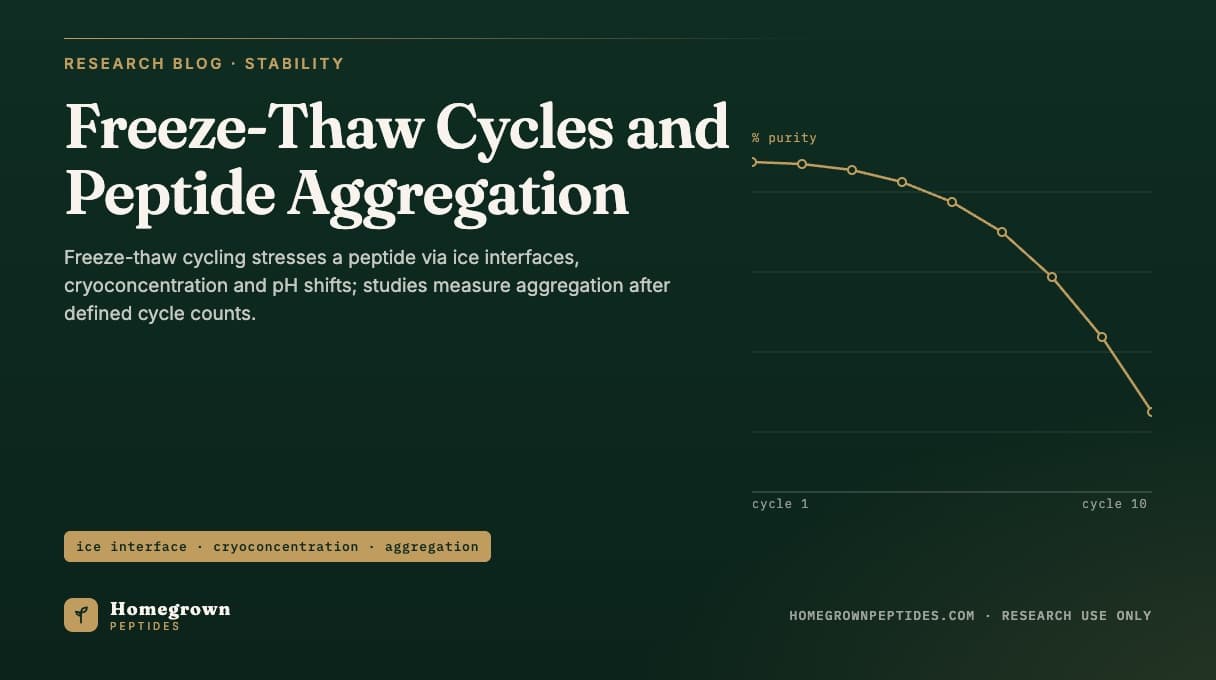
Each freeze-thaw cycle stresses a peptide solution three ways at once: adsorption and partial unfolding at the growing ice-water interface, cryoconcentration of peptide and buffer salts into a shrinking unfrozen channel, and, in phosphate-buffered solutions, a measurable pH shift as buffer salts crystallize out. Stability studies quantify this with SEC-HPLC, dynamic light scattering, turbidity, thioflavin T fluorescence and sub-visible particle counting, reported by cycle count: a solution unaffected after one freeze-thaw can show detectable aggregate by the third or fifth cycle. That is why methods papers treat single-use aliquoting as standard practice, not a one-time precaution.
| Mechanism | What happens | Source |
|---|---|---|
| Ice-water interface adsorption | Molecules migrate to the growing ice surface and partially unfold there; H/D exchange mapping localized this to specific surface segments of lactate dehydrogenase | Zhang et al., 2011 |
| Cryoconcentration | As ice forms, the shrinking unfrozen fraction concentrates peptide, salts and excipients together in residual channels between ice crystals | Lu et al., 2025 |
| Phosphate buffer pH shift | Phosphate buffer salts crystallize unevenly on cooling, driving a substantial pH change between +25 and -30 degrees C | Kolhe et al., 2010 |
| Cold denaturation | Below a cold-denaturation temperature, structure can destabilize independent of ice-surface contact, adding to the aggregation driving force | Lu et al., 2025 |
| Excipient co-concentration | A preservative concentrated alongside the peptide can synergize with ice-interface and thaw-phase stress to increase particles and aggregate | Xu et al., 2026 |
What actually happens inside the vial during a freeze-thaw cycle?
A peptide solution does not freeze all at once. Ice nucleates and grows inward from the container wall, excluding dissolved molecules into an ever-shrinking pocket of unfrozen liquid that concentrates peptide, salts and excipients, sometimes by an order of magnitude, before the whole volume solidifies. On thaw, the most concentrated, most stressed fraction re-dilutes last. Mechanistic work on a bispecific antibody evaluated temperature, freeze concentration, ice formation, cooling rate and cold denaturation side by side and identified protein interaction with ice, not freeze concentration alone, as the dominant aggregation driver (Lu et al., 2025).
How does ice-water interface exposure unfold a peptide?
The ice-water interface behaves like any other interface a folded molecule can adsorb to: hydrophobic or surface-reactive residues orient toward it, pulling a compact fold partly open. Hydrogen/deuterium exchange mass spectrometry on lactate dehydrogenase during single freezing versus repeated cycling showed a single freeze produced local, partly reversible unfolding confined to specific surface segments, while repeated cycling produced irreversible aggregation with more global structural rearrangement (Zhang et al., 2011). One freeze-thaw event and ten are not the same stress multiplied linearly: repeated cycling compounds interfacial exposure with accumulating structural damage.
What is cryoconcentration, and why does it concentrate more than just the peptide?
Cryoconcentration concentrates the peptide, the buffer salts and any preservative together in the shrinking unfrozen fraction. That matters because it can push local concentration into a range where self-association or fibrillation becomes favorable even when the bulk stock looks dilute. A 2026 mechanistic study on a preserved antibody formulation found cryoconcentration enhanced interaction between a preservative (benzyl alcohol) and the protein during freezing, compounding with ice-induced micro-crystal formation and thaw-phase exposure to increase subvisible particles, soluble aggregates and acidic variants over repeated cycling (Xu et al., 2026). The same freeze-concentration effect is a known contributor in large-scale drug-substance freezing generally, independent of any particular excipient.
Why does a phosphate-buffered solution shift pH when it freezes?
Sodium phosphate buffer is the well-characterized case: its two salt forms crystallize out of a freezing solution at different rates, shifting the ratio remaining in the liquid phase and driving pH away from its room-temperature value. Measurement across common pharmaceutical buffers found sodium phosphate showed the greatest pH change of any buffer on cooling from +25 to -30 degrees C, while histidine, acetate, citrate and succinate shifted less than one pH unit over the same range (Kolhe et al., 2010). Neutron and dynamic light scattering on lactate dehydrogenase confirmed selective phosphate crystallization caused a pronounced shift, and that a histidine buffer removed it entirely for the same protein (Sonje et al., 2021). Whether the pH shift itself, rather than cryoconcentration or a missing cryoprotectant, is the proximate cause varies by system: one IgG2 antibody study found aggregation tracked with cryoprotectant presence and phase-transition time, not pH change (Kolhe et al., 2010).
Does cold denaturation apply outside large proteins?
Cold denaturation is loss of folded structure at low rather than high temperature, better documented in multidomain proteins than in short peptides, many of which lack a single cooperatively folded structure to lose. The freezing-stress literature treats it as one input alongside ice-interface and cryoconcentration effects (Lu et al., 2025). For most short research peptides, ice-interface adsorption and cryoconcentration remain the better-supported mechanisms; see how peptides degrade for the chemical pathways that run alongside this physical one.
How do labs actually measure aggregation after freeze-thaw stress?
No single assay captures the whole size range of aggregate freeze-thaw stress produces, which is why stability papers run several methods in parallel.
| Method | What it detects | Notes from the literature |
|---|---|---|
| Size-exclusion chromatography (SEC-HPLC) | Soluble monomer loss and soluble high-molecular-weight species | Detected monomer loss only once insoluble aggregate crossed a detectable threshold; missed early particle formation microflow imaging caught (Barnard et al., 2011) |
| Dynamic light scattering (DLS) | Particle size shifts from sub-aggregate to larger species | Used with neutron scattering to quantify freeze-thaw aggregation of lactate dehydrogenase across buffer and concentration conditions (Sonje et al., 2021) |
| Turbidity (optical density) | Bulk, visible-range light scattering from larger particles | Fast screening readout for gross aggregation; usually paired with a more specific method |
| Thioflavin T (ThT) fluorescence | Amyloid-like, cross-beta-sheet fibril structure specifically | Standard assay for fibrillation kinetics in peptides prone to ordered self-assembly, versus amorphous aggregate |
| Sub-visible particle counting (microflow imaging) | Discrete particles, roughly 1 to 100 microns | Detected rising particle counts after each of three cycles in an IgG2 antibody even when SEC showed no change (Barnard et al., 2011) |
What do the published cycle-by-cycle numbers actually show?
Reported cycle counts vary by study, but the pattern is consistent: effects accumulate with cycle number, and the count at which they become detectable depends on concentration, buffer and assay sensitivity.
| System | Cycles tested | Method | Measured outcome |
|---|---|---|---|
| IgG2 monoclonal antibody, histidine buffer | 3 cycles | Microflow imaging + SEC-HPLC | Particle counts rose after each cycle; SEC showed no change at this count, while imaging resolved formulation differences SEC could not (Barnard et al., 2011) |
| Lactate dehydrogenase, high concentration (1000 microgram/mL) | 5 cycles | DLS + neutron scattering | No detectable aggregation; the protein's own concentration had a self-stabilizing effect at this count (Sonje et al., 2021) |
| Lactate dehydrogenase, low concentration (10 to 100 microgram/mL) | 5 cycles | DLS + neutron scattering | Irreversible aggregation in phosphate buffer; a histidine buffer (no crystallization-driven pH shift) avoided it at the same count (Sonje et al., 2021) |
| Lactate dehydrogenase, single freeze vs. repeated cycling | 1 vs. multiple cycles | Hydrogen/deuterium exchange mass spectrometry | One freeze gave localized, partly reversible surface unfolding; repeated cycling gave irreversible aggregation with global change (Zhang et al., 2011) |
| Trastuzumab with benzyl alcohol preservative | Multiple repeated cycles | Microflow imaging, chromatography, spectroscopy | Subvisible particles, soluble aggregates and acidic variants all rose with cycling; preservative made it worse (Xu et al., 2026) |
Why are GLP-1 class peptides singled out for fibrillation risk?
GLP-1 receptor agonist peptides, including liraglutide and related analogs, are studied as a model system for self-assembly because they form distinct oligomeric states that interconvert and can progress into amyloid-like fibrils under solution stress, a property that is well documented but incompletely resolved mechanistically. A 2026 analytical chemistry study used high-pressure NMR to reversibly drive liraglutide between its two oligomeric states and dissociate fibrils under controlled pressure, since conventional methods struggle to resolve this class's oligomerization pathway (Xu et al., 2026). That tendency is why a fibril-specific assay such as ThT, rather than turbidity or SEC, is the relevant readout here. Lot-specific analytical data for a GLP-1 class research peptide is posted on our NN9535 research lot page.
Why do methods sections default to single-use aliquots instead of refreezing a stock?
The practical mitigation that recurs across this literature is simple: divide a reconstituted stock into single-use volumes before the first freeze, so each aliquot is thawed only once. Methods sections describe this as the way a protocol avoids repeated interfacial exposure and cryoconcentration cycling altogether, not a fix for one failed run. The Xu et al. 2026 preserved-antibody study reached the same conclusion from the other direction, recommending refrigerated rather than frozen storage for a benzyl-alcohol-containing formulation once repeated freeze-thaw was identified as its dominant stress. For storage setup and labeling, see setting up a small-lab peptide storage station; for how long a lyophilized peptide stays stable before this chemistry is relevant, see how long do lyophilized peptides last. A broader comparison of lyophilized versus reconstituted storage, temperature and light is in peptide storage and stability, which this article extends with cycle-count data.
Frequently asked questions
Does one freeze-thaw cycle meaningfully damage a peptide solution?
Published data suggest a single freeze produces smaller, more localized, sometimes partly reversible effects than repeated cycling. Hydrogen/deuterium exchange studies on a model protein found a single freeze caused localized unfolding at surface segments, while repeated cycling caused irreversible, globally unfolded aggregation (Zhang et al., 2011).
Is cloudiness the only sign of freeze-thaw damage?
No. Microflow imaging detected rising subvisible particle counts across freeze-thaw cycles before standard SEC-HPLC showed any monomer loss, meaning a solution can accumulate measurable aggregate while still appearing clear on a less sensitive assay (Barnard et al., 2011).
Does buffer choice change freeze-thaw outcomes for the same protein?
Yes, substantially in some systems. Switching a model protein from phosphate buffer, which crystallizes unevenly and shifts pH on freezing, to histidine buffer, which does not, prevented irreversible aggregation at the same cycle count and concentration (Sonje et al., 2021).
Does concentration affect how much freeze-thaw damage occurs?
In one documented case, yes, in the protective direction: a model protein at high concentration resisted aggregation through five cycles, while the same protein at lower concentration aggregated irreversibly under otherwise similar conditions, attributed to self-stabilization at higher concentration (Sonje et al., 2021).
Is ThT fluorescence necessary if a sample already passed SEC-HPLC?
ThT detects amyloid-like, cross-beta-sheet fibril structure, a different signal than the soluble high-molecular-weight species SEC resolves. For peptide classes documented to self-assemble into fibrils, such as GLP-1 analogs, a clean SEC trace does not rule out fibril formation (Xu et al., 2026).
Is freeze-thaw stress the same for a lyophilized powder as a reconstituted solution?
No. The mechanisms here, ice-water interface exposure, cryoconcentration and buffer pH shift, require a liquid solution with dissolved peptide and buffer salts. A dry, lyophilized powder is not subject to this chemistry; see how long do lyophilized peptides last for its own stability questions.
Why does cryoconcentration matter even in a dilute stock?
Because the unfrozen fraction during freezing is a small remaining pocket of the original liquid, not the whole volume. Peptide, salts and any preservative in that pocket become locally concentrated well above the stock's bulk concentration before the sample fully solidifies, the condition under which self-association and fibrillation become more favorable (Xu et al., 2026).
References
- Zhang A, Qi W, Singh SK, Fernandez EJ. A new approach to explore the impact of freeze-thaw cycling on protein structure: hydrogen/deuterium exchange mass spectrometry (HX-MS). Pharm Res. 2011;28(5):1179-93. PubMed 21301933.
- Sonje J, Thakral S, Krueger S, Suryanarayanan R. Reversible Self-Association in Lactate Dehydrogenase during Freeze-Thaw in Buffered Solutions Using Neutron Scattering. Mol Pharm. 2021;18(12):4459-4474. PubMed 34709831.
- Kolhe P, Amend E, Singh SK. Impact of freezing on pH of buffered solutions and consequences for monoclonal antibody aggregation. Biotechnol Prog. 2010;26(3):727-33. PubMed 20039442.
- Lu X, Domingo-Yenes B, Cohen N, Grzincic E. Freezing-induced protein aggregation in a bispecific antibody: Characterization and mechanistic insights. J Pharm Sci. 2025;114(5):103711. PubMed 40021009.
- Xu X, Trigo-Mouriño P, Gao Q, Liang Y, McCoy MA, Reibarkh M. Monitoring Liraglutide Oligomeric Interconversion and Fibril Dissociation through High-Pressure NMR Spectroscopy. Anal Chem. 2026;98(35):25575-25585. PubMed 42708757.
- Barnard JG, Singh S, Randolph TW, Carpenter JF. Subvisible particle counting provides a sensitive method of detecting and quantifying aggregation of monoclonal antibody caused by freeze-thawing: insights into the roles of particles in the protein aggregation pathway. J Pharm Sci. 2011;100(2):492-503. PubMed 20803602.
- Xu ZT, Yang CH, Liu W, Qian C, Fang WJ. Benzyl alcohol exacerbates freeze-thaw-induced aggregation of trastuzumab: elucidating mechanisms and formulation implications for clinical practice. Int J Pharm. 2026;688:126433. PubMed 41325828.
Research use only. Homegrown Peptides products are for laboratory research and are not for human or animal use. Nothing in this article is medical advice.