EU/mL and EU/mg are not interchangeable. EU/mL is a concentration measured directly in the assay vessel, the endotoxin activity in a given volume of test solution. EU/mg is a potency figure, how much of that activity corresponds to each milligram of peptide in the vial, calculated after the fact from the EU/mL result, the dilution used, and the vial's labeled content. A lyophilized research peptide's certificate of analysis almost always reports EU/mg, because that lets different lot sizes and different labs be compared on equal footing.
| Quantity | What it means | Source |
|---|---|---|
| Endotoxin Unit (EU) | Potency against the USP Reference Standard Endotoxin (RSE) or an in-house Control Standard Endotoxin (CSE); ng-per-EU equivalence is lot specific, not fixed | Findlay et al., 2015 |
| Gel-clot lysate sensitivity (lambda) | Commonly labeled 0.03 to 0.25 EU/mL | Sharma et al., 2011 |
| Turbidimetric / chromogenic kinetic sensitivity | Typically 0.001 to 0.5 EU/mL, extending well below gel-clot lambda | Thota et al., 2026 |
| Positive product control (PPC) recovery | Must recover 50 to 200% of the spiked concentration for the dilution to be valid | Fujita et al., 2011 |
| Recombinant Factor C (rFC) status | Alternative method under USP <1085> and Ph. Eur.; equivalence bridging still requested in some filings | Baker et al., 2023 |
| Typical research peptide COA result | EU/mg, commonly under 0.5 EU/mg or below LOQ ("not detected") at the dilution tested | Fukumori et al., 2011 |
What exactly is an Endotoxin Unit measured against?
An EU is not an absolute mass unit the way a milligram is. It is a biological potency unit, defined relative to a reference lot of endotoxin calibrated against the World Health Organization's International Standard for Endotoxin. The USP Reference Standard Endotoxin (RSE) and working Control Standard Endotoxin (CSE) lots used in routine testing are each assigned a potency in EU per nanogram against that standard, and that assignment changes lot to lot. A collaborative study across WHO, Ph. Eur. and USP laboratories established the current WHO 3rd International Standard and cross-calibrated it against the Ph. Eur. biological reference preparation and a USP RSE lot, confirming the nanogram-to-EU relationship for any reference lot has to be established by assay, not carried over from an older lot (Findlay et al., 2015). A certificate reporting "EU/mg" without naming the reference standard and method gives a figure that cannot be cross-checked against a different lab's CSE lot.
What are the three compendial endotoxin test methods?
USP <85> and Ph. Eur. describe three formats built on the horseshoe crab-derived clotting cascade, plus the newer recombinant alternative.
- Gel-clot: lysate mixed with the sample across a dilution series, incubated, then the tube inverted once; a firm gel that holds is positive. Result = lambda x dilution factor at the last positive tube, a semi-quantitative limit test.
- Turbidimetric: tracks rising turbidity as clotting proceeds, read kinetically or at a fixed endpoint, against a standard curve.
- Chromogenic kinetic: a synthetic peptide-chromogen substrate replaces the natural clottable protein. The activated enzyme cascade cleaves it and releases color; a microplate reader tracks onset time at each well, converted to concentration from a standard curve on the same plate.
| Method | Principle | Typical sensitivity | Result type |
|---|---|---|---|
| Gel-clot | Visual clot formation above a labeled threshold | 0.03 to 0.25 EU/mL | Semi-quantitative, limit test |
| Turbidimetric | Light scattering increase from clot-protein precipitation | 0.001 to 0.05 EU/mL (kinetic) | Quantitative, standard curve |
| Chromogenic kinetic | Color development from a cleaved synthetic substrate | 0.001 to 0.5 EU/mL | Quantitative, standard curve |
| Recombinant Factor C (rFC) | Purified recombinant clotting Factor C activated directly by endotoxin, fluorogenic or chromogenic readout, no full cascade and no lysate | 0.005 to 0.5 EU/mL | Quantitative, non-animal-derived reagent |
What is recombinant Factor C, and is it accepted as a compendial method?
Recombinant Factor C (rFC) reagents use a single cloned protein, the first enzyme in the natural clotting cascade, produced recombinantly rather than purified from amebocyte lysate. Endotoxin activates Factor C directly, which cleaves a fluorogenic or chromogenic substrate, giving a signal without the downstream enzymes or the animal-sourced lysate. A multi-center study comparing a recombinant cascade kinetic chromogenic assay against conventional LAL reported comparable validation parameters and consistency between the two reagent types (Pei et al., 2026), and a separate comparison of LAL and recombinant cascade reagents in pharmaceutical products reported similar findings (Thota et al., 2026). USP <1085> and Ph. Eur. both recognize rFC as an alternative method, but a 2023 review found labs switching to it are often still asked for a product-specific equivalence bridging study first, which has slowed adoption (Baker et al., 2023).
How is the Maximum Valid Dilution calculated?
The Maximum Valid Dilution (MVD) is the most dilute a sample can be while the assay still validly detects the specified endotoxin limit: MVD = (limit x concentration) / lambda, where lambda is the lysate's labeled sensitivity. Diluting past the MVD risks missing endotoxin that is below what the sample can register; staying under the MVD while diluting enough to clear interference found in the product control is the balance a validated method has to hit. Worked example, bench math only: a sample with a limit of 5 EU per milligram at 2 milligrams per milliliter, tested with a lysate labeled at 0.03 EU/mL, has an MVD of (5 x 2) / 0.03, roughly 333-fold. Any dilution used has to fall at or below that figure.
What do inhibition and enhancement controls check for, and why does the PPC matter?
A peptide solution, its buffer salts, or residual synthesis byproducts can interfere with the clotting reaction in two directions. Inhibition suppresses the signal, hiding real endotoxin as a false negative. Enhancement exaggerates the signal into a false positive. USP <85> requires a positive product control (PPC): a known amount of endotoxin spiked into the product at the test dilution, with recovery required between 50% and 200% of expected before that dilution is accepted as valid for that product and lot. A study of interfering factors in the bacterial endotoxins test found that saline or buffer dilution, rather than the undiluted matrix, reduced or eliminated interference in most cases tested, the practical reason labs dilute toward the MVD (Fujita et al., 2011). A product that fails PPC recovery gets diluted further, switched methods, or pre-treated, not reported from a dilution already shown unreliable.
How does a measured EU/mL become the EU/mg figure on a certificate?
The assay only produces an EU/mL reading from whatever was loaded into the plate or tube. Converting that into EU/mg needs the test volume and the peptide mass that volume represents, both from the vial's labeled content: EU/mg = (measured EU/mL x test volume in mL) / peptide mass in mg.
| Vial content (mg) | Test volume (mL) | Measured endotoxin (EU/mL) | Calculated result (EU/mg) |
|---|---|---|---|
| 1 mg | 1 mL | 0.40 EU/mL | 0.40 EU/mg |
| 2 mg | 1 mL | 0.30 EU/mL | 0.15 EU/mg |
| 5 mg | 2 mL | 0.25 EU/mL | 0.10 EU/mg |
| 10 mg | 2 mL | below 0.05 EU/mL (below LOQ) | reported as not detected at this dilution |
Two vials with the same measured EU/mL can land on very different EU/mg figures once vial mass and test volume are factored in, which is why comparing raw EU/mL bench notes across labs, rather than final EU/mg results, misleads. Teams reconstituting a vial for in-house testing should use sterile technique to avoid introducing exogenous endotoxin from non-sterile diluent or glassware; a reconstitution kit with sterile, single-use components reduces that risk at the bench.
Where does a parenteral product's endotoxin limit actually come from?
Pharmacopeial endotoxin limits for approved drug products are not arbitrary round numbers; they come from a formula written as K / M. K is a fixed threshold figure set in the general chapters, the pyrogenic response threshold per unit of body mass from historical rabbit pyrogen and clinical data. M is the maximum amount of that product given to a patient per unit of body mass within a defined time window, unique to each product's labeling. K divided by M yields the endotoxin limit in EU per milligram for that product, which is why two approved drugs can carry different limits under the same method. This is a regulatory derivation for a release specification, not a tool for calculating how much of anything to administer; nothing here describes a protocol for use in a person or animal. A research peptide sold without approved labeling has no defined M, so its limit instead comes from the supplier's internal specification, commonly tighter than a K/M-derived limit.
What does "<0.5 EU/mg" or "not detected" actually tell you?
Both are ceilings tied to a specific dilution and method LOQ, not a precise measured value. "Not detected" means the signal fell below the assay's LOQ at the dilution tested, not that the sample has zero endotoxin molecules. "<0.5 EU/mg" means the calculated result came out under 0.5 without resolving a more precise figure. A tighter claim needs a lower dilution, valid only if it stays under the MVD and passes PPC recovery. A complete certificate states the method, lysate or reagent sensitivity, and dilution tested alongside the EU/mg figure; a bare number cannot be verified by a second lab. See how to read a peptide certificate of analysis for this result alongside identity and purity, and what is endotoxin testing for the basic LAL mechanism this builds on. Beyond purity covers sterility and heavy-metal testing alongside it.
Frequently asked questions
Is EU/mL the same number as EU/mg?
No. EU/mL is the concentration measured directly in the test solution. EU/mg is calculated afterward by multiplying that EU/mL figure by the test volume and dividing by the peptide mass the vial is labeled to contain.
Which compendial method is the most sensitive?
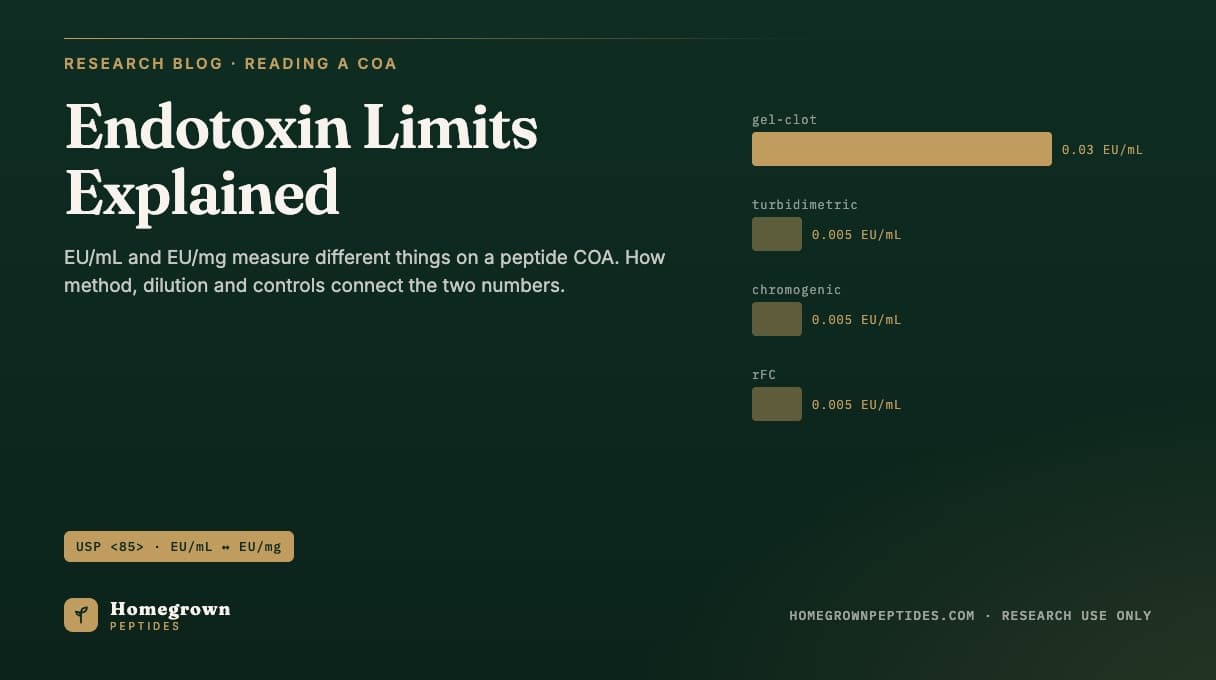
Turbidimetric and chromogenic kinetic methods generally quantify lower concentrations than gel-clot, down to about 0.001 to 0.005 EU/mL depending on the kit, versus a gel-clot lambda typically no lower than 0.03 EU/mL.
Why might two labs report different EU/mg figures for the same vial?
Different test volumes, CSE lots, method sensitivities, and dilutions tested all change the final EU/mg calculation even on material from the same vial.
Does "not detected" mean a sample is completely free of endotoxin?
No. It means the signal was below the method's limit of quantitation at the dilution tested, not that endotoxin content is zero.
Is recombinant Factor C a full replacement for LAL testing everywhere?
It is recognized as an alternative method in USP and Ph. Eur. general chapter frameworks, but adoption has been uneven because some regulators and quality systems still request a product-specific bridging study showing equivalence to the LAL-based result before accepting a switch.
What is the practical difference between inhibition and enhancement?
Inhibition masks real endotoxin as a false negative; enhancement exaggerates the signal into a false positive. Both are checked with a positive product control spike, required to recover 50 to 200% of the expected value.
References
- Findlay L, Desai T, Heath A, Poole S. Collaborative study for the establishment of the WHO 3rd International Standard for Endotoxin, the Ph. Eur. endotoxin biological reference preparation batch 5 and the USP Reference Standard for Endotoxin Lot H0K354. Pharmeur Bio Sci Notes. 2015;2015:73-98. PubMed 26830160.
- Fujita Y, Tokunaga T, Kataoka H. Saline and buffers minimize the action of interfering factors in the bacterial endotoxins test. Anal Biochem. 2011;409(1):46-53. PubMed 20951111.
- Pei Y, Cai T, Liu H, Chen W. Multi-center study of the recombinant cascade reagent (kinetic chromogenic assay) as an alternative method for bacterial endotoxin testing: method validation, product suitability, and consistency evaluation with limulus amebocyte lysate. J Pharm Biomed Anal. 2026;281:117634. PubMed 42385328.
- Thota P, Kumar P, Teotia AK, Kaushik A. Study of LAL and recombinant cascade reagents methods for bacterial endotoxin testing in pharmaceutical products. PDA J Pharm Sci Technol. 2026;80(3):288-297. PubMed 41844320.
- Baker E, Ponder J, Oberdorfer J, Spreitzer I. Barriers to the use of recombinant bacterial endotoxins test methods in parenteral drug, vaccine and device safety testing. Altern Lab Anim. 2023;51(6):401-410. PubMed 37855095.
- Mitra A, Joshi S, Arjun C, Kulkarni S. Limulus amebocyte lysate testing: adapting it for determination of bacterial endotoxin in 99mTc-labeled radiopharmaceuticals at a hospital radiopharmacy. J Nucl Med Technol. 2014;42(4):278-282. PubMed 25472516.
- Sharma S, Mittal BR, Vatsa R, Singh B. Gel clot bacterial endotoxin test of FDG: Indian scenario. Indian J Nucl Med. 2011;26(3):149-152. PubMed 23326067.
- Fukumori NT, de Campos DG, Massicano AV, de Pereira NP. A portable test system for determination of bacterial endotoxins in 18F-FDG, 99mTc, and lyophilized reagents for labeling with 99mTc. J Nucl Med Technol. 2011;39(2):121-124. PubMed 21565953.
Research use only. Homegrown Peptides products are for laboratory research and are not for human or animal use. Nothing in this article is medical advice.