No published trial has administered CJC-1295 and ipamorelin together and tracked outcomes at week 4, week 8 and week 12. The real timeline data are split across two separate literatures: a 28-day human repeated-administration study of CJC-1295 that tracked IGF-1 week by week, and shorter rodent studies of ipamorelin that tracked bone and growth-plate endpoints over 2 to 3 weeks. Past roughly six weeks, there is no published combined-compound data at all.
That gap matters because the search question assumes a continuous 12-week record exists. It does not. What exists is a well-documented early window (days 1 through 28, with some follow-up to day 42) for the GHRH analog, and a separate, shorter animal record for the ghrelin-receptor agonist. Below is what each study actually measured, at which timepoint, with its own citation, so the real data can be told apart from the marketing framing.
| Key fact | Value reported | Source |
|---|---|---|
| Longest human study window with weekly sampling, CJC-1295 (either form) | 28 days of repeated subcutaneous administration, with IGF-1 sampled approximately weekly | Teichman et al., 2006 |
| Longest follow-up after administration stopped | IGF-1 tracked for roughly two more weeks after the 28-day administration period ended | Teichman et al., 2006 |
| Ipamorelin receptor target | GHS-R1a (ghrelin receptor), selective for GH release over cortisol, prolactin, ACTH | Raun et al., 1998 |
| Longest repeated-administration rat window for ipamorelin, bone endpoint | Approximately 2 weeks of repeated subcutaneous administration | Johansen et al., 1999 |
| Published combined CJC-1295 + ipamorelin human trials located | None identified in the peer-reviewed literature | Literature search for this article |
| Approximate molecular weight, ipamorelin | 711 g/mol (pentapeptide amide) | Raun et al., 1998 |
Has any published study combined CJC-1295 and ipamorelin?
No. The two compounds are studied in separate literatures. CJC-1295 is a modified growth-hormone-releasing-hormone (GHRH) fragment, studied as a standalone agent in the human trial described below. Ipamorelin is a selective ghrelin-receptor agonist, studied mostly in rodent models with a handful of early-phase human pharmacokinetic work. A rationale for pairing a GHRH analog with a ghrelin mimetic exists in the broader secretagogue literature (combining the two mechanisms can produce a larger acute GH pulse than either alone), but that rationale comes from trials of other GHRH-plus-GHRP pairs, not from a trial that administered CJC-1295 and ipamorelin together and tracked them for 12 weeks. For the mechanistic case, see the discussion of why labs pair a GHRH analog with a ghrelin mimetic in cjc-1295-and-ipamorelin-in-combination-research.
What did the CJC-1295 trial actually track week by week?
The only controlled human trial of CJC-1295 with weekly sampling is Teichman et al. (2006), run in healthy adults. It had two parts. A single-administration part gave escalating amounts of the long-acting (DAC-conjugated) form and sampled GH and IGF-1 for several days afterward. A repeated-administration part gave subcutaneous administrations across 28 days at two amount levels and sampled IGF-1 at intervals through that period and into a follow-up window after administration stopped. The long-acting form, which binds plasma albumin through its drug affinity complex (DAC), produced a sustained IGF-1 elevation that built over the first one to two weeks of the study, remained elevated through day 28, and then declined gradually over roughly two more weeks once administration stopped. That multi-week profile is specific to the DAC-conjugated analog. The no-DAC form sold under this catalog's handle clears far faster (its half-life is measured in minutes, not days), so its pharmacokinetic and IGF-1 timeline looks much more like the short, single-administration cohorts in the same paper than like the sustained 28-day curve. The distinction between the two forms is covered in detail in cjc-1295-dac-vs-no-dac.
What does the ipamorelin literature show about repeated administration over time?
Raun et al. (1998) characterized ipamorelin as a selective GH secretagogue in both rat and human testing, establishing acute, amount-related GH pulses with minimal effect on cortisol or prolactin. That paper is mostly an acute pharmacology study, not a multi-week timeline. The clearest "over time" ipamorelin data come from rodent bone studies: Johansen et al. (1999) gave rats repeated subcutaneous ipamorelin across roughly two weeks and measured longitudinal bone growth and growth-plate width at the end of that window, finding an increase relative to vehicle. Andersen et al. (2001) extended the model by co-administering a glucocorticoid alongside ipamorelin across a several-week period, tracking bone-formation markers at the end of the study, and reported that ipamorelin partially offset the glucocorticoid-associated reduction in those markers. Neither paper reports a week 4, week 8 and week 12 series; both report a single endpoint measured at the end of a defined study window. The two rodent bone studies behind that point are summarised on the Ipamorelin page.
Why would a GHRH analog and a ghrelin mimetic be studied together at all?
The physiological rationale is decades old and does not involve CJC-1295 or ipamorelin specifically. A GHRH analog increases the amount of GH released per pituitary pulse; a ghrelin-receptor agonist increases pulse frequency and amplifies the GHRH signal at the pituitary. Trials combining other members of each class in the same test session have shown an acute GH pulse larger than either compound given alone, which is the mechanistic basis researchers cite when a GHRH analog and a ghrelin mimetic are studied in the same regimen. That synergy has been demonstrated acutely (within a single test day), not as a tracked multi-week outcome for this specific pairing.
Where does the published timeline data actually stop?
For CJC-1295 (DAC-conjugated), the published record runs from day 1 through roughly day 42 (28 days of administration plus about two weeks of follow-up), with IGF-1 as the main tracked marker. For ipamorelin, the published repeated-administration record in rodents runs 2 to roughly 3 to 4 weeks depending on the model, with bone-formation or growth-plate markers as the endpoint. There is no published data point for either compound, alone or combined, at week 8 or week 12. A search phrase built around 4, 8 and 12 weeks is asking for a dataset that has not been generated and published.
Timeline: what each study measured, by week
| Week | Study | What was measured | Finding reported |
|---|---|---|---|
| Week 1 | Teichman et al., 2006 (DAC cohort) | Serum IGF-1, sampled after administration began | IGF-1 rising above the pre-administration baseline |
| Week 2 | Teichman et al., 2006 (DAC cohort) | Serum IGF-1 | Continued elevation, approaching a plateau |
| Week 2 | Johansen et al., 1999 (rat) | Tibial growth-plate width, longitudinal bone growth | Growth-plate width increased versus vehicle at the end of the study |
| Week 4 (day 28) | Teichman et al., 2006 (both forms) | Serum IGF-1, GH pulse amplitude | DAC cohort sustained elevation; no-DAC cohort profile closer to single-administration kinetics |
| Weeks 4 to 6 (post-administration) | Teichman et al., 2006 | Serum IGF-1 during follow-up after administration stopped | Gradual decline back toward baseline |
| Several weeks (exact window not matched to 4/8/12) | Andersen et al., 2001 (rat) | Bone-formation markers under concurrent glucocorticoid exposure | Markers partially preserved versus glucocorticoid alone |
| Week 8 | None located | No published CJC-1295 or ipamorelin study reports an endpoint at this timepoint | Data gap |
| Week 12 | None located | No published CJC-1295 or ipamorelin study reports an endpoint at this timepoint | Data gap |
Study table
| Study | Model and n | Amount and route, as reported | Endpoint | Finding |
|---|---|---|---|---|
| Teichman et al., 2006 (PubMed 16352683) | Healthy adults, single- and repeated-administration cohorts | 30 and 60 micrograms per kilogram, subcutaneous, repeated across a 28-day period (long-acting and short-acting forms compared) | Serum IGF-1, GH pulse amplitude | Sustained IGF-1 elevation with the long-acting form across the 28-day period and a two-week decline after stopping |
| Raun et al., 1998 (PubMed 9849822) | Rat and healthy human male volunteers | Ascending amounts up to the high end tested, intravenous and subcutaneous, single-session acute testing | GH, cortisol, prolactin, ACTH | Amount-related GH release with selectivity over the other three hormones |
| Gobburu et al., 1999 (PubMed 10517341) | Healthy human volunteers (single ascending amount cohorts) | Single intravenous administrations across an ascending amount range | GH concentration-time profile, modeled half-life | Pharmacokinetic/pharmacodynamic model describing a short plasma half-life and an amount-dependent GH response |
| Johansen et al., 1999 (PubMed 10219687) | Rat, repeated-administration cohort | Subcutaneous administration, repeated across roughly a 2-week period | Tibial growth-plate width, longitudinal bone growth | Increased growth-plate width and bone growth versus vehicle |
| Andersen et al., 2001 (PubMed 11735224) | Rat, glucocorticoid co-administration model | Subcutaneous administration, repeated across a several-week period alongside corticosterone exposure | Bone-formation markers | Partial preservation of bone-formation markers versus glucocorticoid exposure alone |
| Bowers et al., 1990 (PubMed 2156873) | Healthy adult men, acute same-day testing | Intravenous bolus of a GHRP-class ghrelin mimetic combined with a GHRH-class analog, single test session | GH pulse amplitude | Combined administration produced a larger acute GH pulse than either compound given alone |
How this is handled in a research setting
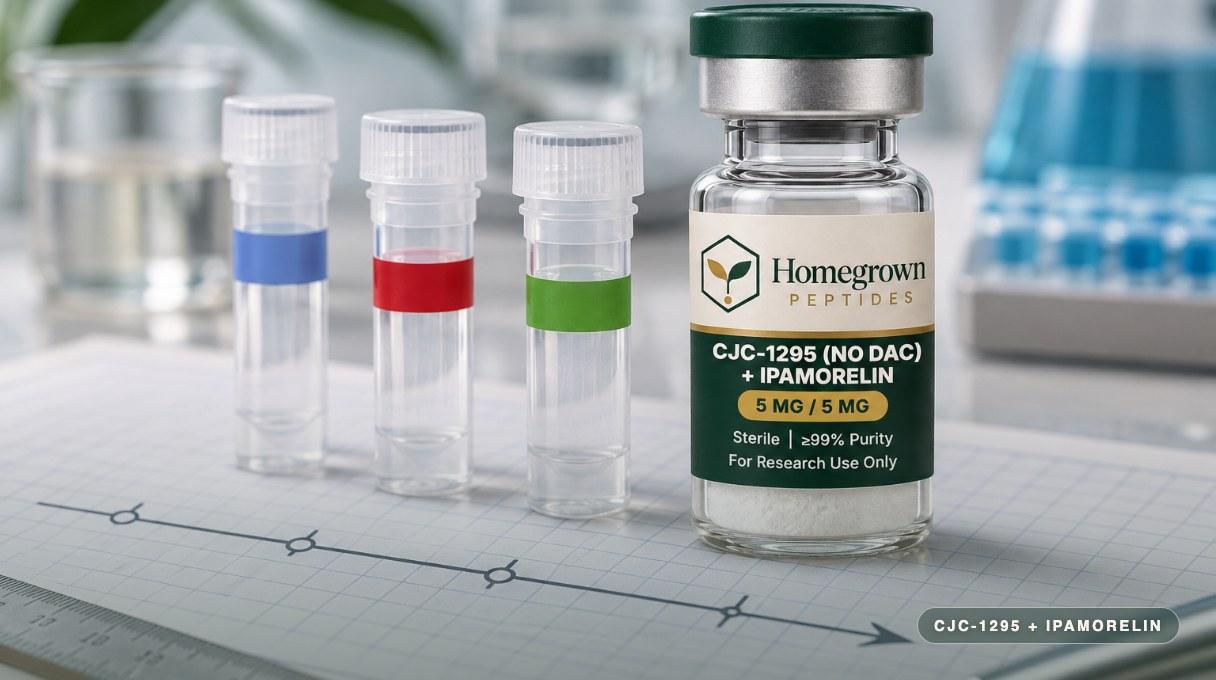
Both compounds, including the blended cjc-1295-no-dac-ipamorelin vial format, ship as lyophilized powder and are reconstituted immediately before use in a study; the math for turning a milligram amount of powder into a working concentration is covered step by step in reconstituting-lyophilized-peptides. Reconstituted solution is kept refrigerated and used within the stability window on the certificate of analysis, and every lot should be checked against its certificate before it goes into a study design; what to look for on that certificate is explained in how-to-read-a-peptide-coa. Neither compound is validated for continuous infusion in these trials; every study cited here used a bolus or a series of repeated bolus administrations, not a drip.
What would a real 4, 8 and 12 week comparison need to show?
To answer the search question properly, a trial would need to co-administer both compounds, draw blood at matched intervals through at least 12 weeks, and report IGF-1, GH pulse amplitude and at least one body-composition or bone marker at each timepoint with the same assay used throughout. No such trial has been published as of this writing. Anyone quoting a specific week-12 outcome for the combination is extrapolating from the separate single-compound studies above, not reporting a measured result.
Frequently asked questions
Does ipamorelin's effect get smaller with repeated administration?
The rodent repeated-administration studies (Johansen 1999, Andersen 2001) report positive endpoints at the end of their study windows rather than a week-by-week decline, but neither study was designed to test for attenuation specifically, so the question of whether the GH-releasing effect itself fades with weeks of repeated exposure has not been directly measured in the published ipamorelin literature.
What is the practical difference between CJC-1295 with DAC and without DAC in these studies?
Only the DAC-conjugated form produced the sustained, multi-week IGF-1 curve in Teichman et al. (2006); the no-DAC form's much shorter plasma half-life means its measured profile tracks the single-administration, hours-to-a-day kinetics rather than a 28-day curve. The full comparison is in cjc-1295-dac-vs-no-dac.
What happened to IGF-1 after the 28-day CJC-1295 administration period ended?
In the long-acting cohort, Teichman et al. (2006) reported a gradual decline in serum IGF-1 over the roughly two-week follow-up period after administration stopped, consistent with clearance of the long-acting analog from the circulation.
Are there any published 8-week or 12-week trials of either compound?
No trial identified in this review reports data at week 8 or week 12 for CJC-1295, ipamorelin, or the combination. The longest tracked human window is roughly six weeks (28 days of administration plus follow-up), and the longest tracked animal window is a few weeks.
What species have these compounds actually been tested in?
CJC-1295's controlled study data come from healthy human adults. Ipamorelin's data are a mix: the original characterization used both rat and human testing, while the longer repeated-administration, bone-focused work used rats exclusively.
Why do researchers pair a GHRH analog with a ghrelin-receptor agonist in a study design at all?
Because the two mechanisms act on different parts of the same pulse: the GHRH analog increases how much GH is released per pulse, and the ghrelin-receptor agonist increases pulse frequency and amplifies the signal. Older trials combining other GHRH-class and GHRP-class agents in a single test session (such as Bowers et al., 1990) showed a larger acute GH pulse from the pair than from either compound alone, which is the basis for studying this class of pairing. See growth-hormone-secretagogues-explained for the broader mechanism.
Is there a published trial that measured body composition for either compound over multiple weeks?
Not for ipamorelin or CJC-1295 specifically in the papers reviewed here. Body-composition endpoints appear elsewhere in the broader GH-secretagogue literature for other compounds in the class, but not as a matched 4/8/12-week series for this pairing.
References
- Teichman SL, Neale A, Lawrence B, Gagnon C, Castaigne JP, Frohman LA. Prolonged stimulation of growth hormone (GH) and insulin-like growth factor I secretion by CJC-1295, a long-acting analog of GH-releasing hormone, in healthy adults. J Clin Endocrinol Metab. 2006;91(3):799-805. PubMed 16352683.
- Raun K, Hansen BS, Johansen NL, Thogersen H, Madsen K, Ankersen M, Andersen PH. Ipamorelin, the first selective growth hormone secretagogue. Eur J Endocrinol. 1998;139(5):552-561. PubMed 9849822.
- Gobburu JV, Agerso H, Jusko WJ, Ynddal L. Pharmacokinetic-pharmacodynamic modeling of ipamorelin, a growth hormone releasing peptide, in human volunteers. Pharm Res. 1999;16(9):1412-1416. PubMed 10517341.
- Johansen PB, Nowak J, Skjaerbaek C, Flyvbjerg A, Andreassen TT, Wilken M, Orskov H. Ipamorelin, a new growth-hormone-releasing peptide, induces longitudinal bone growth in rats. Growth Horm IGF Res. 1999;9(2):106-113. PubMed 10219687.
- Andersen NB, Malmlof K, Johansen PB, Andreassen TT, Ortoft G, Oxlund H. The growth hormone secretagogue ipamorelin counteracts glucocorticoid-induced decrease in bone formation of adult rats. Growth Horm IGF Res. 2001;11(5):266-272. PubMed 11735224.
- Bowers CY, Reynolds GA, Durham D, Barrera CM, Pezzoli SS, Thorner MO. Growth hormone (GH)-releasing peptide stimulates GH release in normal men and acts synergistically with GH-releasing hormone. J Clin Endocrinol Metab. 1990;70(4):975-982. PubMed 2156873.
Research use only. Homegrown Peptides products are for laboratory research and are not for human or animal use. Nothing in this article is medical advice.