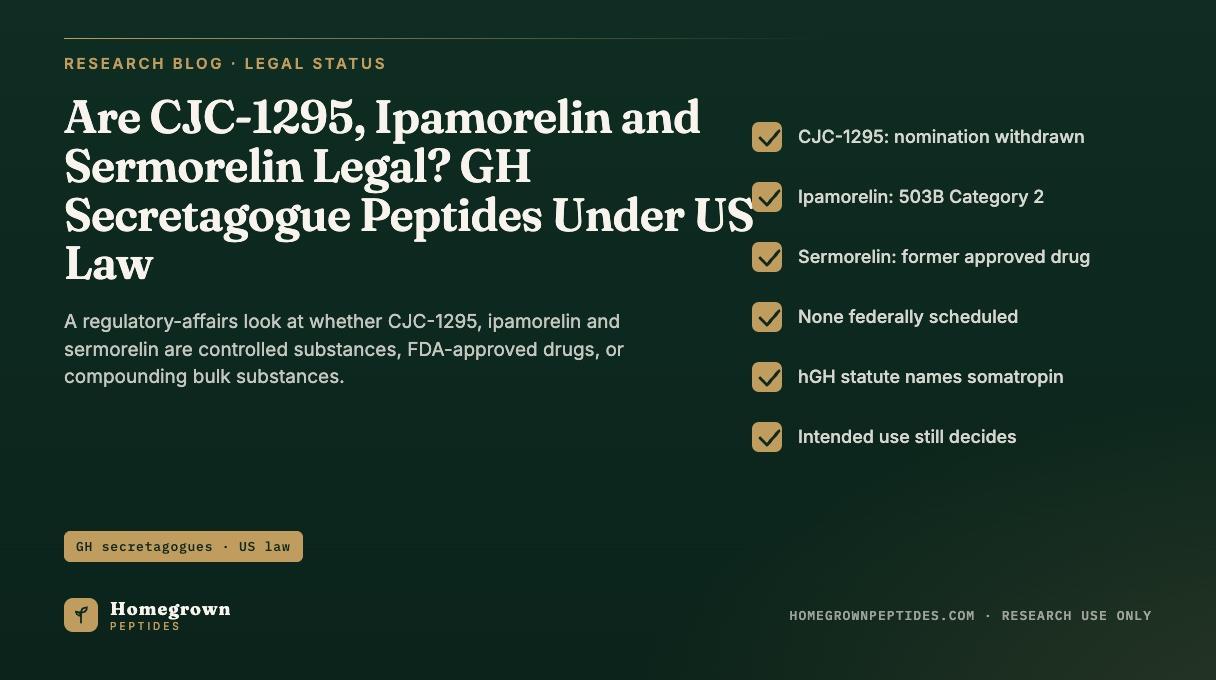
None of these three peptides, CJC-1295, ipamorelin or sermorelin, is a federally controlled substance, and none is named by its own identity in the federal human growth hormone statute. All three are lawful as laboratory reagents; each becomes an unapproved new drug once a seller's labeling or marketing shows intent for human use. Their FDA compounding histories differ: ipamorelin acetate sits in 503B Category 2 (added September 29, 2023), CJC-1295's own Category 2 nomination was withdrawn, and sermorelin acetate was once the active ingredient in an FDA-approved drug later discontinued for reasons unrelated to safety.
As of November 7, 2026. This article describes United States federal law and published agency actions as of that date. It is general information, not legal advice; the rules differ by state and change over time, and anyone with a specific question should consult a lawyer licensed in their jurisdiction.
| Peptide | Controlled substance? | 503A / 503B status | Approved drug history | Source |
|---|---|---|---|---|
| CJC-1295 | No. Not on DEA's alphabetical controlled substances list. | Nominated to the 503A bulks list; nomination withdrawn by the nominator. No category entry. | No FDA-approved drug product under this name. | DEA list; FDA Category 2 page |
| Ipamorelin acetate | No. Not on DEA's alphabetical controlled substances list. | 503B Category 2, added September 29, 2023. | No FDA-approved drug product under this name. | DEA list; FDA Category 2 page |
| Sermorelin acetate | No. Not on DEA's alphabetical controlled substances list. | Not on the 503B Category 2 list. 503A category status not verified for this article. | Active ingredient in GEREF, an FDA-approved injection, later discontinued for reasons FDA determined were unrelated to safety or effectiveness (determination dated March 4, 2013). | DEA list; Federal Register notice |
| GHRP-6 | No. Not on DEA's alphabetical controlled substances list. | 503B Category 2, added September 29, 2023. | No FDA-approved drug product under this name. | DEA list; FDA Category 2 page |
What are CJC-1295, ipamorelin and sermorelin?
Sermorelin is a 29-residue fragment of growth hormone-releasing hormone, written GHRH(1-29) in the literature. Background on its sequence is at /blog/what-is-sermorelin.
CJC-1295 is a modified GHRH analog. Two forms circulate in the research-peptide trade: one bound to a Drug Affinity Complex (DAC), and a shorter-acting form without it, compared at /blog/cjc-1295-dac-vs-no-dac.
Ipamorelin is unrelated to the GHRH family: it is a ghrelin-receptor agonist acting on the growth hormone secretagogue receptor. More on its receptor pharmacology is at /blog/what-is-ipamorelin, and the rationale for pairing a GHRH analog with a ghrelin mimetic is at /blog/cjc-1295-and-ipamorelin-in-combination-research. For how these sit alongside TH9507, see /blog/growth-hormone-secretagogues-explained. Homegrown Peptides lists ipamorelin acetate with a lot-matched certificate of analysis at /products/ipamorelin, and sermorelin acetate the same way at /products/sermorelin.
Are CJC-1295, ipamorelin and sermorelin controlled substances?
The Controlled Substances Act sets up five schedules. 21 U.S.C. 812(a) states: "There are established five schedules of controlled substances, to be known as schedules I, II, III, IV, and V." A substance lands in Schedule I when, under 812(b)(1), "(A) The drug or other substance has a high potential for abuse. (B) The drug or other substance has no currently accepted medical use in treatment in the United States. (C) There is a lack of accepted safety for use of the drug or other substance under medical supervision." Current schedules are maintained at 21 CFR part 1308, and DEA also publishes an alphabetical reference list of everything scheduled.
A text search of the DEA "Controlled Substances, Alphabetical Order" PDF found none of: CJC-1295, ipamorelin, sermorelin, GHRP-6, TH9507, somatropin, "growth hormone" or "peptide". None of these compounds appears on DEA's list. That answers one question, not the whole one: a substance can sit entirely outside the Controlled Substances Act and still be an unlawful unapproved drug under the separate Food, Drug, and Cosmetic Act, the statute that actually governs most research-peptide enforcement.
Does the federal human growth hormone statute apply to them?
Congress wrote a specific criminal provision for human growth hormone misuse, separate from ordinary new-drug rules. 21 U.S.C. 333(e)(1) states: "Except as provided in paragraph (2), whoever knowingly distributes, or possesses with intent to distribute, human growth hormone for any use in humans other than the treatment of a disease or other recognized medical condition, where such use has been authorized by the Secretary of Health and Human Services under section 355 of this title and pursuant to the order of a physician, is guilty of an offense punishable by not more than 5 years in prison, such fines as are authorized by title 18, or both." A violation involving someone under 18 carries up to 10 years under 333(e)(2).
The statute defines its own key term. 333(e)(4) states: "As used in this subsection the term 'human growth hormone' means somatrem, somatropin, or an analogue of either of them." None of CJC-1295, ipamorelin or sermorelin is somatrem or somatropin; they are chemically distinct, and ipamorelin targets a different receptor entirely. Whether a GHRH analog or a ghrelin-receptor agonist counts as "an analogue of" somatropin under this criminal statute is not settled by the text itself. This article treats that question as open; readers needing a definitive reading should ask a lawyer rather than rely on any secondary summary, including this one.
What is each one's 503A and 503B compounding status?
Separately from scheduling and the growth hormone statute, FDA maintains lists of bulk drug substances pharmacies may use when compounding a drug for an individual patient. A substance qualifies for 503A compounding if it meets a USP or NF monograph, is a component of an FDA-approved drug, or appears on the 503A bulks list. Category 1 substances "may be eligible for inclusion on the 503A bulks list"; Category 2 substances carry "significant safety risks relating to the use of these substances in compounding pending further evaluation," and FDA "does not intend to adopt the policy described for the substances in category 1" for them; Category 3 substances were "nominated with insufficient supporting information for FDA to evaluate them." Under a revised interim policy, FDA "does not intend to place bulk drug substances nominated on or after January 7, 2025, into these categories" at all.
FDA's Category 2 page, current as of April 22, 2026, places ipamorelin acetate, GHRP-2 and GHRP-6 in that category, each added September 29, 2023. CJC-1295 appears on the same page under a different heading: nomination withdrawn by the party that nominated it. FDA is explicit that "a withdrawn nomination is not a safety finding in either direction." Sermorelin does not appear on the Category 2 page at all; this article does not assert sermorelin holds 503A Category 1 status, since that was not independently verified.
| Substance | Current entry | Date | FDA's stated reason |
|---|---|---|---|
| Ipamorelin acetate | 503B Category 2 | September 29, 2023 | "may pose risk for immunogenicity for certain routes of administration due to the potential for aggregation or peptide-related impurities" |
| GHRP-2 | 503B Category 2 | September 29, 2023 | "may pose risk for immunogenicity due to the potential for aggregation and peptide-related impurities" |
| GHRP-6 | 503B Category 2 | September 29, 2023 | "may pose risk for immunogenicity for certain routes of administration due to the potential for aggregation and peptide-related impurities" |
| CJC-1295 | Nomination withdrawn | Not applicable | Nominator withdrew the nomination; FDA states this is not a safety finding in either direction |
| Sermorelin | Not listed in Category 2 | Not applicable | No Category 2 entry found; prior approved-drug history documented separately below |
A 503A or 503B category entry is not a verdict on whether a substance may be possessed outside a licensed compounding pharmacy; it governs what that pharmacy may use to compound a patient-specific preparation, not whether a retail sale labeled for research is lawful.
What makes a sale of one of these peptides lawful or unlawful?
Outside the compounding framework, the general new-drug rule controls. 21 U.S.C. 355(a) states: "No person shall introduce or deliver for introduction into interstate commerce any new drug, unless an approval of an application filed pursuant to subsection (b) or (j) is effective with respect to such drug." None of CJC-1295, ipamorelin or sermorelin has such an approval today, so each is a new drug whenever intended for human use, and distributing it for that use without an effective application violates section 355(a).
What decides most cases is intent, not chemistry. 21 CFR 201.128 states intended use refers to "the objective intent of the persons legally responsible for the labeling of an article," shown by "labeling claims, advertising matter, or oral or written statements," by the article's "design or composition," and by "circumstances surrounding the distribution of the article." A "laboratory research only" label does not escape this test if a seller's website points toward human use.
FDA's 2026 warning letters to peptide sellers apply this reasoning. In an August 24, 2026 letter to Peptide Partners LLC, FDA listed products including a TH9507 product, quoted website statements about effects in people, and wrote: "Despite statements on your product labeling marketing your products 'for research use only' and 'not for human or veterinary use,' evidence obtained from your website establishes that your products are intended to be drugs for human use." A June 17, 2026 letter to Wholesale Peptide used nearly identical language over different products. Neither letter named CJC-1295, ipamorelin or sermorelin, but the reasoning applies the same way to any secretagogue peptide: a research-use disclaimer does not control when other evidence shows intent for human treatment.
Does state law change anything?
Federal law is the floor, not the ceiling. Most states run their own food, drug and cosmetic act alongside a state controlled substances act, and a state attorney general or health agency can sometimes add a substance to a state schedule independent of DEA action. State "drug" definitions closely track the federal one in 21 U.S.C. 321(g), but details and enforcement priorities vary and are not cataloged here. A state-by-state look at research-peptide sales is at /blog/are-research-peptides-legal-in-the-united-states.
Frequently asked questions
Is CJC-1295 legal in the US?
CJC-1295 is not a federally controlled substance under the Controlled Substances Act, and it is lawful as a laboratory reagent sold and labeled for research use only. It becomes an unapproved new drug under 21 U.S.C. 355(a) the moment a seller's labeling, advertising or other circumstances show an intent for human use. Its 503A bulks list nomination was withdrawn, which FDA states is not a safety finding in either direction.
Is ipamorelin banned?
Ipamorelin, as ipamorelin acetate, is not listed on DEA's controlled substances list, so it is not a banned federal controlled substance. It is in FDA's 503B Category 2 of bulk substances carrying stated safety concerns for compounding, added September 29, 2023, which is a compounding-specific restriction rather than a federal ban on the substance itself.
Why is ipamorelin in Category 2 but CJC-1295 is not?
Ipamorelin acetate received a Category 2 entry on September 29, 2023, with FDA citing immunogenicity risk tied to possible aggregation or peptide-related impurities. CJC-1295 was also nominated for Category 2 at one point, but that nomination was withdrawn by whoever nominated it. FDA is explicit that a withdrawn nomination carries no safety conclusion in either direction, so the difference in current status reflects where each nomination landed procedurally, not a documented difference in risk.
Was sermorelin ever FDA-approved?
Yes. Sermorelin acetate was the active ingredient in GEREF, an approved injectable drug product that was later discontinued. In a March 4, 2013 Federal Register notice, FDA determined that the withdrawal from sale was not for reasons of safety or effectiveness, a finding that permits abbreviated applications to reference the discontinued product.
Are these the same as human growth hormone legally?
Not by name. The federal human growth hormone statute, 21 U.S.C. 333(e)(4), defines "human growth hormone" as "somatrem, somatropin, or an analogue of either of them." CJC-1295, ipamorelin and sermorelin are not somatrem or somatropin. Whether any of them is an "analogue" of somatropin for purposes of that specific statute is not resolved by the statutory text, and this article does not assert an answer.
What does WADA say about these peptides?
USADA and the World Anti-Doping Agency publish their own Prohibited List for athletes under sport governance rules that are entirely separate from the Controlled Substances Act and the Food, Drug, and Cosmetic Act. A compound's absence from DEA's controlled substances list or from an FDA compounding category says nothing about whether it appears on a given year's Prohibited List. This article does not assert which secretagogue peptides appear on the current List; that is a question for the List itself, not for federal drug law.
References
- Cornell Legal Information Institute. 21 U.S.C. 333, Penalties. law.cornell.edu.
- Cornell Legal Information Institute. 21 U.S.C. 812, Schedules of controlled substances. law.cornell.edu.
- Drug Enforcement Administration. Controlled Substances, Alphabetical Order. deadiversion.usdoj.gov.
- Cornell Legal Information Institute. 21 U.S.C. 355, New drugs. law.cornell.edu.
- Cornell Legal Information Institute. 21 CFR 201.128, Meaning of intended uses. law.cornell.edu.
- U.S. Food and Drug Administration. Bulk Drug Substances Used in Compounding Under Section 503A of the FD&C Act. Content current as of May 14, 2026. fda.gov.
- U.S. Food and Drug Administration. Certain Bulk Drug Substances for Use in Compounding That May Present Significant Safety Risks. Content current as of April 22, 2026. fda.gov.
- U.S. Food and Drug Administration. Warning Letter to Peptide Partners LLC. August 24, 2026. fda.gov.
- Federal Register. Determination That GEREF (Sermorelin Acetate) Injection Was Not Withdrawn From Sale for Reasons of Safety or Effectiveness. March 4, 2013. federalregister.gov.
Research use only. Homegrown Peptides products are for laboratory research and are not for human or animal use. Nothing in this article is medical advice.