The BPC-157 orthopedic literature covers four connective-tissue models: transected Achilles tendon, tendon-to-bone detachment, transected or crushed quadriceps muscle, and a smaller line of ligament and tendon-to-bone-at-the-shoulder work relevant to a rotator cuff question. All of these studies are in rats, all use intraperitoneal or local administration, and all measure tensile strength, histology or fibroblast behavior rather than any pain or function score.
| Key fact | Detail | Source |
|---|---|---|
| Tendon model used most often | Transected rat Achilles tendon | Staresinic M, et al. J Orthop Res. 2003 |
| Muscle models used | Transected quadriceps and crush-injury quadriceps | Staresinic M, et al. 2006; Novinscak T, et al. 2008 |
| Ligament model used | Rat ligament injury with systemic and local application arms | Cerovecki T, et al. J Orthop Res. 2010 |
| Shoulder/rotator-cuff-relevant model | Tendon-to-bone detachment and reattachment, the same mechanical question a rotator cuff repair poses | Krivic A, et al. Inflamm Res. 2008 |
| Primary endpoints across these papers | Tensile (breaking) strength, histological scoring, fibroblast outgrowth and migration | Study table below |
| Human orthopedic trial data | Not present in the papers reviewed here; the orthopedic evidence base is entirely rat and in vitro | Reference list below |
What does the Achilles tendon literature actually measure?
The foundational paper in this line transects the Achilles tendon in rats, then follows repair with mechanical testing (how much force the tendon withstands before failing) and histology (how the collagen and cellular architecture look under a microscope at defined time points). The same paper also takes fibroblast cells out of tendon explants and grows them in culture, reporting that explants from treated tendons sent out more and faster-migrating fibroblasts than controls. A follow-up line of work from a separate research group (Chang, Tsai, Pang and colleagues) isolated Achilles tendon fibroblasts directly into culture and reported increased survival, migration and outgrowth at defined concentrations, then extended the same cell system to measure growth hormone receptor expression. That second group's work is useful corroboration because it comes from outside the original Zagreb laboratory, even though its endpoints are cellular rather than whole-tendon mechanical ones.
A second Achilles-focused design detaches the tendon from the bone entirely rather than cutting across the tendon body, modeling a tendon-to-bone injury rather than a mid-substance tear. That paper adds corticosteroid and anti-inflammatory co-administration arms, asking whether the tendon-to-bone unit's functional recovery still proceeds when a drug known to slow connective-tissue repair is present at the same time. The reported result is that recovery proceeded in that paper's own measures despite the co-administered drug, which the authors frame as evidence that the effect is not simply additive with, or dependent on, an inflammation-driven mechanism.
What do the quadriceps muscle studies measure?
Two designs cover muscle. A transection model cuts across the quadriceps and measures tensile strength and histological repair markers over a multi-week course, testing two amounts that differ by three orders of magnitude. A separate crush-injury model compresses the muscle rather than cutting it, which produces a different injury pattern (more diffuse fiber damage, less clean wound margin) and measures structural and functional recovery by a different combination of histology and functional testing specific to that paper. A third design layers systemic corticosteroid administration on top of a muscle injury model, asking the same question the tendon-to-bone paper asked: does the measured recovery still occur when a known repair-slowing drug is present. None of the three muscle designs measures grip strength, running performance, or any whole-animal functional task; all three stay at the level of tissue mechanics and histology.
What does the ligament literature measure, and is there a rotator cuff study?
The ligament line of work uses a rat ligament injury model and runs both a systemic (intraperitoneal) arm and a local application arm, where the peptide solution is placed directly at the injury site in addition to, or instead of, the systemic dose. The endpoints are the same family as the tendon and muscle work: mechanical testing of the repaired ligament and histological scoring.
There is no rat supraspinatus (rotator cuff) study with that exact anatomical label in the record reviewed for this article. What exists instead is the tendon-to-bone detachment model, which asks the same underlying mechanical question a rotator cuff repair poses in a human shoulder: can a tendon that has pulled away from its bony attachment reattach and regain strength, and does that process change under a co-administered drug that normally impairs it. Readers should treat "rotator cuff" as a description of the clinical question the tendon-to-bone model is analogous to, not as a label the original papers use for their own rat model; this is a case where the research question and the specific anatomical site diverge, and the owner should confirm whether a dedicated shoulder/supraspinatus paper exists before this distinction is published as written.
Study table: tendon, ligament and muscle models by paper
| Study | Model and n | Amount and route (as reported) | Endpoint | Finding |
|---|---|---|---|---|
| Staresinic et al., 2003 (PubMed) | Rat, transected Achilles tendon, group sizes reported per time point across the observation course | 10 micrograms per kilogram, intraperitoneal, every 24 hours for the full course | Tensile strength, histology, fibroblast outgrowth from explants | Tensile strength and fibroblast outgrowth measures were higher versus untreated controls at matched time points |
| Krivic et al., 2008 (PubMed) | Rat, Achilles tendon-to-bone detachment, arms with and without corticosteroid or NSAID co-administration | 10 micrograms per kilogram, intraperitoneal, every 24 hours | Functional recovery of the tendon-to-bone unit | Recovery proceeded in the treated arms even with a co-administered drug that slowed recovery in controls |
| Chang et al., 2011 (PubMed) | Rat Achilles tendon in vivo plus tendon-fibroblast explant culture in vitro, n reported per group | In vivo: microgram-per-kilogram range, subcutaneous; in vitro: nanomolar range in culture medium | Cell survival, migration, outgrowth; tendon histology | Fibroblast survival, migration and outgrowth increased in culture; tendon histology improved in the matched in vivo arm |
| Chang et al., 2014 (PubMed) | Tendon fibroblast culture, in vitro only | Nanomolar range in culture medium | Growth hormone receptor expression | Receptor expression rose in a concentration-related pattern in culture |
| Staresinic et al., 2006 (PubMed) | Rat, transected quadriceps muscle, group sizes per time point | 10 micrograms per kilogram and 10 nanograms per kilogram, intraperitoneal, every 24 hours | Muscle tensile strength, histological repair markers | Both amounts were associated with faster early functional recovery of the transected muscle |
| Novinscak et al., 2008 (PubMed) | Rat, quadriceps crush injury | 10 micrograms per kilogram, intraperitoneal, every 24 hours | Muscle structure recovery, functional testing specific to the crush model | Structural and functional recovery measures favored the treated arm versus untreated crush controls |
| Pevec et al., 2010 (PubMed) | Rat, muscle injury with systemic corticosteroid co-administration | 10 micrograms per kilogram, intraperitoneal, every 24 hours | Muscle repair measures under corticosteroid-impaired conditions | Muscle repair measures were higher relative to corticosteroid-only controls |
| Cerovecki et al., 2010 (PubMed) | Rat, ligament injury model, systemic and local application arms | 10 micrograms per kilogram, intraperitoneal, plus a separate local-application arm; every 24 hours for the systemic arm | Ligament mechanical strength, histological scoring | Mechanical strength and histology scores were ahead of untreated controls in both the systemic and local arms |
What is common across all four models?
Every orthopedic paper in this table uses a rat, a surgically created or crush-type injury, and an observation window measured in weeks rather than months. Every paper reports a mechanical or histological endpoint rather than a behavioral or pain-related one, which means none of them speak to how an animal moved, favored a limb, or displayed any discomfort-related behavior during repair. None of the four models have a published human-trial counterpart in the record reviewed here, and tensile-strength testing in these rat models is a destructive, terminal measurement, not something that could be repeated serially in the same animal or extended to a human study design without a fundamentally different method.
How is this handled in a research setting?
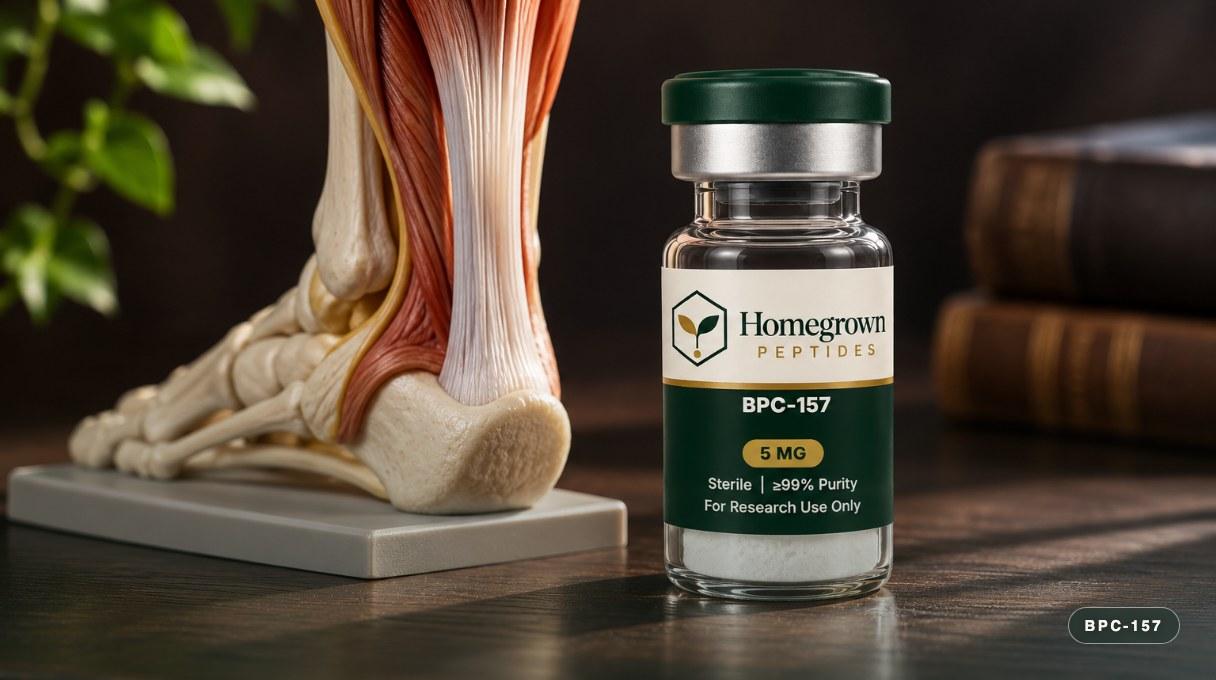
Tendon, ligament and muscle study designs in this literature start from the same material a lab researcher would: lyophilized peptide reconstituted to a known concentration immediately before use, with the concentration math covered in our guide to reconstituting lyophilized peptides. Because fibroblast and tensile-strength endpoints are sensitive to peptide identity and purity, matching the research lot to its certificate of analysis matters more in this literature than in less structure-dependent assays; see how to read a peptide certificate of analysis for what each reported value means. Several labs studying tendon and muscle repair run BPC-157 alongside a second peptide in the same model; our piece on the GHK-Cu, BPC-157 and TB-500 blend in tissue-repair research models covers how that combined design is typically set up. Homegrown supplies both the single-peptide BPC-157 research vial and the combined BPC-157 / TB-500 vial used in that kind of paired study design, each with a lot-matched certificate of analysis.
Frequently asked questions
Which specific tendon has the most published BPC-157 data?
The Achilles tendon, both as a mid-substance transection model and as a tendon-to-bone detachment model, has the largest and oldest body of orthopedic BPC-157 papers reviewed here.
Is there a dedicated rotator cuff (supraspinatus) rat study?
A dedicated study under that specific anatomical label was not identified in this review. The closest published analog is the Achilles tendon-to-bone detachment model, which tests the same reattachment-and-strength question. This point should be confirmed before publication.
Do the muscle studies measure strength the animal can voluntarily produce, or tissue strength under a testing machine?
Tissue strength under a mechanical testing machine (tensile or breaking-strength testing), not a voluntary performance measure like grip strength or running distance.
Does the ligament study use the same amount as the tendon studies?
Yes, the ligament paper reviewed here uses the same nominal microgram-per-kilogram figure reported in several of the tendon and muscle papers, plus a separate local-application arm not present in the tendon papers.
Do any of these studies include a sham-injury control group?
The papers reviewed here compare treated versus untreated injured animals rather than describing a separate sham-surgery arm in the summaries available; a reader wanting that detail should check each paper's full methods section directly.
Why do fibroblast cell-culture studies matter if the orthopedic question is about whole tendons?
Cell-culture work isolates one proposed mechanism, fibroblast survival and migration, from the many variables present in a whole transected tendon, letting researchers test that single mechanism more precisely, even though a culture result cannot stand in for a whole-tendon mechanical result on its own.
Are BPC-157 and TB-500 studied in the same tendon models?
Not as a routine combined-amount arm within the papers reviewed here; each peptide's orthopedic literature was built separately. Labs that pair the two in practice typically run them as parallel study arms rather than a single combined-dose experiment.
References
- Staresinic M, Sebecic B, Patrlj L, et al. Gastric pentadecapeptide BPC 157 accelerates healing of transected rat Achilles tendon and in vitro stimulates outgrowth of fibroblasts from tendon explants. J Orthop Res. 2003;21(6):976-983. PubMed PMID.
- Krivic A, Majerovic M, Jelic I, Seiwerth S, Sikiric P. Modulation of early functional recovery of Achilles tendon to bone unit after transection by BPC 157 and anti-inflammatory agents. Inflamm Res. 2008;57(10):485-492. PubMed PMID.
- Chang CH, Tsai WC, Lin MS, Hsu YH, Pang JH. The promoting effect of pentadecapeptide BPC 157 on tendon outgrowth, cell survival, and cell migration. J Appl Physiol (1985). 2011;110(3):774-780. PubMed PMID.
- Chang CH, Tsai WC, Hsu YH, Pang JH. Pentadecapeptide BPC 157 enhances the growth hormone receptor expression in tendon fibroblasts. Molecules. 2014;19(11):19066-19077. PubMed PMID.
- Staresinic M, Petrovic I, Novinscak T, et al. Effective therapy of transected quadriceps muscle in rat: gastric pentadecapeptide BPC 157. J Orthop Res. 2006;24(5):1109-1117. PubMed PMID.
- Novinscak T, Brcic L, Staresinic M, et al. Gastric pentadecapeptide BPC 157 as an effective therapy for muscle crush injury in the rat. Surg Today. 2008;38(8):716-725. PubMed PMID.
- Pevec D, Novinscak T, Brcic L, et al. Impact of pentadecapeptide BPC 157 on muscle healing impaired by systemic corticosteroid application. Med Sci Monit. 2010;16(3):BR81-88. PubMed PMID.
- Cerovecki T, Bojanic I, Brcic L, et al. Pentadecapeptide BPC 157 (PL 14736) and ligament repair in the rat. J Orthop Res. 2010;28(9):1155-1161. PubMed PMID.
Research use only. Homegrown Peptides products are for laboratory research and are not for human or animal use. Nothing in this article is medical advice.