Bacteriostatic water is sterile water for injection that carries a small, standardized amount of benzyl alcohol, typically 0.9%, added specifically as an antimicrobial preservative. The benzyl alcohol does not sterilize the water itself; sterility comes from the manufacturing process. What the preservative does is limit the growth of microorganisms that could otherwise be introduced into the container across repeated needle draws from the same vial, which is why bacteriostatic water is built around multi-dose use in a laboratory setting rather than a single-draw, single-use container. This article looks at the chemistry of that preservative, the monograph that defines the product, and why the multi-dose rationale exists.
| Attribute | Detail |
|---|---|
| Base composition | Sterile water for injection plus benzyl alcohol, commonly 0.9% (9 mg/mL) |
| Role of benzyl alcohol | Antimicrobial preservative; limits bacterial growth across repeated vial access, does not sterilize on its own |
| Reference standard | Bacteriostatic Water for Injection, USP, defined by the USP monograph and FDA-approved product labeling |
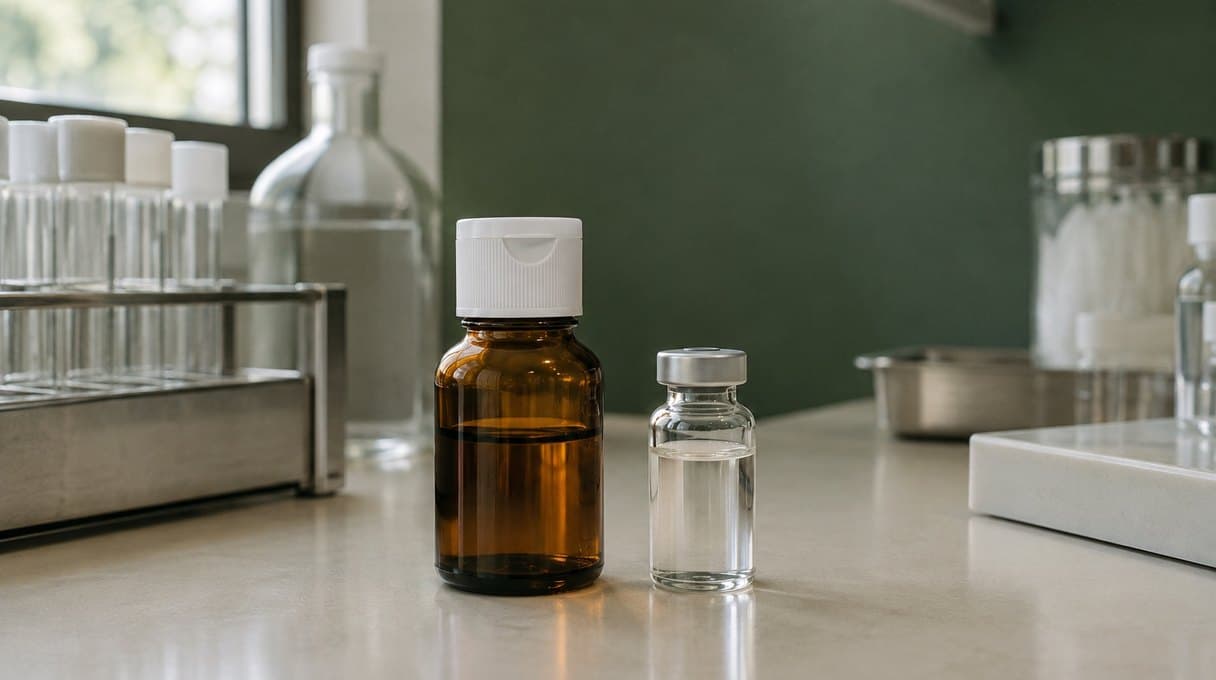
| Typical container | Multi-dose vial with a rubber stopper designed for repeated needle entry |
| Compatibility note | Not every peptide or protein tolerates benzyl alcohol equally; some formulations show preservative-induced aggregation in the literature |
What is benzyl alcohol doing chemically in the water?
Benzyl alcohol is a small aromatic alcohol that has long been used as an antimicrobial preservative in injectable and topical pharmaceutical products because it disrupts microbial cell membranes at concentrations that are tolerated in short-term parenteral products. In bacteriostatic water, it is present at a standardized low concentration, commonly 0.9%, chosen to provide antimicrobial activity across the useful life of a multi-dose vial without introducing an unmanageable level of the preservative into whatever is reconstituted with it. The mechanism is bacteriostatic rather than bactericidal in most practical contexts, meaning it primarily slows or halts microbial growth rather than instantly killing every organism present, which is consistent with its role: limiting bioburden that could accumulate as a vial is repeatedly accessed rather than functioning as a terminal sterilization step.
What does the USP monograph and FDA labeling actually specify?
"Bacteriostatic Water for Injection, USP" is a defined pharmacopeial product: sterile water for injection to which benzyl alcohol has been added as a bacteriostatic agent, packaged for multiple-dose use. FDA-approved product labeling for this exact product, available through FDA's DailyMed database, specifies the benzyl alcohol concentration, confirms the multi-dose vial format, and states the antimicrobial preservative's role in the formulation (FDA/DailyMed, Bacteriostatic Water for Injection, USP). This labeling is the primary reference point for what the product actually contains; a lab handling note or vendor description is a summary of that same underlying specification, not a separate standard.
Why does a multi-dose vial need a preservative at all?
A single-use, single-draw container is designed to be opened once and discarded, so there is no realistic window for microbial contamination to grow before use. A multi-dose vial, by contrast, is designed to be entered by a needle multiple times over its useful life, and each puncture is an opportunity to introduce a small amount of microbial contamination from the needle or the surrounding environment. The antimicrobial preservative exists specifically to keep any such contamination from growing to a meaningful level between draws. A pharmaceutical research paper examining interactions between peptides and preservatives in multi-dose aqueous formulations frames this directly: the preservative's job is to maintain antimicrobial efficiency across the vial's dosing life while the formulation itself, including any peptide present, is also being assessed for compatibility with that preservative (Heljo et al., 2015). This is the underlying engineering logic for why bacteriostatic water, rather than plain sterile water, is the standard choice for a vial that will be accessed more than once on the bench. How many draws a given vial needs to support is itself a variable worth planning for; see choosing the right vial size for how that math is typically approached.
What compatibility issues have been reported between benzyl alcohol and peptides or proteins?
Benzyl alcohol is not chemically inert toward every peptide or protein it comes into contact with, and the pharmaceutical formulation literature documents specific cases where it can promote unwanted aggregation. An early mechanistic study on a recombinant interleukin-1 receptor antagonist reported that benzyl alcohol induced aggregation of the protein in aqueous solution under certain conditions, and worked out some of the physical chemistry behind that interaction (Zhang et al., 2004). A more recent study specifically examining antimicrobial excipient-induced aggregation in parenteral peptide therapeutic formulations extended this picture across a broader set of peptide molecules and preservatives, reporting that the choice of preservative, including benzyl alcohol, can measurably affect the physical stability of a peptide formulation depending on the specific peptide and conditions involved (Li et al., 2022). The 2015 study on peptide-preservative interactions in multi-dose formulations, cited above for the multi-dose rationale, also reported that peptide self-interaction behavior changed in the presence of certain preservatives, underscoring that compatibility is peptide-specific rather than a universal property of "adding benzyl alcohol." For a lab, the practical takeaway from this literature is that bacteriostatic water is a well-characterized, standard reagent, but confirming compatibility with a specific peptide preparation, rather than assuming universal compatibility, is consistent with how the formulation science treats these interactions.
How does bacteriostatic water compare with plain sterile water in lab practice?
Plain sterile water for injection contains no antimicrobial preservative and is intended for prompt, single-use application once opened. Bacteriostatic water's benzyl alcohol content is what allows repeated draws from the same vial over a longer working period on the bench. Our companion article, bacteriostatic water vs sterile water, walks through this comparison in more detail, including when a lab might choose one over the other based on how a reconstituted preparation will be used and how many draws a single vial needs to support. General reconstitution technique, including concentration math for a given vial size, is covered in reconstituting lyophilized peptides. Lot-specific specs for our own multi-dose supply are posted on the bacteriostatic water, 30 mL bottle lot page.
Frequently asked questions
How much benzyl alcohol is in bacteriostatic water?
Bacteriostatic Water for Injection, USP is commonly formulated with 0.9% benzyl alcohol (9 mg per mL). The exact figure is stated on the specific product's FDA-approved labeling.
Does bacteriostatic water sterilize whatever is reconstituted with it?
No. The water itself is manufactured sterile, and the benzyl alcohol acts as a preservative that limits microbial growth across repeated vial access; it is not a sterilization step for material added to the vial afterward.
Is bacteriostatic water interchangeable with sterile water in every case?
Not automatically. Because benzyl alcohol has been reported to interact with, and in some cases destabilize, certain peptide and protein formulations, compatibility is specific to the molecule involved rather than a given for every preparation.
Why is bacteriostatic water sold in a multi-dose vial format?
Its antimicrobial preservative is specifically included to support repeated needle access to the same vial over its useful life, which is the scenario a single-use sterile water container is not designed for.
Is the benzyl alcohol concentration standardized?
Yes. Bacteriostatic Water for Injection, USP follows a defined pharmacopeial specification, and the concentration used in a given FDA-approved product is stated on that product's official labeling.
References
- FDA/DailyMed. Bacteriostatic Water for Injection, USP, prescribing information (Hospira, Inc.). DailyMed label.
- Zhang Y, Roy S, Jones LS, et al. Mechanism for benzyl alcohol-induced aggregation of recombinant human interleukin-1 receptor antagonist in aqueous solution. J Pharm Sci. 2004;93(12):3076-89. PubMed 15514986.
- Heljo P, Ross A, Zarraga IE, Pappenberger A, Mahler HC. Interactions Between Peptide and Preservatives: Effects on Peptide Self-Interactions and Antimicrobial Efficiency In Aqueous Multi-Dose Formulations. Pharm Res. 2015;32(10):3201-12. PubMed 25893328.
- Li M, Falk BT, Lu X, et al. Molecular Mechanism of Antimicrobial Excipient-Induced Aggregation in Parenteral Formulations of Peptide Therapeutics. Mol Pharm. 2022;19(9):3267-3278. PubMed 35917158.
Research use only. Homegrown Peptides products are for laboratory research and are not for human or animal use. Nothing in this article is medical advice.