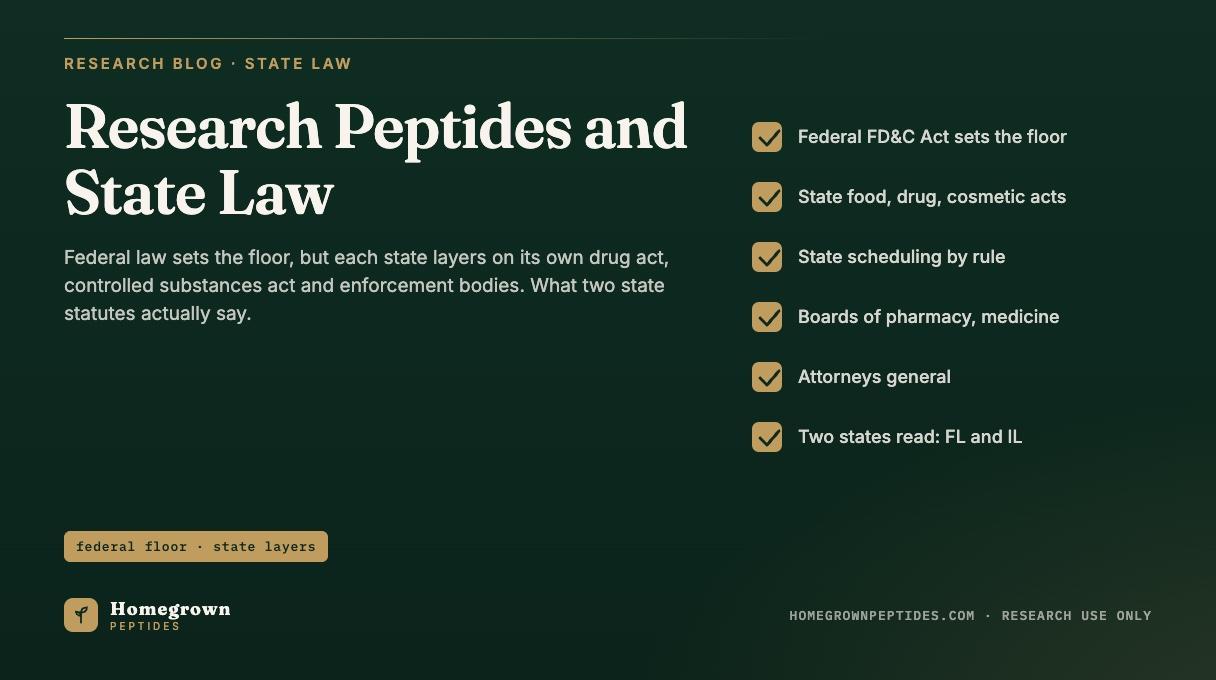
Federal law sets the floor, but every state also has its own food, drug and cosmetic act that mirrors the federal definitions of drug and misbranding, its own controlled substances act that can schedule substances the federal government has not, and its own boards and attorney general. The same research vial can face different enforcement depending on the state.
As of November 7, 2026. This article describes United States federal law and published agency actions as of that date. It is general information, not legal advice; the rules differ by state and change over time, and anyone with a specific question should consult a lawyer licensed in their jurisdiction.
This article draws state facts from exactly two states: Florida and Illinois. No other state's law, board action or scheduling decision is named or implied below, and whether any state has banned or scheduled a research peptide was not verified; that question is addressed directly in the FAQ.
Key facts
| Layer | Federal source | Florida | Illinois |
|---|---|---|---|
| Drug definition | 21 U.S.C. 321(g)(1) | Fla. Stat. 499.003(b) | 410 ILCS 620 (no separate definition section was read; see prohibited acts below) |
| Prohibited acts | 21 U.S.C. 331(a) | Fla. Stat. 499.005(1), (2), (5) | 410 ILCS 620, Sec. 3, 3.1, 3.2 |
| Independent scheduling authority | 21 U.S.C. 812 (Schedules I through V, maintained at 21 CFR part 1308) | Fla. Stat. 893.035 (Attorney General rule authority, independent of federal scheduling) | Not verified for this article; Illinois has its own controlled substances act, but it was not read for this piece |
| Named enforcing body | FDA, under 21 U.S.C. 331 and 355 | "The department" under chapter 499, administered by Florida's Department of Business and Professional Regulation | Not specified in the sections read |
| False or misleading advertisement | 21 U.S.C. 352(a)(1) | Fla. Stat. 499.005(5) | Not quoted in the sections read |
Why is there a state layer at all?
The federal Food, Drug, and Cosmetic Act reaches articles introduced or delivered for introduction into interstate commerce. 21 U.S.C. 331(a) prohibits "the introduction or delivery for introduction into interstate commerce of any food, drug, device, tobacco product, or cosmetic that is adulterated or misbranded." That commerce hook is why FDA's warning letters and import alerts speak in terms of shipment and distribution rather than simple possession.
States do not need that hook. A state legislature can regulate manufacture, sale, repackaging and holding for sale entirely within its own borders, and most states have written a food, drug and cosmetic act that parallels the federal one, plus their own controlled substances act. For the federal framework, see are research peptides legal in the United States. This article covers the state layer on top of it.
How do state drug definitions compare with the federal one?
Florida's definition of "drug" in Fla. Stat. 499.003 was written to track the federal definition clause for clause. The federal definition, at 21 U.S.C. 321(g)(1), and the Florida definition sit almost side by side.
| Clause | Federal, 21 U.S.C. 321(g)(1) | Florida, Fla. Stat. 499.003 |
|---|---|---|
| Pharmacopoeia recognition | "(A) recognized in the official United States Pharmacopoeia, official Homoeopathic Pharmacopoeia of the United States, or any supplement to any of them" | "(a) Recognized in the current edition of the United States Pharmacopoeia and National Formulary, official Homeopathic Pharmacopoeia of the United States, or any supplement to any of those publications" |
| Disease-related intended use | "(B) intended for use in the diagnosis, cure, mitigation, treatment, or prevention of disease in man or other animals" | "(b) Intended for use in the diagnosis, cure, mitigation, treatment, therapy, or prevention of disease in humans or other animals" |
| Structure or function intent | "(C) intended to affect the structure or any function of the body of man or other animals" (food excluded) | "(c) Intended to affect the structure or any function of the body of humans or other animals" |
| Component clause | "(D) intended for use as a component of any article specified in clause (A), (B), or (C)" | "(d) Intended for use as a component of any article specified in paragraph (a), paragraph (b), or paragraph (c)" |
The only substantive addition in the Florida text is the word "therapy" in the disease clause, plus a closing phrase: Florida's definition "includes active pharmaceutical ingredients." That phrase matters for a research peptide, since it puts a bulk active ingredient, not just a finished dosage form, inside Florida's definition of drug.
Illinois's Food, Drug and Cosmetic Act, 410 ILCS 620, was read for this article only through its prohibited acts sections (Sec. 3 through 3.2). A separate, free-standing definition of "drug" in the Illinois act was not located, so none is quoted here.
What do state prohibited-acts sections cover?
Florida's Fla. Stat. 499.005 lists prohibited acts in the same structure as the federal 21 U.S.C. 331. Subsection (1) prohibits "the manufacture, repackaging, sale, delivery, or holding or offering for sale of any drug, device, or cosmetic that is adulterated or misbranded or has otherwise been rendered unfit for human or animal use." Subsection (2) prohibits "the adulteration or misbranding of any drug, device, or cosmetic." Subsection (5) prohibits "the dissemination of any false or misleading advertisement of a drug, device, or cosmetic."
Illinois's 410 ILCS 620 runs in parallel. Sec. 3 states that "the enumerated acts in Sections 3.1 through 3.21 and the causing thereof are prohibited in this State." Sec. 3.1 prohibits "the manufacture, sale or delivery, holding or offering for sale of any food, drug, device or cosmetic that is adulterated or misbranded," and Sec. 3.2 prohibits "the adulteration or misbranding of any food, drug, device or cosmetic." No false-advertisement clause was located in the Illinois sections reviewed.
| Conduct | Florida, Fla. Stat. 499.005 | Illinois, 410 ILCS 620 |
|---|---|---|
| Sale or manufacture of an adulterated or misbranded drug | Subsection (1), quoted above | Sec. 3.1, quoted above |
| Adulteration or misbranding itself | Subsection (2), quoted above | Sec. 3.2, quoted above |
| False or misleading advertisement | Subsection (5), quoted above | Not quoted in the sections read |
The false-advertisement clause reaches marketing copy more broadly than a labeling-only misbranding claim, including a website page or a product listing. That is the same kind of evidence FDA leans on at the federal level when it reads a seller's own site to establish intended use; see the discussion of that mechanism in why research use only is not a loophole.
Can a state schedule a peptide the federal government has not?
Yes, as a matter of legal mechanism, at least in Florida. The federal Controlled Substances Act, at 21 U.S.C. 812(a), establishes five schedules, and a Schedule I finding under 812(b)(1) requires a determination that a substance "has a high potential for abuse," "has no currently accepted medical use in treatment in the United States," and lacks "accepted safety for use of the drug or other substance under medical supervision." Those findings, and the resulting list, are maintained at 21 CFR part 1308, not in the statute itself.
Florida does not need to wait on that federal process. Fla. Stat. 893.035 gives Florida's Attorney General standing authority to add substances to the state's own schedules by rule, on the finding that "new substances are being created which are not controlled under the provisions of this chapter but which have a potential for abuse similar to or greater than that for substances controlled under this chapter." That is a state-level scheduling path independent of the DEA.
Whether that Florida authority, or a comparable authority elsewhere, has actually been used against a specific research peptide was not verified for this article. No state action scheduling a research peptide is asserted here, and no absence of such an action is asserted either. Check a specific state's current schedules directly rather than inferring an answer from federal scheduling status.
Which state bodies can act?
Three kinds of state body show up here. First, the agency administering the state's drug act: in Florida, "the department" under chapter 499, identified as Florida's Department of Business and Professional Regulation. Second, boards of pharmacy and medicine, which license compounding and prescribing and sit alongside, not inside, the drug act; compounding runs on its own federal track, covered in what FDA's 503A bulk drug substances lists mean for research peptides. Third, a state Attorney General, who in Florida holds rulemaking authority over new controlled substances under 893.035 and, in many states, also enforces consumer-protection statutes against false advertising. Beyond Florida and Illinois, the specific office and its powers vary by state and were not verified here.
How does intended use travel into state law?
At the federal level, 21 CFR 201.128 fills in how FDA reads intended use. It refers to "the objective intent of the persons legally responsible for the labeling of an article," shown by "labeling claims, advertising matter, or oral or written statements," by the article's "design or composition," and by "circumstances surrounding the distribution of the article." It also states that "a firm would not be regarded as intending an unapproved new use for an approved drug based solely on that firm's knowledge that such drug was being prescribed or used by health care providers for such use."
That regulation does not bind a state applying its own statute. But because Florida's drug definition uses the same "diagnosis, cure, mitigation, treatment, therapy, or prevention of disease" language as the federal one, the same kind of evidence (labeling, advertising, website claims) is what a state agency would look to first.
How should a laboratory read its own state?
This article verified only Florida and Illinois. For any other state, the following is a checklist of what to look up directly, not a summary of what any state says:
- The state's own food, drug and cosmetic act, including its definition of "drug" and its prohibited-acts section.
- The state's controlled substances act and its current schedules, including any delegated rulemaking authority comparable to Florida's 893.035.
- Rules published by the state board of pharmacy and board of medicine, since those govern compounding and prescribing separately from the drug act itself.
- Guidance or enforcement actions published by the state Attorney General, since consumer-protection and false-advertising authority often sits there rather than with the drug-act agency.
A laboratory's own certificate of analysis, for a product such as KPV, documents identity, purity and endotoxin results; it says nothing about which state's prohibited-acts section applies to a given sale, and it is not a substitute for checking the statute directly. California is one more example worth naming generically: it has its own food, drug and cosmetic law, not quoted in this article.
Frequently asked questions
Are research peptides legal in Florida?
Fla. Stat. 499.003 and 499.005 do not name research peptides as a category and do not ban them by name. What the statute prohibits is manufacturing, selling or holding for sale a drug that is adulterated or misbranded, and disseminating a false or misleading advertisement of a drug. This is a description of the statute's text, not a certification that any specific product or seller complies with it.
Are research peptides legal in Illinois?
The same logic applies under 410 ILCS 620. Sections 3.1 and 3.2 prohibit manufacturing, selling or delivering an adulterated or misbranded drug, and prohibit adulteration or misbranding itself. Illinois's act does not name research peptides as a category in the sections read, and no separate definition of "drug" from that act is quoted here.
Has any state banned or scheduled a research peptide?
That was not verified for this article. No state action scheduling or banning a specific research peptide is asserted here, and no claim that none has is made either. A mechanism for a state to schedule a substance the federal government has not exists in at least Florida, under 893.035; whether it or a comparable authority elsewhere has been used against a research peptide needs to be checked against that state's current schedules directly.
Do state laws apply to online orders shipped into the state?
Both statutes reach more than in-person retail sale. Florida's 499.005(1) reaches "the manufacture, repackaging, sale, delivery, or holding or offering for sale" of a covered article, and Illinois's Sec. 3.1 reaches "the manufacture, sale or delivery, holding or offering for sale" of one. Delivery and holding for sale are named acts on their own, consistent with a state's drug act reaching a product once it is delivered or held for sale within that state, regardless of where the order was placed.
Who enforces these state laws?
In Florida, chapter 499 names "the department," identified as the Florida Department of Business and Professional Regulation, with the Attorney General holding separate rulemaking authority over new controlled substances under 893.035. The Illinois sections read did not name a specific enforcing office. Beyond these two states, the enforcing body varies and was not checked here.
Does a vendor's compliance in one state carry over to another state?
No. Each state's drug act, controlled substances act and board rules are their own statutes, enforced independently of one another and of federal law. A product that raises no issue under Florida's 499.005 or Illinois's 410 ILCS 620 is not thereby shown to comply with a different state's statute, which this article has not read.
References
- Cornell Law School Legal Information Institute. 21 U.S.C. 321, Definitions. Accessed November 7, 2026. law.cornell.edu.
- Cornell Law School Legal Information Institute. 21 U.S.C. 331, Prohibited acts. Accessed November 7, 2026. law.cornell.edu.
- Cornell Law School Legal Information Institute. 21 U.S.C. 812, Schedules of controlled substances. Accessed November 7, 2026. law.cornell.edu.
- Cornell Law School Legal Information Institute. 21 CFR 201.128, Meaning of intended uses. Accessed November 7, 2026. law.cornell.edu.
- Florida Legislature. Florida Statutes 499.003, Definitions. Accessed November 7, 2026. leg.state.fl.us.
- Florida Legislature. Florida Statutes 499.005, Prohibited acts. Accessed November 7, 2026. leg.state.fl.us.
- Florida Legislature. Florida Statutes 893.035, Control of new substances; findings of fact; delegation of authority to Attorney General to control substances by rule. Accessed November 7, 2026. leg.state.fl.us.
- Illinois General Assembly. Illinois Food, Drug and Cosmetic Act, 410 ILCS 620. Accessed November 7, 2026. ilga.gov.
Research use only. Homegrown Peptides products are for laboratory research and are not for human or animal use. Nothing in this article is medical advice.