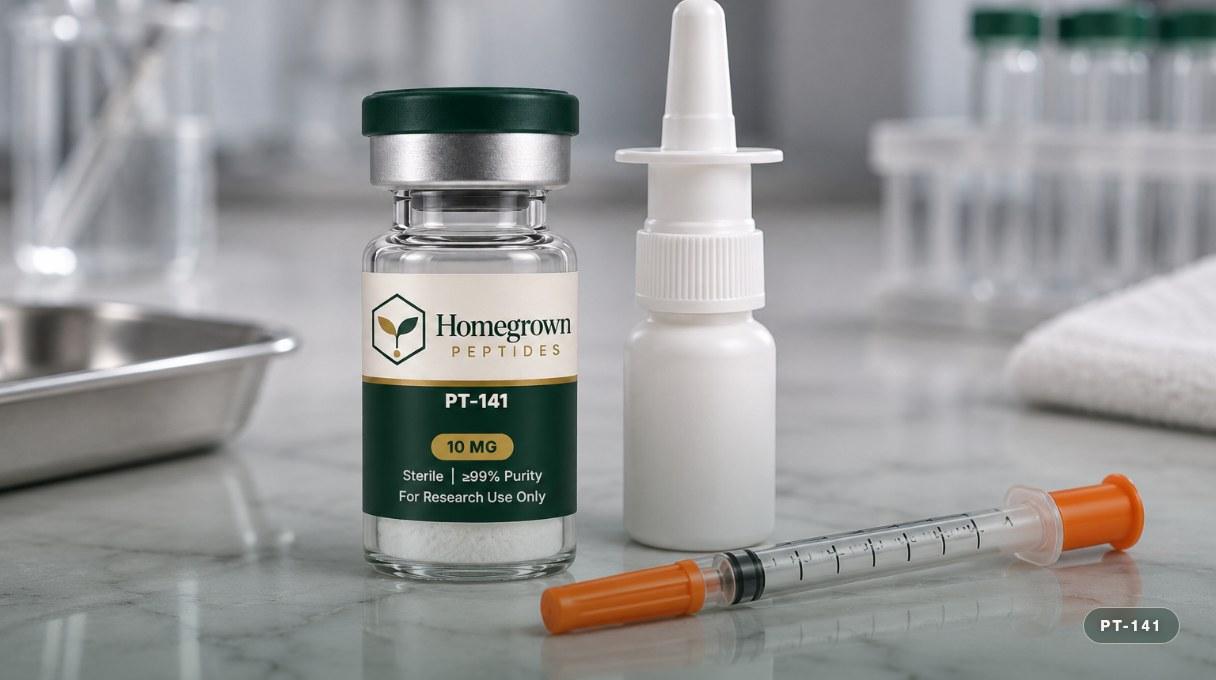
PT-141 (bremelanotide) entered clinical development as an intranasal spray for erectile dysfunction in the early 2000s. The intranasal program did not continue past its early studies because higher intranasal amounts produced a fast, high absorption peak that tracked with measurable increases in blood pressure. The sponsor moved the molecule to subcutaneous injection, which produced a flatter absorption curve at the amounts studied and became the delivery route used in the later trials that led to an approved subcutaneous autoinjector for sexual arousal disorder in women. The route change, not the receptor pharmacology, is the reason PT-141 is associated with an injectable format in the current literature rather than a nasal product.
| Key fact | What the record shows | Source |
|---|---|---|
| Original delivery route studied | Intranasal spray, Phase 1 and early Phase 2 pharmacokinetic and pharmacodynamic program | Molinoff et al., 2003 (PubMed 12851303) |
| Reason the intranasal route was not carried forward | Higher intranasal amounts produced a rapid absorption peak associated with transient increases in systolic and diastolic blood pressure | Molinoff et al., 2003 (PubMed 12851303); program history summarized in later reviews |
| Replacement route | Subcutaneous injection, flatter plasma concentration curve at the amounts carried into later trials | Program history; Kingsberg et al., 2019 |
| Receptor target | Melanocortin receptor agonist, active at MC4R, structurally related to alpha-MSH | Pfaus et al., 2004 (PubMed 15226502) |
| Later approved format | Subcutaneous autoinjector for premenopausal women with acquired, generalized hypoactive sexual desire disorder | Kingsberg et al., 2019 |
Why Did PT-141's Intranasal Program Get Discontinued?
The intranasal formulation of PT-141 was the first delivery route to reach human pharmacokinetic and pharmacodynamic testing. Early studies in healthy male subjects and men with mild to moderate erectile dysfunction examined a range of intranasal amounts and measured plasma drug concentration alongside cardiovascular parameters. As the intranasal amount increased, so did the rate at which the compound crossed the nasal mucosa into the bloodstream. That fast absorption produced a sharp early peak in plasma concentration, and the higher-amount cohorts showed measurable, transient increases in blood pressure that tracked with the peak. The cardiovascular signal, not a lack of effect on the intended sexual function endpoints as defined in the trial, is what is credited in the pharmacology literature with ending further intranasal development. Melanocortin receptor agonism itself has a known cardiovascular arm (melanocortin pathways intersect with central blood pressure regulation), so the finding was mechanistically consistent rather than an isolated anomaly of the nasal formulation.
What Did the Pharmacokinetic Data Show for Each Route?
The two delivery routes produced distinct plasma concentration profiles. Intranasal administration showed a short time to peak concentration (reported in the early PT-141 program as occurring within roughly the first half hour after administration) and a correspondingly steep rise in the concentration curve. Subcutaneous administration produced a slower climb to peak concentration and a lower, more sustained plateau at a comparable amount, which is the pharmacokinetic signature that correlated with a smaller cardiovascular signal in the program's safety data. The comparison is the clearest documented case in the melanocortin-agonist literature of a route change being driven primarily by absorption kinetics rather than by a change in the target amount or a lack of a measurable pharmacodynamic effect.
| Study | Model and n | Amount and route reported | Endpoint | Finding |
|---|---|---|---|---|
| Molinoff et al., 2003 (PubMed 12851303) | Human, healthy male volunteers and men with mild to moderate erectile dysfunction, early-phase cohorts | Intranasal PT-141, ascending single amounts across several milligram-range cohorts | Plasma concentration curve; systolic and diastolic blood pressure | Higher intranasal amounts produced a fast absorption peak and an amount-related rise in blood pressure, prompting a shift to subcutaneous dosing for later work |
| Pfaus et al., 2004 (PubMed 15226502) | Ovariectomized, hormone-primed female rat, behavioral solicitation testing across multiple dose cohorts | Subcutaneous melanocortin receptor agonist related to the PT-141 series | Solicitational and proceptive sexual behaviors scored by direct observation | Subcutaneous dosing increased solicitation behavior in a dose-related pattern, supporting a central, receptor-mediated mechanism independent of the nasal route |
| Diamond et al., Int J Impot Res, 2004 (intranasal PK/safety program) | Human, healthy males and men with erectile dysfunction, single and repeat intranasal cohorts | Intranasal PT-141, several ascending amounts, single and short repeat-dose cohorts | Plasma concentration, heart rate, blood pressure, tolerability | Confirmed an amount-related blood pressure signal at higher intranasal amounts, consistent with Molinoff et al., 2003 |
| Rosen et al., Int J Impot Res, 2004 (subcutaneous PK/safety program) | Human, healthy males and men with an inadequate response to a PDE5 inhibitor | Subcutaneous PT-141, ascending amounts in the low milligram range | Plasma concentration, blood pressure, erectile response measures | Subcutaneous dosing produced a flatter concentration curve than the intranasal program at comparable amounts, with a smaller blood pressure signal |
| Clayton et al., dose-finding trial, 2016 | Human, premenopausal women with a sexual arousal or desire disorder diagnosis, randomized, placebo-controlled | Subcutaneous bremelanotide, 0.75 to 1.75 milligram range, self-administered as needed | Sexual function endpoints as defined in the trial; tolerability measures | Identified the amount range carried forward into the Phase 3 program, with transient nausea and flushing reported more often than placebo |
| Kingsberg et al., Obstet Gynecol, 2019 | Human, two randomized, double-blind, placebo-controlled Phase 3 trials in premenopausal women | Subcutaneous bremelanotide, 1.75 milligrams, self-administered as needed, autoinjector | Sexual function endpoints as defined in the trial; tolerability monitoring including blood pressure checks | Subcutaneous dosing at this amount met its predefined endpoints with transient, modest blood pressure changes similar across visits, not the sustained program-ending signal seen with higher intranasal amounts |
How Does Subcutaneous Delivery Change the Absorption Curve Compared With a Spray?
Route of administration changes how fast a peptide reaches systemic circulation and how high the peak concentration climbs for a given amount. Nasal mucosa is a thin, highly vascularized barrier, which is useful for peptides that need rapid onset but makes the absorption rate sensitive to formulation and nasal blood flow at the time of dosing. Subcutaneous tissue absorbs more slowly because the compound has to diffuse through interstitial space and enter capillaries or lymphatics before reaching the bloodstream, which smooths out the concentration curve and lowers the peak-to-trough ratio. For a melanocortin receptor agonist with a cardiovascular side arm, a lower, slower peak is the pharmacokinetic property that matters most for the margin between the amount needed for a measurable effect and the amount that produces a measurable blood pressure change. This is the general principle behind the broader literature on peptide bioavailability by route, and PT-141's program history is one of the better-documented single-compound illustrations of it.
Why Didn't the Later Trials Go Back to a Nasal Spray?
Once the subcutaneous program showed an adequate margin between the pharmacodynamic signal and the blood pressure signal, there was no pharmacological reason to revisit the nasal route. The Phase 3 program used a subcutaneous autoinjector delivering a fixed amount, self-administered as needed rather than on a fixed interval, which fits the compound's reported pharmacokinetic profile: a predictable absorption curve and a return to baseline within hours. The general tradeoffs between nasal and injectable peptide delivery formats (onset speed, first-pass avoidance, mucosal irritation, formulation stability) are documented across other research peptides as well, but PT-141 is the clearest published case where a route change was driven specifically by a cardiovascular finding rather than by stability, cost, or convenience considerations.
What Was Reported About Blood Pressure Across the Program?
| Program stage | Route | What was monitored | What was reported |
|---|---|---|---|
| Early Phase 1/2a | Intranasal | Systolic and diastolic blood pressure, heart rate, at intervals after dosing | Transient, amount-related increases at higher intranasal amounts, larger than at lower amounts |
| Early Phase 2 safety program | Intranasal | Repeat-dose blood pressure monitoring | Confirmed the amount-related signal; higher amounts were not carried forward |
| Subcutaneous PK/safety program | Subcutaneous | Blood pressure at matched time points to the intranasal program | Smaller peak blood pressure change than intranasal at a comparable systemic exposure |
| Phase 2 dose-finding | Subcutaneous | Blood pressure checks at study visits, plus tolerability reporting | Transient nausea and flushing reported more often than placebo; blood pressure changes described as modest and self-limited |
| Phase 3 program | Subcutaneous | Blood pressure at scheduled visits across the trial duration | Reported as consistent with the Phase 2 safety profile, supporting approval of the fixed-amount autoinjector |
How this is handled in a research setting: PT-141 ships as a lyophilized powder and is reconstituted with bacteriostatic or sterile water immediately before use in a study, following the general math and handling steps described in reconstituting lyophilized peptides. A certificate of analysis for the lot in use should be checked for identity and purity before any reconstitution step; see how to read a peptide certificate of analysis for what each section of that document reports. Research-grade PT-141 is supplied for laboratory use only and carries no instructions for human or animal administration.
Frequently asked questions
Is PT-141 still studied as a nasal spray?
The published literature does not describe an active intranasal development program for PT-141 following the early 2000s pharmacokinetic and safety studies. The compound's later clinical history, including the Phase 3 program, used subcutaneous dosing.
Why does the route of administration change blood pressure response for the same compound?
Route changes the absorption rate and the shape of the plasma concentration curve. A faster, higher peak concentration from intranasal dosing coincided with a larger measured blood pressure change than a slower, flatter subcutaneous curve at a comparable amount, which is consistent with a concentration-dependent cardiovascular effect rather than a route-specific toxicity.
What receptor does PT-141 act on?
PT-141 (bremelanotide) is a melanocortin receptor agonist, with activity reported at MC4R, and it is structurally related to alpha-melanocyte-stimulating hormone. The preclinical behavioral pharmacology, including the rat solicitation studies, is consistent with a central, receptor-mediated mechanism.
Did the intranasal program report any other findings besides blood pressure?
The intranasal PK and safety program also reported transient nausea and flushing at higher amounts, findings that persisted into the subcutaneous program as well and were tracked as tolerability measures in the later trials.
How is PT-141 different from melanotan II in these studies?
Melanotan II is a related, non-selective melanocortin agonist studied earlier in sexual-behavior pharmacology. PT-141 (bremelanotide) was developed as a related melanocortin receptor agonist carried through a formal PK and safety program, which is why it has the more detailed route-comparison literature summarized here.
What amount range was used in the subcutaneous Phase 3 trials?
The Phase 3 program used a fixed subcutaneous amount of 1.75 milligrams, self-administered as needed rather than on a fixed schedule, following the amount-finding work reported in the Phase 2 dose-finding trial.
Does the blood pressure finding mean the subcutaneous route is free of cardiovascular signal?
No. The Phase 3 safety monitoring still tracked blood pressure at study visits and reported changes, but at a magnitude and pattern the trials characterized as modest and consistent with the earlier Phase 2 safety data, in contrast to the larger signal seen at higher intranasal amounts.
References
- Molinoff PB, Shadiack AM, Earle D, Diamond LE, Quon CY. PT-141: a melanocortin agonist for the treatment of sexual dysfunction. Ann N Y Acad Sci. 2003;994:96-102. PubMed 12851303.
- Pfaus JG, Shadiack A, Van Soest T, Tse M, Molinoff P. Selective facilitation of sexual solicitation in the female rat by a melanocortin receptor agonist. Proc Natl Acad Sci U S A. 2004;101(27):10201-10204. PubMed 15226502.
- Diamond LE, Earle DC, Rosen RC, Willett MS, Molinoff PB. Double-blind, placebo-controlled evaluation of the safety, pharmacokinetic properties and pharmacodynamic effects of intranasal PT-141, a melanocortin receptor agonist, in healthy males and patients with mild-to-moderate erectile dysfunction. Int J Impot Res. 2004;16(1):51-59. PubMed PMID.
- Rosen RC, Diamond LE, Earle DC, Shadiack AM, Molinoff PB. Evaluation of the safety, pharmacokinetics and pharmacodynamic effects of subcutaneously administered PT-141, a melanocortin receptor agonist, in healthy male subjects and patients with an inadequate response to a PDE5 inhibitor. Int J Impot Res. 2004;16(2):135-142. PubMed PMID.
- Clayton AH, Althof SE, Kingsberg S, DeRogatis LR, Kroll R, Goldstein I, Kaminetsky J, Spana C, Lucas J, Jordan R, Portman DJ. Bremelanotide for female sexual dysfunctions in premenopausal women: a randomized, placebo-controlled dose-finding trial. Womens Health (Lond). 2016;12(4):325-337. PubMed PMID.
- Kingsberg SA, Clayton AH, Portman D, Williams LA, Krop J, Jordan R, Lucas J, Simon JA. Bremelanotide for the treatment of hypoactive sexual desire disorder: two randomized phase 3 trials. Obstet Gynecol. 2019;134(5):899-908. PubMed PMID.
- Diamond LE, Earle DC, Garcia WD, Spana C. Co-administration of low doses of intranasal PT-141, a melanocortin receptor agonist, and sildenafil citrate, augments erectile response to visual sexual stimulation in men with erectile dysfunction. Int J Impot Res. 2005;17(3):211-216. PubMed PMID.
Research use only. Homegrown Peptides products are for laboratory research and are not for human or animal use. Nothing in this article is medical advice.