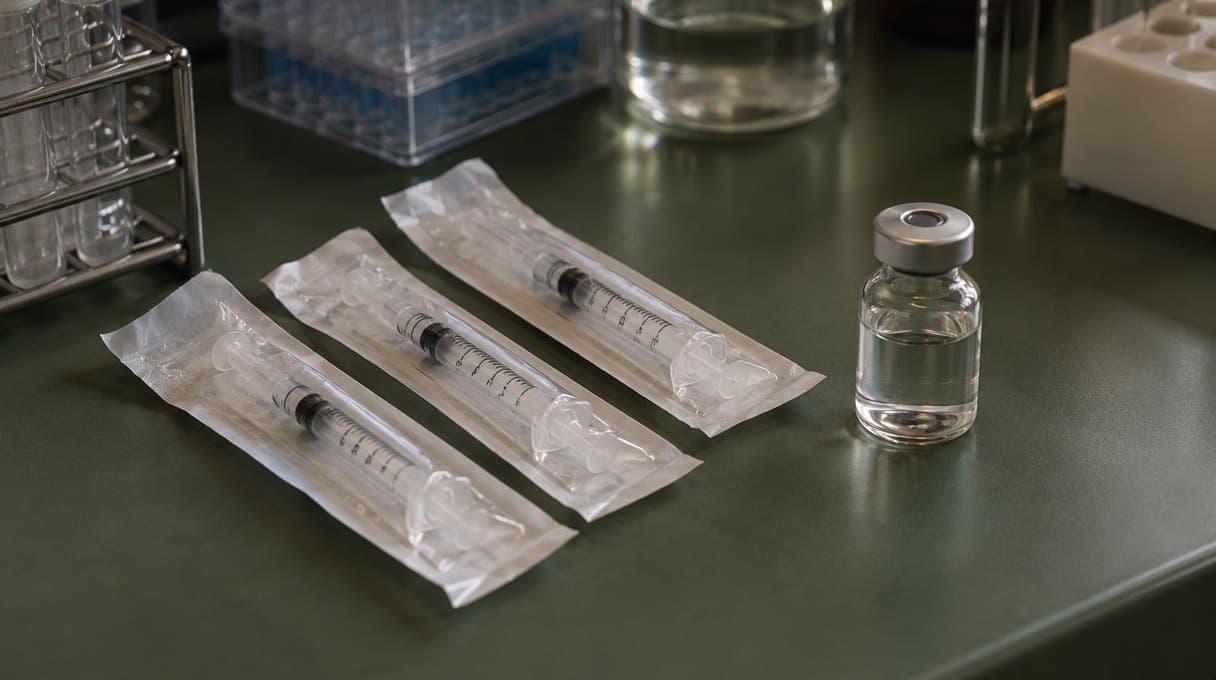
Insulin-style syringes are a common small-volume measuring tool on a peptide research bench, chosen for the same reason they were originally designed: fine gradations over a very small total volume, typically 0.3 mL to 1 mL, marked in units rather than only in milliliter fractions. For a lab measuring out small, precise volumes of a reconstituted peptide solution for an assay or a dilution series, the graduation scale, the needle gauge, and a property called dead space all affect how accurately the marked number on the barrel matches the volume actually drawn and dispensed. This article covers those three variables as laboratory measurement equipment, not as guidance for administering anything to a person or animal.
| Feature | What it affects on the bench |
|---|---|
| Unit markings (typically U-100 scale) | Graduations calibrated to a specific concentration convention; reading the barrel correctly requires knowing what the marked units correspond to in milliliters for your solution |
| Needle gauge (commonly 29-31 gauge for this syringe class) | Smaller-bore needles increase flow resistance for a given solution, which matters when dispensing a more viscous preparation |
| Dead space | The small residual volume left in the needle hub and syringe tip after the plunger is fully depressed; this volume is not part of the measured dose on the barrel scale |
| Barrel volume range | Typically 0.3, 0.5 or 1 mL total capacity, which sets the smallest and largest volumes that can be measured with reasonable precision |
| Why gauge and volume matter together | A very fine needle drawing a viscous or particulate-containing solution can distort the true drawn volume if air bubbles or incomplete draws are not checked for |
What do the unit markings on an insulin syringe actually mean?
Insulin syringes are traditionally marked in "units" calibrated to a specific historical concentration convention (U-100), not directly in milliliters, which means the same barrel marking corresponds to a different milliliter volume depending on what convention the markings assume versus the actual concentration of whatever solution is being measured. For a lab using this syringe type to measure a reconstituted peptide solution rather than a U-100 insulin product, the unit markings only make sense once converted to the milliliter volume they represent on that specific syringe. Our article on mg, mcg, IU and insulin-syringe units explained works through that conversion in detail; the short version is that "units" on the barrel are a graduation convention, not a universal dose unit, and treating them as interchangeable with milligrams or milliliters of an arbitrary solution without doing the conversion is a common source of measurement error.
What is dead space, and why does it matter for accurate measurement?
Dead space is the small volume of a syringe-needle assembly that lies beyond the calibrated barrel scale, in the needle hub and the tip of the syringe, and that cannot be expelled by fully depressing the plunger. This volume does not show up as part of the reading on the barrel, but it still holds some of whatever solution was drawn up. A study measuring how syringe-needle design affects dead space volume across different commercial syringe types quantified how much this residual volume can differ between a low-dead-space design and a conventional Luer-style needle-syringe combination (Binka et al., 2015). For lab work involving very small, precise volumes, especially when a syringe is being used to transfer a measured amount of solution for a dilution series or an assay, the existence of this unmeasured residual volume is a real source of systematic error that is easy to overlook if the only number being checked is the plunger position against the barrel scale.
What have accuracy studies found when measuring small volumes with a syringe?
Multiple published studies have measured how consistently different syringe designs and filling techniques reproduce an intended small volume. A study evaluating syringe design and filling technique for small-volume drawing reported that both factors affected measurement accuracy, meaning the syringe itself and the technique used to fill it are both variables in the final result, not just the nominal volume marked on the barrel (Krauthammer et al., 2023). An earlier study comparing different small-volume syringe designs reported similar findings: the specific syringe used measurably affected both the accuracy (how close to the intended volume) and precision (how consistent across repeated draws) of the volume actually delivered (Moisseiev et al., 2017). A separate study assessing how accurately personnel drew up small liquid volumes using standard syringes reported meaningful variability between individual draws, underscoring that technique, not only equipment, contributes to measurement error when working with small volumes (Cambruzzi et al., 2023). Together, this literature supports treating the barrel marking as a nominal target rather than a guaranteed exact volume, particularly at the smaller end of a syringe's graduated range.
How does needle gauge interact with a solution's viscosity?
Needle gauge describes the internal bore diameter of the needle: a higher gauge number corresponds to a narrower bore. A narrower bore increases resistance to flow for a given solution, which becomes more noticeable as a solution's viscosity increases. Studies examining the syringeability of viscous pharmaceutical solutions, work generally conducted in a formulation-development context rather than a peptide-research one, have measured how the force needed to move a plunger at a given rate increases with both narrower needle gauge and higher solution viscosity, and have used that relationship to characterize how "easy" or "difficult" a given solution is to dispense through a specific needle (Feng et al., 2023; Zhao et al., 2023). For a lab, the practical takeaway is that a very fine gauge needle, useful for its precision and for minimizing waste at the tip, can become a bottleneck if the solution being measured is more viscous than water, which is a reason to match needle gauge to the specific solution being handled rather than defaulting to the finest gauge available for every task.
How should a lab think about total dispensing error?
Dead space, barrel graduation resolution, and technique-related draw variability all contribute to the same practical outcome: the volume actually transferred can differ slightly from the volume read off the barrel. For most bench tasks involving dilution series or transferring reconstituted peptide solution between containers for an assay, this margin of error is small relative to the total volume being handled, but it grows in relative importance as the measured volume itself gets smaller. Our guide on reconstituting lyophilized peptides and our reconstitution calculator guide both cover the concentration math side of this; matching the right syringe, needle gauge and technique to that calculated volume is the measurement side of getting an accurate result on the bench. Our 31-gauge, 1 mL syringe pack lists the barrel graduation and needle specifications for the exact syringe used in the comparisons above.
Frequently asked questions
Why are insulin-style syringes common on a peptide research bench?
Their fine graduations over a small total barrel volume make them a practical tool for measuring small volumes of reconstituted solution accurately, which is a common need when preparing dilutions or aliquots for laboratory assays.
What is "dead space" and does it affect the reading on the barrel?
Dead space is residual volume in the needle hub and syringe tip that is not part of the calibrated barrel scale. It does not change what the barrel reads, but it does mean a small amount of solution beyond the marked volume remains in the syringe-needle assembly after the plunger is depressed.
Do all insulin-style syringes have the same dead space?
No. Published measurements comparing syringe-needle designs have found dead space volume varies by design, with low-dead-space syringes measurably reducing this residual volume compared with standard designs (Binka et al., 2015).
Does needle gauge matter if I am only measuring, not administering anything?
Yes, for the same reason it matters in any fluid-handling context: gauge affects how easily a given solution's viscosity moves through the needle, which can influence how smoothly and accurately a volume is drawn or transferred during bench work.
How much measurement error is typical when drawing up a small volume?
Published studies on drawing up small liquid volumes have reported meaningful variability between individuals and between syringe designs, though the specific figures depend on the syringe, the volume, and the technique used in each study (Cambruzzi et al., 2023).
References
- Krauthammer M, Harel G, Moisseiev E. Syringe design and filling technique affect accuracy of anti-vascular endothelial growth factor intravitreal injections. Retina. 2023;43(3):514-519. PubMed 36729828.
- Moisseiev E, Rudell J, Tieu EV, Yiu G. Effect of Syringe Design on the Accuracy and Precision of Intravitreal Injections of Anti-VEGF Agents. Curr Eye Res. 2017;42(7):1059-1063. PubMed 28306392.
- Cambruzzi M, Knowles T, Macfarlane P. Accuracy of drawing up liquid medications by veterinary anaesthetists and nurses. Vet Anaesth Analg. 2023;50(6):502-506. PubMed 37806870.
- Binka M, Paintsil E, Patel A, Lindenbach BD, Heimer R. Survival of Hepatitis C Virus in Syringes Is Dependent on the Design of the Syringe-Needle and Dead Space Volume. PLoS One. 2015;10(11):e0139737. PubMed 26536599.
- Feng X, Wu KW, Balajee V, Leissa J, Ashraf M, Xu X. Understanding syringeability and injectability of high molecular weight PEO solution through time-dependent force-distance profiles. Int J Pharm. 2023;631:122486. PubMed 36521635.
- Zhao C, Zhu Z, Cao X, et al. Evaluation the injectability of injectable microparticle delivery systems on the basis of injection force and discharged rate. Eur J Pharm Biopharm. 2023;190:58-72. PubMed 37437667.
Research use only. Homegrown Peptides products are for laboratory research and are not for human or animal use. Nothing in this article is medical advice.